Attachment styles are systematic, habitual patterns of expectations, emotions, and behaviours that people exhibit in their close relationships.
These styles form initially through a child’s early experiences with caregivers, as Bowlby’s attachment theory describes.
In adulthood, they are primarily defined by two dimensions: attachment anxiety (a fear of rejection and abandonment) and attachment avoidance (a discomfort with emotional closeness and reliance on others).
The intersection of these two dimensions creates four distinct adult attachment styles, which define how individuals view themselves and others.
What are the 4 attachment styles?
Attachment styles describe people’s comfort and confidence in close relationships, fear of rejection and yearning for intimacy, and preference for self-sufficiency or interpersonal distance.
Attachment styles comprise cognitions relating to both the self (‘Am I worthy of love’) and others (‘Can I depend on others during times of stress’).
- Secure Attachment: Securely attached individuals are comfortable with intimacy and can balance dependence and independence in relationships.
- Preoccupied Attachment (Anxious in Children): Individuals with this attachment style crave intimacy and can be overly dependent and demanding in relationships.
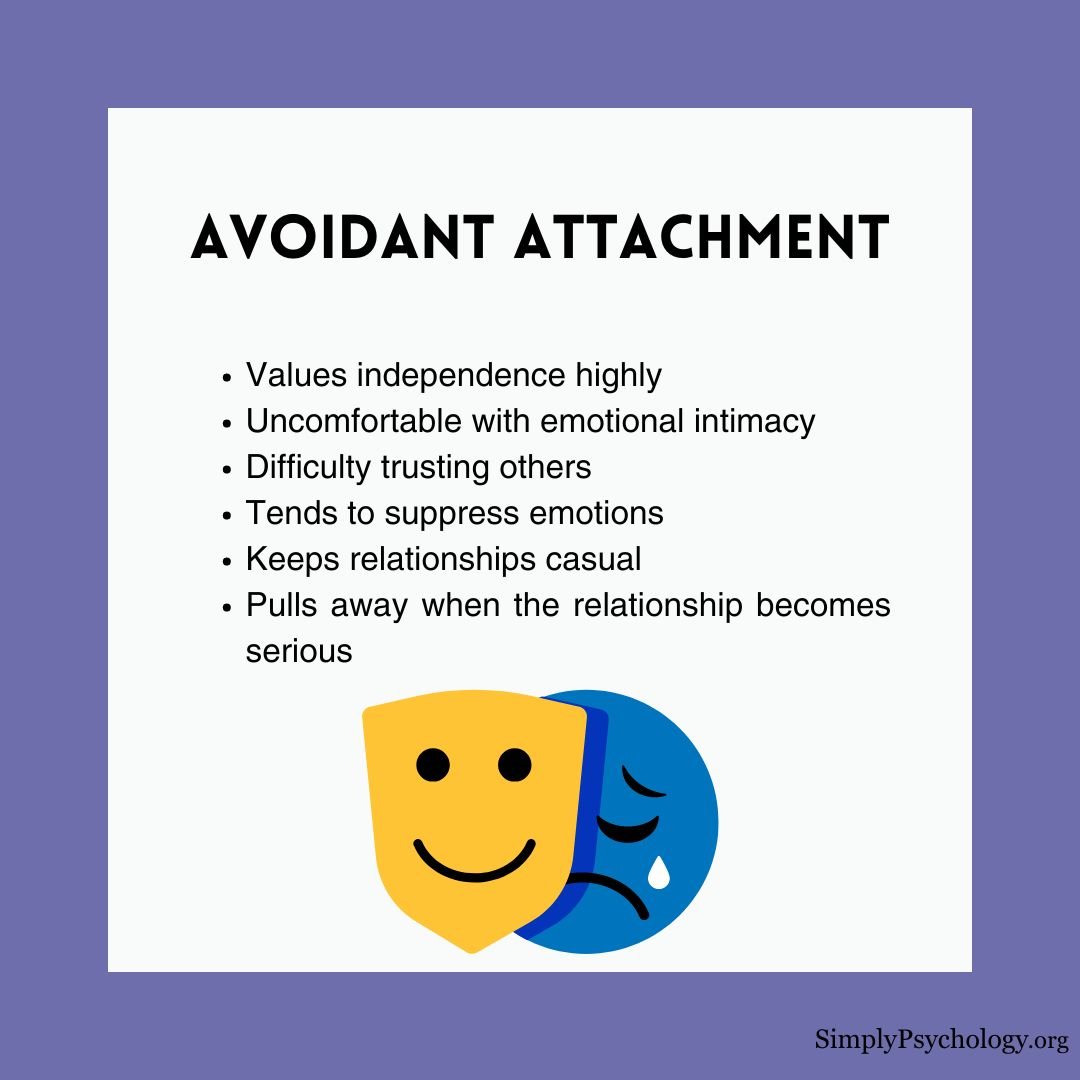
- Dismissive Attachment (Avoidant in Children): This style is characterized by a strong sense of self-sufficiency, often to the point of appearing detached. Individuals with dismissive attachment value their independence highly and may seem uninterested in close relationships.
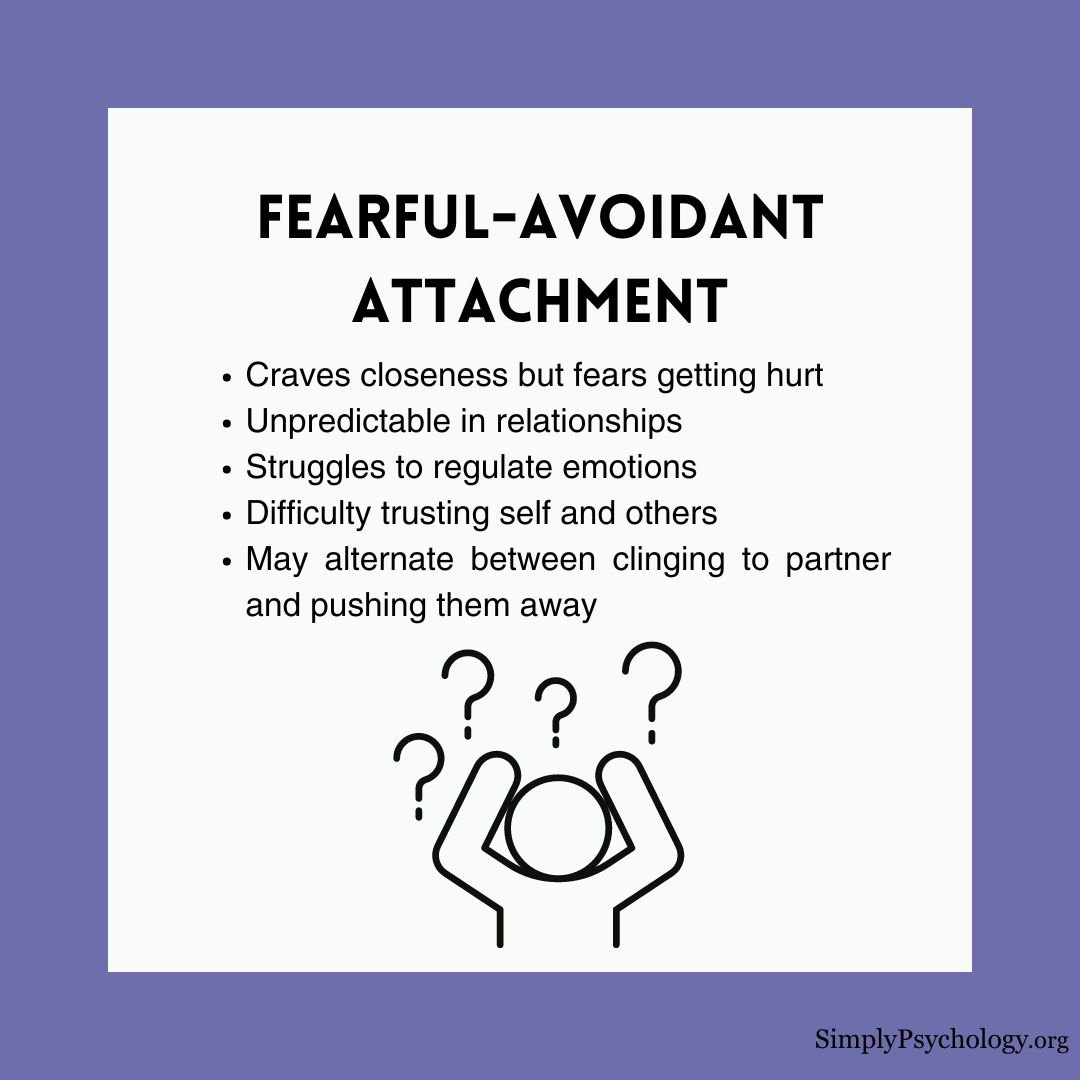
- Fearful Attachment (Disorganized in Children): Individuals with a fearful attachment style desire close relationships and fear vulnerability. They may behave unpredictably in relationships due to their internal conflict between a desire for intimacy and fear of it.
Hazan and Shaver’s (1987) Love Quiz Study
The four-category model above builds on a landmark study that first applied Ainsworth’s infant styles to adult romantic love.
Aim: Hazan and Shaver (1987) tested whether Ainsworth’s infant attachment styles could describe how adults experience romantic love.
Method: Newspaper readers completed a “love quiz,” choosing which of three descriptions – secure, avoidant, or anxious-ambivalent – best fitted their romantic feelings. They also recalled their childhood relationships with their parents.
Results: 56% of respondents identified as secure, 24% as avoidant, and 20% as anxious-ambivalent, closely matching Ainsworth’s infant proportions. Secure adults recalled warmer childhoods than preoccupied adults did.
Conclusion: Hazan and Shaver warned against firm continuity claims. Later relationships give people chances to revise their internal working model, so continuity is a tendency rather than a fixed destiny.
Not sure what your attachment style is? You can easily find out by taking our attachment style quiz.

Secure Attachment Characteristics
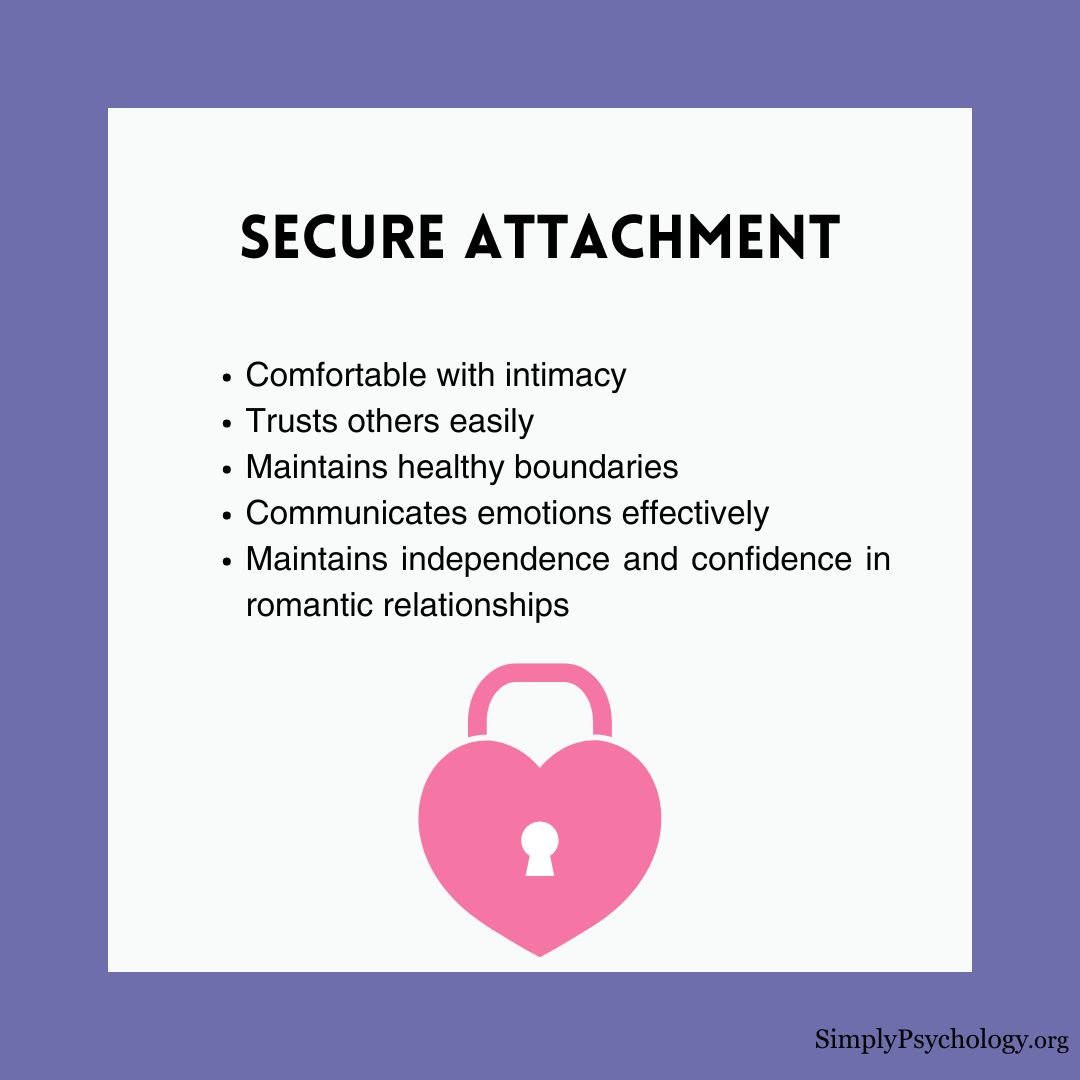
Securely attached adults tend to hold positive self-images and positive images of others, meaning that they have both a sense of worthiness and an expectation that other people are generally accepting and responsive.
As Children
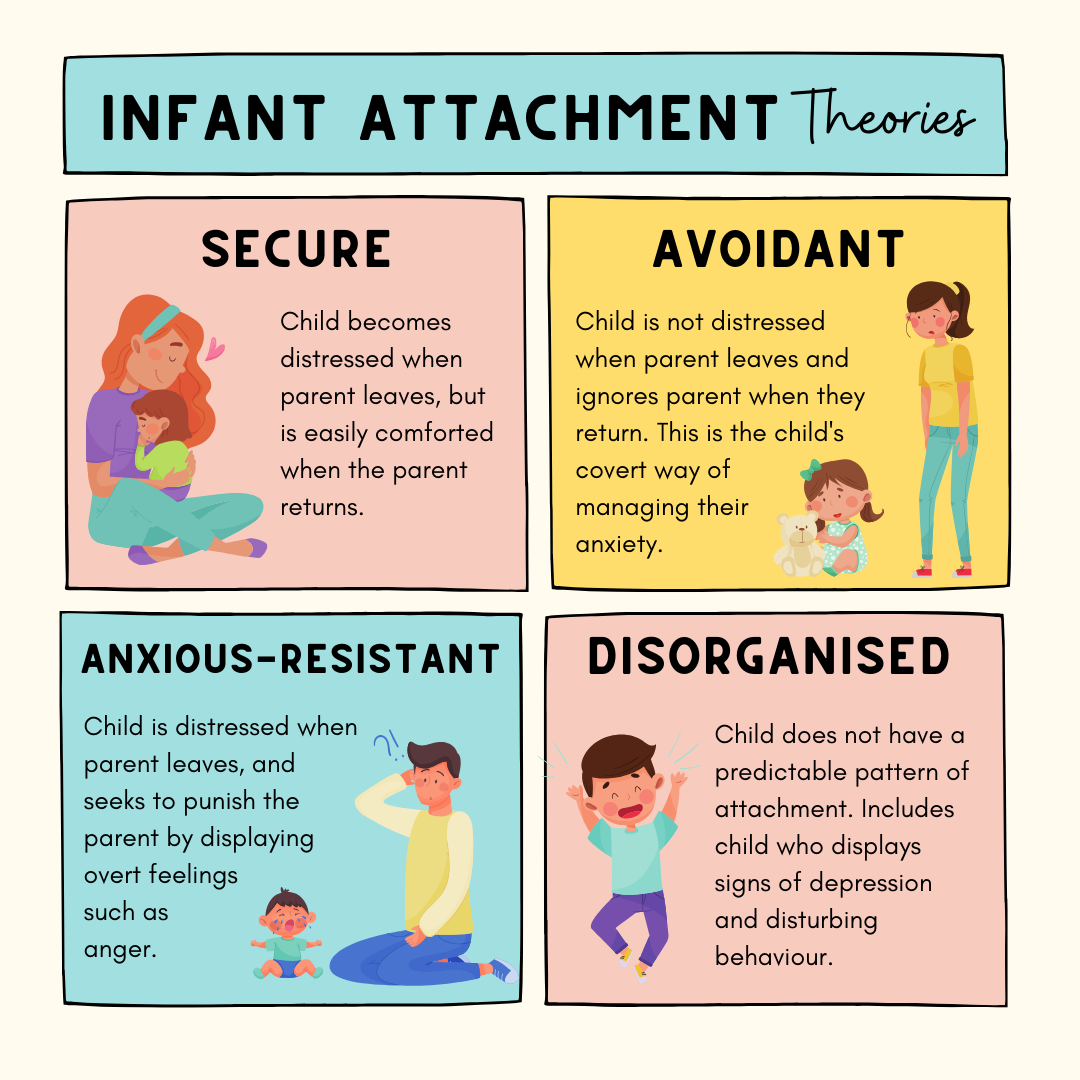
Secure attachment occurs because the mother meets the emotional needs of the infant.
Children with a secure attachment use their mother as a safe base to explore their environment.
They are moderately distressed when their mother leaves the room (separation anxiety) and seek contact with their mother when she returns.
They also show moderate stranger anxiety; they show some distress when approached by a stranger.
As Adults
Adults who demonstrate a secure attachment style value relationships and affirm the impact of relationships on their personalities.
They display a readiness to recall and discuss attachments that suggest much reflection regarding previous relationships.
Secure adults openly express emotions and thoughts with others. They are comfortable depending on others for help, and equally comfortable being depended on.
Many secure adults do experience negative attachment-related events. Even so, they can objectively assess people and events and still assign a positive value to relationships in general.
Secure lovers characterized their most important romantic relationships as happy and trusting. They can support their partners despite the partners’ faults.
Their relationships also tend to last longer. Secure lovers believe that although romantic feelings may wax and wane, romantic love will never fade.
Through the statistical analysis, secure lovers were found to have had warmer relationships with their parents during childhood.
Preoccupied Attachment Characteristics
Individuals with a preoccupied attachment (called anxious when referring to children) hold a negative self-image and a positive image of others, meaning that they have a sense of unworthiness but generally evaluate others positively.
They strive for self-acceptance by attempting to gain approval and validation from their relationships with significant others.
They also require higher levels of contact and intimacy in relationships with others.
As Children
Children with this type of attachment are clingy to their mother in a new situation and are not willing to explore. This suggests that they do not yet trust her.
They are extremely distressed when separated from their mother.
When the mother returns, they are pleased to see her and go to her for comfort, but they cannot be comforted and may show signs of anger towards her.
This type of attachment style occurs because the mother sometimes meets the infant’s needs and sometimes ignores their emotional needs, i.e., the mother’s behavior is inconsistent.
As Adults
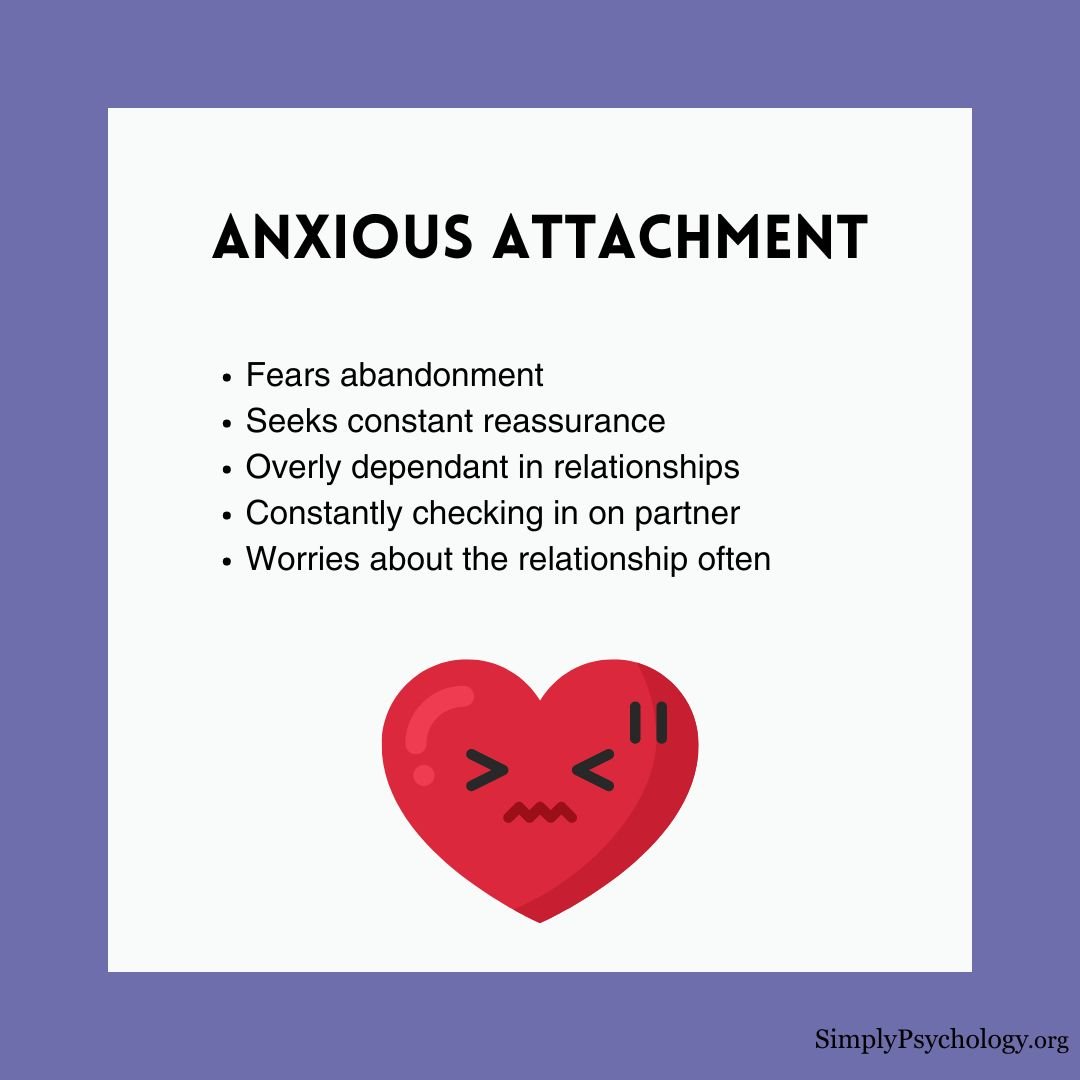
Such individuals crave intimacy but remain anxious about whether other romantic partners will meet their emotional needs. Autonomy and independence can make them feel anxious.
Additionally, they are preoccupied with dependency on their own parents and still actively struggle to please them.
They can become distressed if they read someone’s recognition or care as insincere or not responsive enough.
Their attachment system is prone to hyperactivation during times of stress, emotions can become amplified, and overdependence on others is increased (Mikulincer & Shaver, 2003).
Preoccupied lovers characterize their most important romantic relationships by obsession, desire for reciprocation and union, emotional highs and lows, and extreme sexual attraction and jealousy.
Preoccupied lovers often believe that it is easy for them to fall in love, yet they also claim that unfading love is difficult to find.
Compared with secure lovers, preoccupied lovers report colder relationships with their parents during childhood.
Anxious attachment is also known as insecure resistant or anxious ambivalent.
Dismissive Attachment Characteristics
Dismissive attachment style is demonstrated by adults with a positive self-image and a negative image of others. Their internal working model is based on an avoidant attachment established during infancy.
As Children
Children with an avoidant attachment do not use the mother as a safe base.
They show little distress on separation and little stranger anxiety, and they are not joyful when the mother returns.
Reunion brings no relief. A stranger comforts them about as readily as their own mother does.
Avoidant attachment occurs because the mother ignores the emotional needs of the infant, so closeness brings little reward and the child learns to rely on itself instead.
As Adults
They prefer to avoid close relationships and intimacy with others to maintain a sense of independence and invulnerability. This means they struggle with intimacy and value autonomy and self-reliance.
Dismissive-avoidant adults deny experiencing distress associated with relationships and downplay the importance of attachment in general, viewing other people as untrustworthy.
According to Dr. Julie Smith, a clinical psychologist, these are the signs of an avoidant attachment style in adult relationships:
- When your partner seeks intimacy with you, the barriers go up. The more they try to get close, the more you pull back.
- You hold back on starting new relationships because trusting people is so hard.
- You sometimes end relationships to gain a sense of freedom.
- You keep your partner at arm’s length emotionally because it feels safer, but they often accuse you of being distant.
Dismissive lovers are characterized by fear of intimacy, emotional highs and lows, and jealousy.
They are often unsure of their feelings toward their romantic partner. They believe that romantic love can rarely last and that it is hard for them to fall in love (Hazan & Shaver, 1987).
They see seeking closeness as unlikely to ease their distress. So they deliberately shut down the attachment system, stop seeking support, and handle distress alone.
Dismissive individuals learn to suppress their emotions outwardly, even though they still feel emotional arousal internally (Mikulincer & Shaver, 2005).
Cutting themselves off from strong feelings, their own or others’, shapes how they experience romantic relationships.
Fearful Attachment Characteristics
Adults with a fearful-avoidant attachment style (also referred to as disorganized) hold a negative model of self and also a negative model of others, fearing both intimacy and autonomy.
As Children
Their behavior often shows no single coherent strategy. Rather than steady avoidance or steady clinginess, they may approach the caregiver and then abruptly pull back, freeze, or seem dazed.
Main and Solomon (1986) first identified this pattern. They called it “fright without solution”: the caregiver who should offer comfort is also the child’s source of fear.
The caregiving behind it is often frightening or frightened: abuse, neglect, or a caregiver’s own unresolved trauma.
Reunions bring conflict, not relief. If separated from the caregiver even briefly, the child reacts in contradictory ways on reunion.
They may run toward their caregiver, then change course and run away or act out instead.
To this child, caregivers read as untrustworthy.
Without support, these patterns can carry into adulthood, making it harder to feel secure in any relationship.
As Adults
“Like dismissing avoidant, they often cope with distancing themselves from relationship partners, but unlike dismissing individuals, they continue to experience anxiety and neediness concerning their partner’s love, reliability, and trustworthiness” (Schachner, Shaver & Mikulincer, 2003, p. 248).
A fearful avoidant prefers casual relationships. They may stay in the dating stage for a long time, since this feels safer to them.
This is not always by choice. More often, they fear getting closer to someone.
A study found that those with a fearful avoidant attachment style are likely to have more sexual partners and higher sexual compliance than other attachment styles (Favez & Tissot, 2019).
One reason may be physical closeness without emotional risk. More sexual partners can meet their need for closeness without asking them to also be emotionally vulnerable.
Poorer boundaries may play a role too. Many learned as children that their boundaries do not matter. This is not the case for all fearful avoidants, though.
A partner with this attachment style may prefer to keep their partner at a distance so that things do not get too emotionally intense.
Sharing feels risky. They may be reluctant to share too much of themselves, to protect themselves from eventual hurt.
If the relationship gets too deep, or they are asked to share personal stories, the fearful-avoidant may shut down rapidly.
Chaos can feel familiar. Many grew up in a household that was chaotic and toxic, so as adults they may expect their own relationships to be chaotic too.
Calm can feel wrong. A secure, steady partner may leave them suspecting something is off.
They may challenge their partner, or create a problem, to make the relationship feel more familiar, even if less settled.
That familiarity comes at a cost.
They tend to expect something bad to happen and may look for any reason to damage the relationship before it can hurt them first.
They may blame or accuse their partner of things they have not done, threaten to leave, or test their partner to see if this makes them jealous.
All these strategies can push a partner toward ending the relationship.
Continuity Hypothesis
The continuity hypothesis holds that the infant-caregiver bond acts as a template for later social development. Secure, anxious, and avoidant attachment styles tend to stay continuous from infancy into adult romantic relationships.
In other words, security tends to carry forward. A child securely attached in infancy is likely to form healthy, secure relationships as an adult. The internal working model, covered next, is the proposed mechanism behind this link.
The Mechanism of Continuity: The Internal Working Model
Bowlby (1969) proposed that early experiences are encoded into an internal working model (IWM). This is a mental representation of whether attachment figures are available, and whether the self is worthy of care.
This model acts as a psychological lens, filtering how a person interprets intimacy and support throughout life. It is also partly self-confirming.
An anxious adult tends to read a partner’s ambiguous behavior as rejection, while an avoidant adult suppresses attachment-related feelings and downplays closeness.
The IWM drives this continuity. The continuity hypothesis holds that the same early model tends to be carried forward into adult romantic bonds.
Consider an infant whose caregiver is inconsistently responsive: warm one day, distracted the next. In the Strange Situation this infant becomes resistant (Type C), too anxious to explore and unable to be soothed on reunion.
The working model this lays down carries two lessons. The self is not reliably worthy of care, and closeness must be fought for because the person who provides it is unpredictable.
Carried forward, the adult presents as anxious-preoccupied, craving intimacy while chronically fearing abandonment and scanning a partner’s tone for early signs of withdrawal.
While attachment styles are not immutable, they demonstrate significant stability across decades.

Intergenerational Continuity
There is evidence that attachment styles may be transmitted between generations. Parenting habits often repeat.
People tend to base how they parent on their own internal working model, so the pattern this creates can pass through generations of a family.
Main, Kaplan, and Cassidy (1985) found a strong association between the security of the adults’ working model of attachment and that of their infants.
Dismissive adults were often parents to avoidant infants. Preoccupied adults were often parents to anxious infants. How adults conceptualized their attachment relationships had a direct impact on how their infants attached to them.
A rival account exists. The temperament hypothesis is associated with the psychologist Kagan.
It argues that an infant’s inborn temperament shapes both how a parent responds and how the child relates later in life, rather than reflecting a transmitted working model.
On this view, the infant’s own temperament, not only its caregiving, may explain its relationship issues later in life.
The Evolutionary Basis of Attachment Styles
Not every psychologist treats secure attachment as the only “healthy” pattern. Belsky (1999) argued that insecure styles can be adaptive responses to different caregiving environments, not failures.
This section sets out his argument and what it means for how the four attachment styles above should be judged.
Bowlby’s Protection-From-Predators Function
Bowlby (1969) proposed that attachment evolved because it protected infants from predators. This function raises survival chances when the system operates in the setting it evolved for.
He named that setting. The environment of evolutionary adaptedness (EEA) is his term for the ancestral backdrop in which a behaviour such as attachment evolved its function.
Bowlby put it in his own words: “the function of attachment behaviour is protection from predators.” Of the rival explanations he weighed, he judged that “protection from predators seems by far the most likely.”
He also drew a careful line between function and causation. A behaviour’s function is the survival benefit it produces when the system operates in that EEA. Its causation is the actual trigger that switches the behaviour on.
Belsky (1999) sharpened this logic. Survival itself is not the goal of natural selection.
Attachment evolved because the protection it gave improved the chances of successful reproduction, with selection working at the level of the gene and the individual, not the species. Belsky’s point is a correction of emphasis, not a rejection.
Where Bowlby’s own language sometimes read as if the group or species benefited, Belsky insisted that “survival as such clearly isn’t the goal of natural selection.”
The currency that matters, on Belsky’s sharpened reading, is reproductive fitness: success at producing surviving offspring, not mere survival. It is counted at the level of the gene and the individual rather than the species as a whole.
Insecure Styles as Adaptive Strategies
Belsky (1999) argued the ancestral environment was not uniform. In some environments, care was abundant and sensitive. In others, resources were scarce and care was mostly insensitive.
If attachment evolved across many such environments, no single pattern can be the “natural” one. What evolved instead is a repertoire of attachment behaviors that organize flexibly around caregiving conditions.
Where parents can invest heavily in a child, secure attachment is the adaptive choice, since the environment is safe enough to explore.
Where parents cannot or will not invest as heavily, two other strategies may fit better. A resistant strategy maximizes attention from a scarce caregiver, while an avoidant strategy relies on self-reliant detachment from an unresponsive one.
On this view, an “insecure” pattern is not a malfunction. It is an evolved response that once helped a person reproduce successfully in a particular ancestral environment.
From this evolutionary point of view, Belsky (1999) concluded that insecure attachments are just as “natural” as secure ones.
Belsky is not simply rejecting Bowlby’s theory here. He is extending its own logic. A variable ancestral environment, acting on a system built to respond to whatever environment development actually occurs in, naturally produces more than one attachment pattern.
This evolutionary reading does not excuse neglectful caregiving today. Belsky’s claim concerns ancestral reproductive function, not what serves a child’s welfare in the present (see Critical Evaluation below).
A Direct Test: Does Early Unpredictability Shape Later Parenting?
A theoretical argument is only as strong as the evidence behind it. Szepsenwol, Simpson, Griskevicius and Raby (2015) put Belsky’s logic to a direct, prospective test.
The test was demanding.
Aim: to test whether early unpredictability, not only harshness (poverty), forecasts the parental investment a person goes on to provide as an adult, via their own attachment.
Method: Across three studies, the researchers followed a sample from before birth, measuring early unpredictability as changes in parental employment, housing and cohabitation during the child’s first four years.
Harshness was measured separately, by socioeconomic status, and each participant’s own attachment insecurity, assessed later, was tested as the link between the two.
The results were striking.
Results: Early unpredictability, independent of harshness, predicted more negative parenting and less supportive caregiving in adulthood, an effect found specifically in men. Harshness alone showed no comparable effect once unpredictability was accounted for.
The pattern held.
Conclusion: It is the unpredictability of a person’s early environment, filtered through their attachment system, that recalibrates the care they go on to provide the next generation. This supports Belsky’s claim that insecure attachment functions as a contingent strategy rather than a fixed deficit.
There is a real strength here.
Evaluation: Unpredictability was measured decades before the parenting it predicted, which rules out reverse causation. Its main limitation is that the effect held only for men, a pattern that needs independent replication before it can be treated as settled.
A Genetic and Temperament Account
A third explanation is more independent of caregiving altogether. Behavioural-genetic evidence reviewed by Barbaro, Boutwell, Barnes and Shackelford (2017) found that the heritability of attachment is close to zero in infancy.
That is striking.
That heritability then rises across childhood and into adulthood, while a large non-shared-environment component stays present throughout life. This sits awkwardly with an account built entirely around one transmitted mental model.
It also supports the temperament hypothesis introduced above: that inborn disposition, not only caregiving quality, shapes how a person relates.
The three accounts need not compete.
A child’s genetically influenced reactivity could be exactly the mechanism by which some children register the ecological unpredictability that Belsky’s account treats as the trigger. Others are comparatively insensitive to it.
Mental Health Vulnerabilities
Insecure attachment is a fundamental risk factor for developing chronic mental health disorders.
Those with preoccupied or fearful styles are most vulnerable to clinical depression and anxiety.
This vulnerability stems from a lack of Emotional Regulation. Emotional regulation is the ability to monitor and manage one’s emotional reactions effectively.
-
Anxious Attachment: These individuals experience Hypervigilance. Hypervigilance is a state of extreme alertness to signs of social rejection. This leads to constant rumination and negative thought patterns.
-
Avoidant Attachment: These individuals tend to suppress their emotions. While they may appear calm, this defense often collapses under extreme pressure. This can lead to intense self-criticism or “achievement-oriented” depression.
Maladaptive Health Behaviors
Insecure attachment impairs the ability to self-regulate, leading to risky lifestyle choices. These behaviors often serve as misguided attempts to soothe emotional distress.
The route runs through emotion regulation rather than the habits themselves. Under stress, an anxiously attached person’s system hyperactivates, amplifying distress and pulling attention toward reassurance rather than steady self-care (Mikulincer & Shaver, 2003).
An avoidantly attached person suppresses the outward signs of distress instead, but the underlying arousal stays active internally (Mikulincer & Shaver, 2005). Neither pattern leaves much room for patient, future-focused habits.
-
Substance Use: Insecurely attached adolescents are more likely to use nicotine, alcohol, and drugs.
-
Eating Disorders: There is a high correlation between insecure bonds and obesity or restrictive eating.
-
Treatment Non-adherence: Avoidant adults often ignore medical advice. They are less likely to seek preventative screenings or follow medication schedules for chronic illnesses like diabetes.
This fits a wider pattern. Adult attachment style predicts self-reported physical health conditions (McWilliams & Bailey, 2010), and infant attachment security prospectively predicts adult illness risk two decades later (Puig, Englund, Simpson, & Collins, 2013).
Sleep Disturbances and Pain Perception
Attachment insecurity degrades the body’s ability to heal through rest.
Nighttime acts as a psychological trigger because it involves separation. Adults with high attachment anxiety report significantly poorer sleep quality. They spend less time in the deep, restorative stages of sleep.
Separation is exactly the cue that activates the attachment behavioral system in the first place – the same innate alarm that makes an infant protest a caregiver leaving the room. Falling asleep means tolerating that cue alone, every night.
Additionally, these individuals exhibit Pain Catastrophizing.
Pain catastrophizing is a tendency to exaggerate and dwell on physical discomfort. This mindset lowers the threshold for pain, creating a cycle of distress and physical exhaustion.
This too reads as hyperactivation applied to a bodily signal rather than a relationship one. The same tendency to amplify and dwell on a distress cue (Mikulincer & Shaver, 2003) that drives anxious reassurance-seeking in relationships can drive rumination on pain instead.
COVID-19 pandemic
A new study published in the British Journal of Clinical Psychology looked at how attachment styles affected mental health and behavior during the COVID-19 pandemic.
Researchers surveyed over 1300 UK adults at two time points between April and August 2020, tracking attachment styles, adherence to social distancing guidelines, and mental health.
They used advanced, cutting-edge causal modeling methods to estimate the likely causal effects, rather than relying on simple correlations.
People with insecure attachment styles suffered more. Anxious and fearful-avoidant participants had around 5-6% higher depression and anxiety, and were 17-18% lonelier than secure individuals.
These gaps persisted. Secure participants’ symptoms decreased over time, while insecure participants’ elevated depression, anxiety and loneliness did not.
Greater loneliness explains the poorer mental health of insecure groups.
Avoidant participants were also less likely to follow social distancing rules than secure individuals, though the effect size was small. Attachment style itself did not predict how much people’s mental health changed between the two time points.
The takeaway?
Attachment style is a risk factor for worse mental health during difficult collective experiences like lockdowns.
Loneliness is the driver.
Insecure individuals are more prone to it, and that loneliness drives their anxiety and depression.
The study points to targeted interventions against loneliness as one way to promote security.
A limitation is the use of categorical attachment measures, but the advanced statistics provide compelling evidence attachment causally influences our mental health and behaviors during COVID-19.
How Attachment Style Is Measured
Attachment measurement spans the whole lifespan, with different methods used at different ages.
In infancy and early childhood, researchers measure attachment through direct observation of behavior.
In adulthood, measurement splits into two traditions. Developmental and clinical psychologists assess unconscious states of mind through narrative interviews, while social and personality psychologists assess conscious beliefs using self-report questionnaires.
Children: Ainsworth’s Strange Situation
The Strange Situation Procedure (SSP) serves as the primary standardized laboratory assessment for determining infant attachment quality.
This 21-minute observational method measures how children aged 12 to 18 months manage interpersonal stress across a series of eight scripted episodes that elevate infant distress incrementally.
Reunion behaviour matters most.
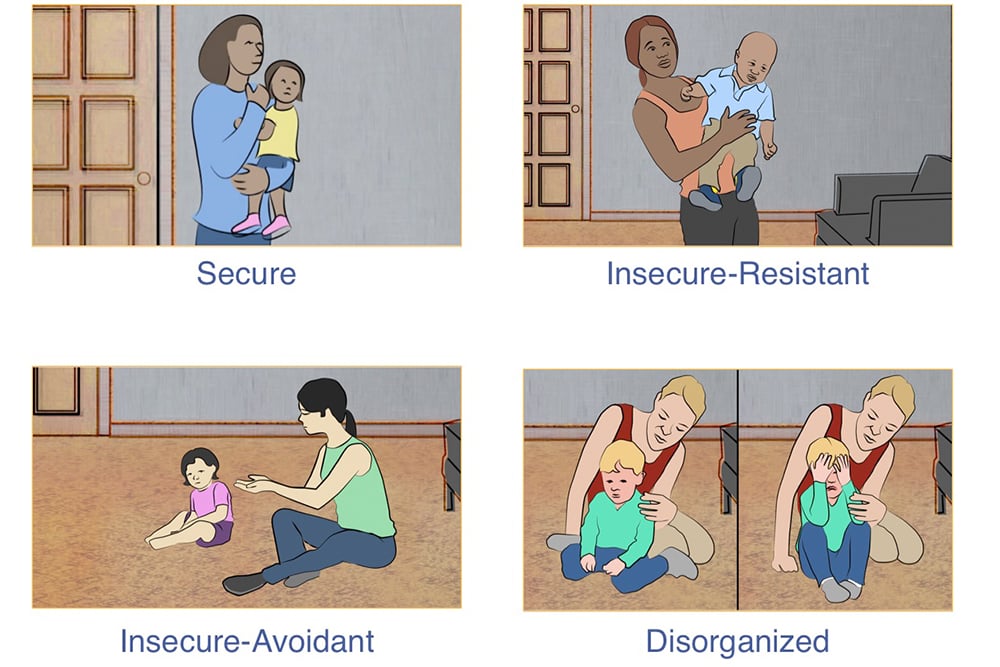
Researchers score how the infant responds when the caregiver returns, alongside its exploration, separation anxiety and stranger anxiety, to classify its attachment as one of four patterns.
- Secure (Type B, ~70%): uses the caregiver as a safe base, is moderately distressed on separation, and seeks and accepts comfort on reunion.
- Insecure-avoidant (Type A, ~15-20%): shows little distress on separation and ignores or avoids the caregiver on reunion.
- Insecure-resistant/ambivalent (Type C, ~10-15%): is too anxious to explore, becomes extremely distressed on separation, and resists contact even while seeking it on reunion.
- Disorganised (Type D, ~15%): shows no coherent strategy; added later by Main and Solomon (1986).
Researchers focus on the Attachment Behavioral System; this refers to an innate psychological program that drives infants to seek proximity to caregivers during times of perceived threat.
The SSP puts that system to the test. By placing infants in a novel environment, it triggers these behaviors directly, revealing whether the child treats the caregiver as a Secure Base.
A secure base is a supportive figure who allows the infant to explore the world with confidence.
Ainsworth proposed the ‘sensitivity hypothesis,’ which states that the more responsive the mother is to the infant during their early months, the more secure their attachment will be.
Adult Attachment Interview
The Adult Attachment Interview (AAI) measures an adult’s Internal Working Model: a mental template of relationships based on early childhood experiences.
This semi-structured interview focuses on the speaker’s Narrative Coherence: the ability to present a logical, integrated, and consistent account of one’s past.
The AAI targets a largely unconscious state of mind, not a belief a person can simply report. That is why it carries real predictive power.
Main, Kaplan, and Cassidy (1985) found that a parent’s own AAI classification strongly predicted their infant’s Strange Situation classification.
Dismissing parents tended to raise avoidant infants. Preoccupied parents tended to raise anxious infants.
This is telling. The interview is not just describing the adult; it is tracking the working model that shapes the next generation’s attachment too.
AAI Narrative Classifications
Researchers code transcripts based on how well the speaker adheres to linguistic rules of cooperation.
| Classification | Narrative Style | Childhood Experience Correlation |
| Secure-Autonomous (F) | Balanced and clear; integrates good and bad memories. | Consistent and sensitive caregiving. |
| Dismissing (Ds) | Brief and sterilized; claims “I don’t remember” or idealizes parents without proof. | Rejection or emotional unavailability. |
| Preoccupied (E) | Long and rambling; filled with current anger or passive confusion. | Inconsistent or intrusive caregiving. |
| Unresolved (U) | Lapses in logic or speech when discussing trauma or loss. | Significant unresolved trauma or grief. |
Self-Report Questionnaires
Social psychologists focus on conscious, explicit beliefs regarding romantic intimacy.
The AAI probes an unconscious state of mind. These scales instead simply ask a person to rate their own feelings about closeness and trust directly.
That difference is one reason the two traditions do not always agree, even when using similar language.
The leading instrument here is the Experiences in Close Relationships (ECR) questionnaire (Brennan, Clark & Shaver, 1998).
It was later revised. The ECR-RS scores attachment separately for parents, friends, and romantic partners rather than assuming one global style.
Self-report has a limit, though. It only captures what a person is willing and able to say about themselves, so it can miss the same unconscious material the AAI is built to reach.
These measures typically treat attachment as a location on two continuous, Orthogonal Dimensions: independent scales that do not influence each other’s score.
Dimensional Scales
-
Attachment Anxiety: This scale measures the fear of abandonment and the need for constant reassurance.
-
Attachment Avoidance: This scale measures the level of discomfort with emotional closeness and the desire for self-reliance.
These two dimensions map onto the same mechanisms described above. High anxiety corresponds to the hyperactivating strategies that amplify distress and demand reassurance. High avoidance corresponds to the deactivating strategies that suppress attachment-related feeling (Mikulincer & Shaver, 2003).
Both dimensions are continuous rather than all-or-nothing. Most people score somewhere between the four corners below rather than fitting one box exactly: a graded picture, not four hard types.
The Experiences in Close Relationships (ECR) scale is the primary tool in this tradition.
It uses 36 items to plot individuals into a four-category model:
- Secure (low anxiety/low avoidance),
- Preoccupied (high anxiety/low avoidance),
- Dismissing-Avoidant (low anxiety/high avoidance),
- Fearful-Avoidant (high anxiety/high avoidance).
Can Your Attachment Style Change?
Is our attachment style a “one-size-fits-all” trait that follows us everywhere, or does it shift depending on who we are with?
The Hierarchy of Attachment
Bartholomew and Horowitz (1991) argue that attachment is a stable individual difference, an inner guide that stays consistent across all relationships.
That view fits the classic internal-working-model account: one template, formed mainly from early caregiving, filters how a person reads intimacy and support in any relationship (Bowlby, 1969).
However, others suggest we hold multiple models simultaneously.
Research by Caron et al. (2012) suggests our attachment models function like a set of Russian dolls:
-
The Global Model: A large, overarching style that covers all types of relationships.
-
Domain-Specific Models: Smaller models tailored to specific categories, such as family, friends, or romantic partners.
-
Relationship-Specific Models: The smallest dolls, representing beliefs about a single, specific person.
While these models are related, they aren’t identical. You might feel secure with your parents but experience deep insecurity with a romantic partner (Cozzarelli, Hoekstra, & Bylsma, 2000).
The two views need not be rivals. A global model can set the default expectation a person brings into a new relationship.
A specific relationship’s own history of responsiveness, or its absence, then revises that default for that one partner – exactly what a working-model account predicts.
Stability vs. Flexibility
While attachment styles are often resistant to change, they are not set in stone.
The literature is often summarised as a 70/30 split, but that figure hides an important detail: how stable attachment looks depends heavily on the time window a study measures.
Studies generally show a 70/30 split in stability:
-
70% Stability: Most people maintain the same attachment style over long periods.
-
30% Flexibility: Nearly a third of individuals experience a shift in their attachment style.
Over a two-decade span, security proves fairly durable. Measured week to week or month to month, far more movement shows up, because everyday relationship events can nudge a working model without overturning it.
Change also clusters around major negative life events rather than happening at random. This fits a working model that updates in response to strong new evidence, rather than a fixed trait immune to experience.
Key Research Findings:
-
Short-term shifts: Baldwin and Fehr (1995) found that 30% of adults changed their style in as little as a week or a few months, with “anxious-ambivalent” individuals being the most likely to fluctuate.
-
Long-term shifts: A 20-year study by Waters et al. (2000) found that 72% of adults held the same classification they had as infants. Those who changed often did so following major negative life events, though change can also occur during positive growth.
The Path to “Earned Security”
John Bowlby (1969) viewed attachment as a series of diverging pathways.
The further you travel down one path (security or insecurity), the harder it is to switch, but it is never impossible.
While the internal working models formed in childhood act as prototypes that powerfully guide future interactions, attachment styles are not permanent destinies.
They can and do change over time in response to major life events, therapy, or new, disconfirming relationship experiences
One of the most encouraging concepts in psychology is earned security.
This describes individuals who grew up in adverse or insecure environments but, through self-reflection, therapy, or supportive adult relationships, developed a secure state of mind as adults.
What actually changes is the internal working model itself. Enough new, reliable evidence – a therapist’s consistent attunement, or a partner who does not confirm old fears – can revise the mental template a person carries into relationships.
That revision, not just a change in surface behaviour, is what the “earned” in earned security refers to.
How Partners Facilitate Change (The ASEM Model)
The Attachment Security Enhancement Model (ASEM) explains how romantic partners can help “rewrite” an insecure partner’s internal script.
This happens through two phases: Short-term Buffering and Long-term Revision.
| Attachment Style | Short-Term “Buffering” (Managing the Symptom) | Long-Term “Revision” (Healing the Core Wound) |
| Anxious | Use “Safe” strategies: Constant reassurance, soothing, and visible displays of commitment. | Improve Model of Self: Validate their personal goals and help them build self-efficacy and independence. |
| Avoidant | Use “Soft” strategies: Respecting their need for autonomy and making non-demanding requests. | Improve Model of Others: Share non-threatening, positive experiences to show that depending on others is safe. |
Over the long term, partners can help revise underlying insecure working models by targeting the core wound.
For an anxious partner, this means validating their personal goals and fostering self-efficacy (improving the model of self).
For an avoidant partner, this involves sharing enjoyable, non-threatening experiences that demonstrate the positive benefits of dependency (improving the model of others).
Through continuous responsive and sensitive interactions, individuals can fundamentally shift toward a more secure attachment orientation.
Critical Evaluation of Attachment Styles
Attachment-styles theory has strong empirical support, but it also has real limits worth understanding before applying it too rigidly.
Strengths
The framework holds up well against several tests of a good psychological model:
- Broad explanatory reach: It links infant caregiving to adult romantic life and to mental-health risk, as covered above under Mental Health Vulnerabilities.
- A validated core measure: The Strange Situation is a reliable, standardized measure. Meta-analysis shows disorganized attachment is the strongest predictor of later externalizing problems (Fearon, Bakermans-Kranenburg, van IJzendoorn, Lapsley, & Roisman, 2010).
- Intergenerational evidence: A caregiver’s own attachment representation predicts their child’s security across three decades of studies (Verhage et al., 2016), supporting the internal-working-model mechanism.
- A dimensional refinement: Bartholomew and Horowitz’s (1991) four-category model gives a graded picture rather than four rigid boxes, fitting people who sit between prototypes.
- An even-handed evolutionary reading: Belsky’s (1999) adaptive-strategy view drops the judgement that insecure care is simply “bad,” fitting the wide cross-cultural variation in attachment patterns (van IJzendoorn & Kroonenberg, 1988) better than one “natural” pattern does.
Limitations
Several open questions temper how far the theory should be pushed:
- Temperament, not just caregiving: meta-analysis finds infant temperament predicts the resistant pattern specifically but not the secure-versus-avoidant split (Groh et al., 2017), so temperament and caregiving likely interact.
- Categories versus dimensions: treating attachment as four discrete “types” oversimplifies what are really continuous anxiety and avoidance dimensions.
- Measurement mismatch: self-report scales rely on retrospective recall and correlate only modestly with the interview-based Adult Attachment Interview, so the two traditions may not measure quite the same thing.
- Cultural variation: the styles derive largely from Western samples. A cross-cultural meta-analysis found marked variation, with Type A more common in Western Europe and Type C in Israel and Japan (van IJzendoorn & Kroonenberg, 1988).
- Continuity can be overstated: the roughly 30% who change style, and the weakening of continuity across adulthood, show that caregiving biases rather than fixes later relationships.
- Risk of naturalizing neglect: Belsky’s adaptive-strategy view (see Evolutionary Basis above), if misread, could seem to excuse insensitive caregiving. The claim concerns ancestral reproductive function only, not a child’s welfare today.
Contemporary Research
Fraley, Gillath, and Deboeck (2021) followed adults naturalistically to test whether major life events produce lasting shifts in attachment style. This refines the 70/30 stability estimate described above.
Prospective research also links attachment security to physical health. Infant attachment predicts adult illness risk (Puig, Englund, Simpson, & Collins, 2013), and adult attachment style predicts self-reported physical health conditions (McWilliams & Bailey, 2010).
Attachment-informed treatment is also advancing.
Zilcha-Mano, Goldstein, Dolev-Amit, Ben David-Sela, and Barber (2021) ran a randomized controlled trial testing whether matching depression treatment to a patient’s attachment orientation improved outcomes. It did.
This complements the Attachment Security Enhancement Model (ASEM) described above. It formalises how partners can “buffer” a person’s symptoms in the short term and, over time, help revise their insecure working model.
Further Information
- Attachment Style Quiz
- How To Know If Your Date Has A Secure Attachment Style
- How To Move From Anxious Attachment To Secure
- BPS Article- Overrated: The predictive power of attachment
- Scoring for the Strange Situation
- A theoretical review of the infant-mother relationship
- Cross-cultural Patterns of Attachment: A Meta-Analysis of the Strange Situation
- How Attachment Style Changes Through Multiple Decades Of Life
Key Takeaways
- Two Core Dimensions: Adult attachment styles are organized by attachment anxiety (fear of rejection) and attachment avoidance (discomfort with closeness).
- Four Adult Styles: Crossing these dimensions produces secure, preoccupied, dismissive, and fearful-avoidant styles, each with its own view of self and others.
- Rooted in Infancy: The adult styles echo Ainsworth’s infant patterns and are thought to be carried forward by an internal working model.
- Not a Fixed Destiny: About 70% of people keep the same style over decades, but roughly 30% shift, especially after major life events or through “earned security.”
- A Debated Origin: Belsky (1999) argues insecure styles may be adaptive responses to different caregiving environments, not pure failures of care.
- Real-World Stakes: Insecure attachment, especially the fearful/disorganized pattern, is linked to poorer mental and physical health outcomes.
References
Ainsworth, M. D. S., Blehar, M. C., Waters, E., & Wall, S. (1978). Patterns of attachment: A psychological study of the strange situation. Lawrence Erlbaum.
Baldwin, M.W., & Fehr, B. (1995). On the instability of attachment style ratings. Personal Relationships, 2, 247-261.
Bartholomew, K., & Horowitz, L.M. (1991). Attachment Styles Among Young Adults: A Test of a Four-Category Model. Journal of Personality and Social Psychology, 61 (2), 226–244.
Belsky, J. (1999). Modern evolutionary theory and patterns of attachment. In J. Cassidy & P. R. Shaver (Eds.), Handbook of attachment: Theory, research, and clinical applications (pp. 141–161). Guilford Press.
Bowlby, J. (1969). Attachment and Loss: Volume I. Attachment. London: Hogarth Press.
Brennan, K. A., Clark, C. L., & Shaver, P. R. (1998). Self-report measurement of adult attachment: An integrative overview. In J. A. Simpson & W. S. Rholes (Eds.), Attachment theory and close relationships (p. 46–76). The Guilford Press.
Brennan, K. A., & Shaver, P. R. (1995). Dimensions of adult attachment, affect regulation, and romantic relationship functioning. Personality and Social Psychology Bulletin, 21 (3), 267–283.
Cassidy, J., & Shaver, P. R. (Eds.). (1999). Handbook of attachment: Theory, research, and clinical applications. Guilford Press.
Caron, A., Lafontaine, M., Bureau, J., Levesque, C., and Johnson, S.M. (2012). Comparisons of Close Relationships: An Evaluation of Relationship Quality and Patterns of Attachment to Parents, Friends, and Romantic Partners in Young Adults. Canadian Journal of Behavioural Science, 44 (4), 245-256.
Coflin, K., & Powell, D. N. (2024). Comparison of emerging adults’ bid responses based on their gender and attachment. Couple and Family Psychology: Research and Practice, 13(3), 224–236.
Collins, N. L., & Read, S. J. (1994). Cognitive representations of adult attachment: The structure and function of working models. In K. Bartholomew & D. Perlman (Eds.) Advances in personal relationships, Vol. 5: Attachment processes in adulthood (pp. 53-90). London: Jessica Kingsley.
Fearon, R. P., Bakermans-Kranenburg, M. J., van IJzendoorn, M. H., Lapsley, A.-M., & Roisman, G. I. (2010). The significance of insecure attachment and disorganization in the development of children’s externalizing behavior: A meta-analytic study. Child Development, 81(2), 435–456.
Fraley, R. C., Gillath, O., & Deboeck, P. R. (2021). Do life events lead to enduring changes in adult attachment styles? A naturalistic longitudinal investigation. Journal of Personality and Social Psychology, 120(6), 1567–1606.
George, C., Kaplan, N., & Main, M. (1984). The Adult Attachment Interview. Unpublished manuscript, University of California at Berkeley.
Groh, A. M., Narayan, A. J., Bakermans-Kranenburg, M. J., Roisman, G. I., Vaughn, B. E., Fearon, R. P., & van IJzendoorn, M. H. (2017). Attachment and temperament in the early life course: A meta-analytic review. Child Development, 88(3), 770–795.
Harlow, H. (1958). The nature of love. American Psychologist, 13, 673-685.
Hill, C., Vasiliou, V. S., Sirois, F. M., Hughes, O., & Thompson, A. R. A meta-analysis of self-compassion and attachment in adults. Psychology and Psychotherapy: Theory, Research and Practice.
Hazan, C., & Shaver, P. (1987). Romantic love conceptualized as an attachment process. Journal of Personality and Social Psychology, 52 (3), 511–524.
Jaurequi, M. E., Kimmes, J. G., Seibert, G. S., Ledermann, T., & Roberts, K. (2023). The role of mindfulness between adult attachment and anxiety: A dyadic approach. Couple and Family Psychology: Research and Practice, 12(3), 132–145.
Main, M., Kaplan, N., & Cassidy, J. (1985). Security in infancy, childhood and adulthood: A move to the level of representation. In I. Bretherton & E. Waters (Eds.), Growing points of attachment theory and research. Monographs of the Society for Research in Child Development, 50 (1-2), 66-104.
Main, M., & Solomon, J. (1986). Discovery of an insecure-disorganized/disoriented attachment pattern. In T. B. Brazelton & M. W. Yogman (Eds.), Affective development in infancy . Ablex Publishing.
McWilliams, L. A., & Bailey, S. J. (2010). Associations between adult attachment styles and self-reported physical health conditions. Psychosomatic Medicine, 72(7), 615–622.
Mohd Hasim, M. J., Hashim, N. H., & Mustafa, H. (2023). Married life: Measuring adult romantic attachment and satisfaction. Couple and Family Psychology: Research and Practice, 12(3), 119–131.
Puig, J., Englund, M. M., Simpson, J. A., & Collins, W. A. (2013). Predicting adult physical illness from infant attachment: A prospective longitudinal study. Health Psychology, 32(4), 409–417.
Springstein, T., Hamerling-Potts, K. K., Landa, I., & English, T. (2023). Adult attachment and interpersonal emotion regulation motives in daily life. Emotion, 23(5), 1281–1293.
Sroufe, L. A. (2005). Attachment and development: A prospective, longitudinal study from birth to adulthood. Attachment & Human Development, 7(4), 349–367.
van IJzendoorn, M. H., & Kroonenberg, P. M. (1988). Cross-cultural patterns of attachment: A meta-analysis of the Strange Situation. Child Development, 59(1), 147–156.
Verhage, M. L., Schuengel, C., Madigan, S., Fearon, R. P., Oosterman, M., Cassibba, R., Bakermans-Kranenburg, M. J., & van IJzendoorn, M. H. (2016). Narrowing the transmission gap: A synthesis of three decades of research on intergenerational transmission of attachment. Psychological Bulletin, 142(4), 337–366.
Vowels, L. M., Vowels, M. J., Carnelley, K. B., Millings, A., & Gibson‐Miller, J. (2023). Toward a causal link between attachment styles and mental health during the COVID‐19 pandemic. British Journal of Clinical Psychology.
Waters, E., Merrick, S., Treboux, D., Crowell, J., & Albersheim, L. (2000). Attachment security in infancy and early adulthood: A twenty-year longitudinal study. Child Development, 71 (3), 684-689.
Waters, E., Weinfield, N. S., & Hamilton, C. E. (2000). The stability of attachment security from infancy to adolescence and early adulthood: General discussion. Child Development, 71 (3), 703-706.
Zilcha-Mano, S., Goldstein, P., Dolev-Amit, T., Ben David-Sela, T., & Barber, J. P. (2021). A randomized controlled trial for identifying the most suitable treatment for depression based on patients’ attachment orientation. Journal of Consulting and Clinical Psychology, 89(12), 985–994.
Zumdahl, M. G., Saxsma, M. G., & Fraley, R. C. (2025). Adult Attachment Outcomes and the Timing of Adverse Childhood Experiences. Personality and Social Psychology Bulletin, 01461672251336491.
Attachment Style Quiz
Discover your attachment style based on the ECR-RS, a validated measure of attachment anxiety and avoidance in close relationships.
This short 9-item questionnaire assesses two core dimensions of adult attachment: anxiety (the degree to which you worry about rejection and abandonment) and avoidance (the degree to which you are uncomfortable with closeness and dependence on others).
Your scores on these two dimensions determine which of four attachment styles best describes your pattern of relating to others: secure, anxious-preoccupied, dismissive-avoidant, or fearful-avoidant.
Based on: Fraley, R. C., Heffernan, M. E., Vicary, A. M., & Brumbaugh, C. C. (2011). The Experiences in Close Relationships—Relationship Structures questionnaire. Psychological Assessment, 23(3), 615–625.
Help us personalise your results
All fields are optional. Your answers are anonymous and used for research purposes only.
Choose how accurately each statement reflects you.
Question 1 of 5
It helps to turn to people close to me in times of need.
I usually discuss my problems and concerns with close others.
I talk things over with people close to me.
I find it easy to depend on people close to me.
I don\\\\\\\'t feel comfortable opening up to others.
All questions must be answered before you continue.
Choose how accurately each statement reflects you.
Question 1 of 4
I prefer not to show others how I feel deep down.
I often worry that close others don\\\\\\\'t really care for me.
I\\\\\\\'m afraid that close others may abandon me.
I worry that close others won\\\\\\\'t care about me as much as I care about them.
All questions must be answered before you continue.
Calculating your results…






BSc (Hons) Psychology, MRes, PhD, University of Manchester
Chartered Psychologist (CPsychol)
Saul McLeod, PhD, is a qualified psychology teacher with over 18 years of experience in further and higher education. He has been published in peer-reviewed journals, including the Journal of Clinical Psychology.

BSc (Hons) Psychology, MSc Psychology of Education
Associate Editor for Simply Psychology
Olivia Guy-Evans is a writer and associate editor for Simply Psychology, where she contributes accessible content on psychological topics. She is also an autistic PhD student at the University of Birmingham, researching autistic camouflaging in higher education.

Stephanie Huang holds a Master of Education degree from Harvard Graduate School of Education. Her academic interests mainly lie in the fields of developmental psychology, social-emotional learning, and informal education.