

Anxious attachment, also known as anxious-preoccupied or ambivalent attachment, is characterised by a profound concern that others will not reciprocate one’s desire for intimacy.
Individuals with this attachment style are often worried about the availability and responsiveness of their partners or other close figures, such as friends or family.
They crave intimacy but simultaneously remain anxious about whether their emotional needs will be met. Autonomy and independence can make them feel insecure.
Anxious attachment triggers are the situations that switch this worry on, such as a partner seeming distant, a slow reply or an unresolved argument.
Key Takeaways
- Core Triggers: Perceived distance, inconsistency, missing reassurance, feeling dismissed, rivals, ambiguity and conflict can all switch on anxious attachment.
- Root Cause: Inconsistent early caregiving can leave the attachment system hypersensitive, so small cues feel like threats of abandonment.
- In the Moment: Pause, breathe, separate the facts from the story your anxiety tells, and self-soothe before you react.
- Healthier Relationships: Boundaries, interests beyond your partner and a shared understanding of attachment styles help couples ride out triggers.
- Verdict: ✅ Supported, with limits – the evidence that threats set off the attachment alarm is stronger than the evidence that a partner can calm it.
1. Inconsistency and Unpredictability
Even perceived inconsistency is highly triggering for anxiously attached individuals.
They have grown up with patterns of “hot and cold” from caregivers, making frequent ups and downs feel normal yet unsettling in a balanced relationship.
The contrast between moments of connection and disconnection can be as distressing as the disconnection itself. It sends their system into disarray because it brings a sense of unpredictability, powerlessness, and a fundamental threat to their safety.
A sudden change in communication is often a major trigger.
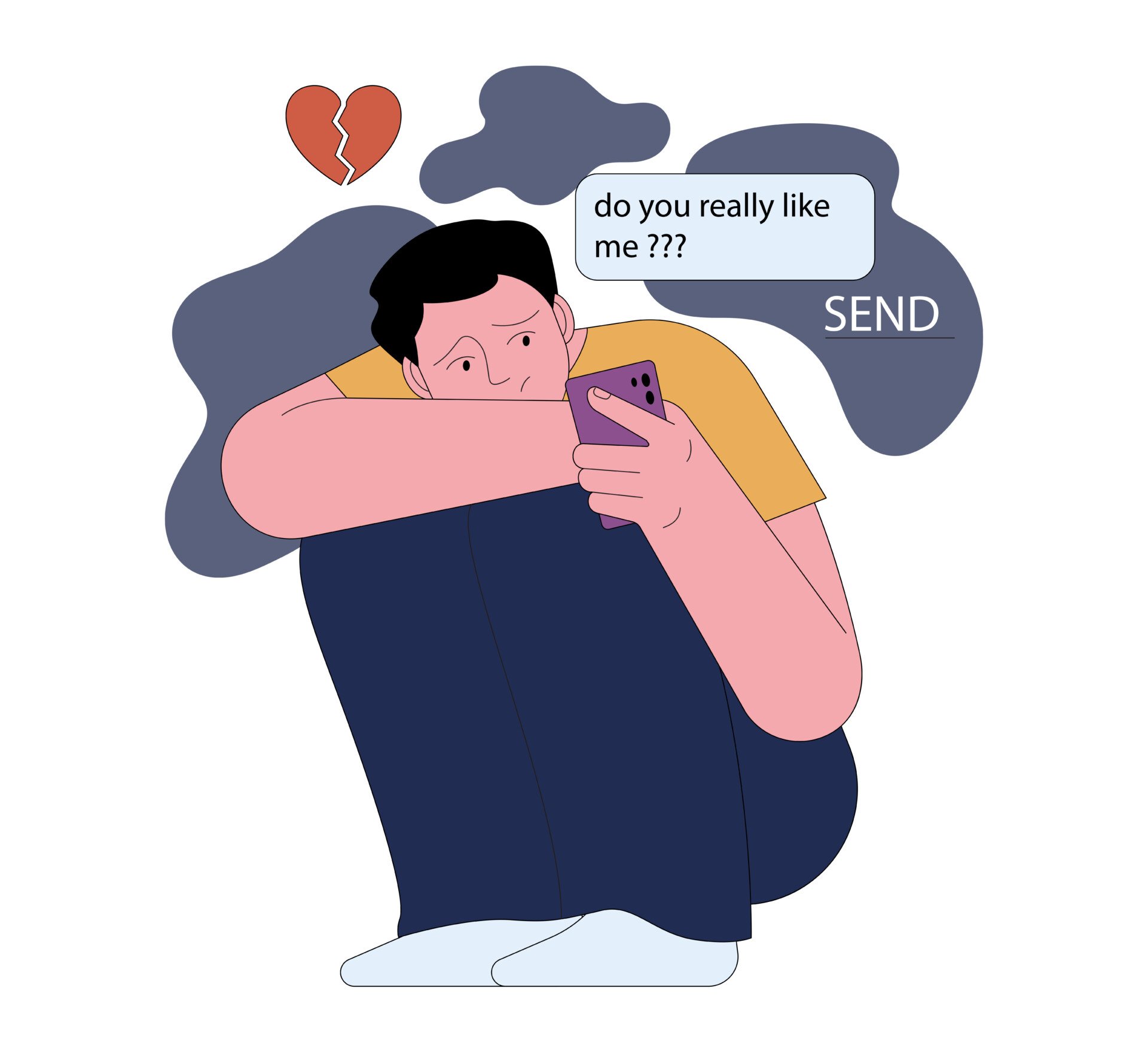
If a partner who normally texts or calls frequently suddenly becomes less responsive, an anxiously attached person might immediately sense something is “wrong.”
A small delay in replies can ignite worry. So can a day of quieter communication.
2. Partner Seeming Distant or Withdrawn
Anxious attachment is triggered by any sign that a loved one is pulling away emotionally or physically.
If a partner is acting distracted, detached, or less affectionate, it often rings alarm bells.
Physical distance can be a trigger, as well.
If a significant other says they “need space” or wants to spend time alone, an anxiously attached person might immediately assume “they don’t want me anymore.” They may even imagine the relationship is in jeopardy.
If a partner travels or if you’re in a long-distance relationship, the lack of closeness can amplify worries about infidelity or drifting apart.
Even a small act like a partner sitting on the opposite end of the couch or not initiating cuddles might be interpreted as a sign of waning affection.
Everyday habits can set it off too. In a daily diary study of 196 partnered adults, people rated how much a partner’s phone use got in the way of time together[1].
On days they perceived more of it, people higher in attachment anxiety reported lower self-esteem and a more depressed mood. They also reported more resentment and were more likely to retaliate by using their own phone.
3. Lack of Reassurance or Affection
People with anxious attachment typically need frequent reassurance that they are loved, valued, and important. When that reassurance isn’t there, feelings of insecurity spike.
This trigger can take many forms:
- Missing words: A partner forgetting to say “I love you,” not complimenting you, or not noticing something special, like a new haircut or a personal achievement.
- Less affection: Fewer hugs, less hand-holding, or reduced sexual intimacy.
- Lower priority: Not feeling like you’re your partner’s highest priority, or seeing them focus on other people or tasks.
Being de-prioritized or taken for granted hurts deeply.
Without regular reassurance, the anxious mind starts filling in the blanks with worst-case scenarios.
4. Feeling Ignored, Dismissed, or Unwanted
Moments of perceived rejection, no matter how small, tend to cut straight to the core wound of an anxiously attached person.
A partner might not listen when you speak. They might downplay your feelings or brush off your concerns.
Similarly, feeling criticized or not good enough can set off attachment anxiety. If the person senses disapproval, it feeds their fear of rejection.
5. Insecurity about Third-party Relationships
Jealousy is a common struggle for those with anxious attachment.
If their partner is very friendly or close with someone else, the anxiously attached person may immediately fear being replaced or betrayed. That someone could be a coworker, an ex, or even a new friend.
Even if nothing inappropriate is happening, the perception of a potential rival for their partner’s attention can trigger anxiety.
Common sparks include:
- Talking about others: Hearing a partner speak enthusiastically about someone else. The anxious person may wonder, “Do they find that person more interesting or attractive than me?”
- Divided attention: Noticing the partner paying attention to others in a way that makes the anxious person feel less special.
- A busy partner: A big project at work or a new hobby leaves less time for the relationship. An anxious person may think, “they care about X more than me.”
Past infidelity or trust breaches can worsen these triggers. If trust was broken before, any situation that remotely resembles that past scenario will set off alarms.
A 2026 systematic review looked at attachment injuries. It pooled 12 qualitative studies (207 participants) in which adults described a betrayal that damaged the felt security of a relationship, most often infidelity.
People described intense distress and grief, damaged self-worth, lasting difficulty sustaining relationships, and trauma-like intrusive thoughts and avoidance[2]. How badly it hurt tracked the injured partner’s sense of betrayal rather than how objectively serious the event was.
Most participants were women. The studies came mainly from North America, so the pattern may not hold everywhere.
6. Ambiguity and Uncertainty in the Relationship
One common trigger is plans that aren’t firm.
Anxiously attached individuals feel safest when a relationship’s status and future are clearly assured.
Undefined or uncertain relationship situations are highly triggering.
This often happens in the early stages of dating. An anxiously attached person will be very sensitive to signals about where things are heading.
Not knowing “are we exclusive?” or “how serious are we?” can create constant worry.
Even in established relationships, unclear answers to big questions (like long-term commitment, or when the partner will be ready for the next step) can keep the anxious person on edge.
Vague plans can feel like personal rejection. The partner may simply be unsure of their schedule.
Any hint that the relationship is on shaky ground can send an anxiously attached person into panic mode.
Even jokes about breakups and “taking a break” can do it, because they threaten the need for security and predictability.
Uncertainty is hard to let go of.
In two experiments with 243 and 141 single adults, people imagined an online-dating scenario. They were then randomly given an explicit rejection, an acceptance, or an unexplained silence, known as ghosting[3].
Ghosted and rejected people were equally distressed. But the ghosted group stayed more emotionally attached and were more likely to plan to monitor the person’s social media and, later, to make contact again.
The study did not test attachment styles, but it shows why open questions are so difficult to settle.
7. Conflict and Criticism
While no one enjoys conflict, those with an anxious attachment often find even small arguments extremely distressing.
A conflict can easily trigger the fear that “this fight means they’re going to leave me.”
During an argument, an anxiously attached person may react in several ways:
- Alarm at shutdown: If a partner shuts down, walks away, or needs space to cool off, those behaviors can be misinterpreted as abandonment.
- Urgency to resolve: They might feel desperate to resolve the conflict immediately, even if it means continuing a toxic argument, because the unresolved tension is agonizing.
- Appeasing: Some anxiously attached individuals people-please to restore harmony, while internally feeling anxious and hurt.
Silent treatment or stonewalling is particularly triggering.
The irony is that the anxious person craves closeness, but if they feel continually stonewalled, they may eventually withdraw in defeat or as a way to cope with the pain.
Conflict registers in the body as well as the mind.
In a study of 124 heterosexual dating couples, men higher in attachment anxiety showed a bigger rise in the stress hormone cortisol[4]. It came while they waited to discuss a disagreement, and they recovered more slowly afterwards.
In the men, a more securely attached partner was associated with lower reactivity and a quicker return to baseline.
Recognizing and Managing Triggers in the Moment
By developing healthier coping strategies, you can gradually train your nervous system to not overreact, and even work toward a more secure attachment style.
Here are some practical tips and strategies to help when you feel your anxious attachment being triggered:
1. Pause and breathe (don’t react immediately)
When a trigger hits, your emotions can surge in a split second. Before doing anything else, pause.
Take a few slow, deep breaths.
Remind yourself that what you’re feeling, while very intense, is not necessarily a sign of an actual emergency.
Often, it’s your attachment alarm sounding a false alarm.
If possible, give yourself a little time alone to cool down. Psychologists advise that it’s wise to “take a timeout and wait for the emotional activation to subside before making a decision”.
In practical terms, that might mean not responding to your partner in the heat of the moment.
2. Ground yourself in the present and reality
Anxiety triggers often come with catastrophic thoughts (“She must be cheating”; “He’s going to break up with me right now”; “They don’t love me anymore”).
Gently challenge these thoughts. Ground yourself in the facts you have.
Ask yourself: What do I actually know to be true at this moment?
Separate the facts from the story your anxiety is telling.
For instance, the fact might be “my partner didn’t reply for 3 hours.”
The story your anxious mind adds is “they must be losing interest or doing something behind my back.”
Practice telling yourself a more balanced story.
For example: “I don’t know why they haven’t replied yet. There could be many reasons (busy, phone died, needing a moment) that have nothing to do with me.”
It may also help to ground your body in the present. Feel your feet on the floor.
Notice the sensations around you, such as the texture of your chair or the sounds in the room.
This can pull you out of the whirlwind of anxious thoughts. Some people find techniques like naming five things you see, four things you feel, three things you hear, etc., useful to get out of your head.
The goal is to interrupt the tunnel vision of anxiety.

3. Self-soothe with healthy coping strategies
This means finding ways to comfort and calm yourself without immediately turning to your partner for reassurance (or, alternatively, without blaming or lashing out at them).
Different techniques work for different people, so it’s good to have a toolkit of coping skills. Here are a few ideas:
- Journaling: Writing slows a racing mind. Worst-case scenarios often look irrational on paper, which helps you step back.
- Mindfulness or meditation: Mindfulness means bringing attention to the present moment without judgment. Over time, it builds the muscle of observing anxious thoughts without reacting to them.
- Physical calming techniques: Triggers activate your body’s stress response. Physical release helps, so try progressive muscle relaxation, or shake out your hands and stretch.
- Engage your senses: Soothing your senses calms you quickly. Try a favorite scent (lavender, chamomile) in a small vial or hand lotion, or listen to calming music or nature sounds.

How Can Relationships Be Healthier Despite These Triggers?
Establishing Healthy Boundaries
Anxious attachers often struggle with emotional and energetic boundaries.
They may tend to curate the environment, trying to fix someone’s bad mood or withdrawal, often from a self-interested place to restore their own calm and safety.
Healing involves discerning what is your responsibility to take and what is not.
This means learning not to “fuss over” a partner’s low energy or withdrawal, even when it triggers your own fears. Not feeding the pattern takes enough self-control and self-awareness.
Diversifying Your Energy and Interests
Anxiously attached individuals can exhibit an “over-focus” on their partner, sometimes to the detriment of their own needs and identity.
Healing involves diversifying your energy across other areas of life, such as other friends, colleagues, and personal interests or hobbies.
This reduces pressure on the partner to be “everything” and helps build trust in intimacy, as the partner feels less smothered.
Learn Each Other’s Attachment Styles
When both partners understand their own and each other’s attachment patterns, they can work together more compassionately.
The first trigger named is not always the real one. Couples therapist Esther Perel describes a client who threatened to leave whenever an argument began.
In session, the deeper trigger emerged: his partner’s ordinary requests for connection, which felt like demands after years of caring for an emotionally needy parent.
Relationship coach Matthew Hussey describes a related pattern from his own life. A partner mentioned a past romantic interest. Jealousy stirred, but he went quiet and cold instead of saying so.
An earlier relationship had taught him that “opening up meant losing my power.” His partner’s non-judgmental reply changed that moment. It let him name the jealousy, which he describes as one of the more repairing moments of the relationship.
A securely attached partner might learn to offer more attunement, while an anxiously attached person can practice self-regulation.
A partner’s touch may help too. In a laboratory experiment with 75 couples, people were made to feel jealous. Without touch, higher attachment anxiety went with more jealousy. With a partner’s arm around the shoulder, that link disappeared[5].
A reassuring picture did not work in the same way. It was a single session with a young, mostly student sample, so treat it as a promising hint, not a rule.
Couples can benefit from:
- Reading about attachment styles together
- Exploring therapy (individual or couples) to work through deeper patterns
- Using tools like the Gottman Method or Emotionally Focused Therapy (EFT)
This turns the relationship into a team effort, not a blame game.
Evidence Check: How Well Does the Research Hold Up?
Verdict: ✅ Supported, with limits. Threats and separations seem to set off the attachment alarm, but whether a partner can calm it is much less clear.
Do threats and separations set off the attachment alarm?
✅ Probably yes, though the reaction depends on attachment style. Lab experiments and studies of real couples agree, but no other team has repeated them. Research suggests that:
- After a threatening word appeared on a screen for a split second, people thought sooner of those they turn to for comfort. More anxious people did so even without a threat, and more avoidant people less so after the word “separation”[6].
- Couples saying goodbye at an airport held hands, sought closeness and showed sadness more than couples flying together. More avoidant women showed less of this, and the results for men were less clear[7].
- As women grew more anxious about a stressful task, secure couples sought and gave more comfort, but more avoidant partners touched and comforted less. Only 83 couples were filmed, for five minutes each[8].
Can a partner’s support calm a triggered partner?
⚠️ Possibly, but it has rarely been shown. A review of 31 studies seldom found it, and the main study for it only watched couples argue. Research suggests that:
- A partner’s support seldom eased the bad feelings that go with insecure attachment, doing so in only nine percent of 151 tests. This means it was rarely found, not that it never happens[9].
- When partners were warmer and less critical during a disagreement, avoidant partners were less angry and pulled away less. But the effects were small, it was one study of 180 couples, and it looked at avoidant people, not anxious ones[10].
Background
Childhood Causes
Anxious attachment typically develops when a primary caregiver is inconsistent in their responses to a child’s emotional needs.
This inconsistency means the caregiver might sometimes be emotionally available, while at other times they are cold and distant.
Children lack the logical reasoning to make sense of this. They grow up fearing they won’t consistently receive the love or support they need.
In response, they develop coping mechanisms aimed at staying close to their caregivers at any cost.
Triggers and Hypersensitivity
This early experience lays the foundation for a heightened sensitivity to perceived threats of rejection during adulthood.
Anxious attachment triggers often stem from a deep-seated fear of abandonment or feeling undervalued.
This chronic emotional activation keeps the person on high alert. They watch for signs of separation, betrayal, or emotional distance.
Anxious attachers are hyper-attuned to subtle changes in a partner’s mood or energy.
Psychologists describe this as having an “emotional radar” that is finely tuned to even subtle changes in others’ behavior.
The anxiously attached person’s system is shaped by early inconsistency. It becomes hypersensitive, detecting threats that may not exist and reacting intensely to situations others might find neutral.
Hyperactivating strategies include energetic and insistent attempts to get a relationship partner to pay more attention and provide better care.
They may engage in clinging, controlling, and coercive responses.
Bowlby (1969) proposed that the attachment system constantly checks two things: whether the environment is safe, and whether an attachment figure is available if needed. When either looks doubtful, the attachment alarm goes off and pushes you to restore closeness.
Seeking closeness is the default response. When it has not worked reliably, people switch to a backup strategy. One is hyperactivation, the escalation described above. The other is deactivation, which is common in avoidant attachment and means suppressing attachment behavior and turning attention away from the other person.
Attachment Style Quiz
Discover your attachment style based on the ECR-RS, a validated measure of attachment anxiety and avoidance in close relationships.
This short 9-item questionnaire assesses two core dimensions of adult attachment: anxiety (the degree to which you worry about rejection and abandonment) and avoidance (the degree to which you are uncomfortable with closeness and dependence on others).
Your scores on these two dimensions determine which of four attachment styles best describes your pattern of relating to others: secure, anxious-preoccupied, dismissive-avoidant, or fearful-avoidant.
Based on: Fraley, R. C., Heffernan, M. E., Vicary, A. M., & Brumbaugh, C. C. (2011). The Experiences in Close Relationships—Relationship Structures questionnaire. Psychological Assessment, 23(3), 615–625.
Help us personalise your results
All fields are optional. Your answers are anonymous and used for research purposes only.
Choose how accurately each statement reflects you.
Question 1 of 5
It helps to turn to people close to me in times of need.
I usually discuss my problems and concerns with close others.
I talk things over with people close to me.
I find it easy to depend on people close to me.
I don\\\\\\\'t feel comfortable opening up to others.
All questions must be answered before you continue.
Choose how accurately each statement reflects you.
Question 1 of 4
I prefer not to show others how I feel deep down.
I often worry that close others don\\\\\\\'t really care for me.
I\\\\\\\'m afraid that close others may abandon me.
I worry that close others won\\\\\\\'t care about me as much as I care about them.
All questions must be answered before you continue.
Calculating your results…
References
- K. B. Carnelley, C. M. Hart, L. M. Vowels, and T. T. Thomas, “Attachment, perceived partner phubbing, and retaliation: A daily diary study,” Journal of Personality, vol. 94, no. 3, pp. 431–445, 2025, doi: 10.1111/jopy.70012.
- R. S. Davidar, D. Ballal, and D. Premlal, “Systematic review and framework synthesis of attachment injuries among romantic couples,” Journal of Social and Personal Relationships, vol. 43, no. 9, pp. 2682–2706, 2026, doi: 10.1177/02654075261436570.
- A. L. Szczesniak, M. E. Pierce, and S. S. Spielmann, “Give up the ghost: Emotional and behavioral responses to ambiguous rejection,” Personal Relationships, vol. 32, no. 3, 2025, doi: 10.1111/pere.70018.
- S. I. Powers, P. R. Pietromonaco, M. Gunlicks, and A. Sayer, “Dating couples’ attachment styles and patterns of cortisol reactivity and recovery in response to a relationship conflict,” Journal of Personality and Social Psychology, vol. 90, no. 4, pp. 613–628, 2006, doi: 10.1037/0022-3514.90.4.613.
- K. J. Kim, B. C. Feeney, and B. K. Jakubiak, “Touch reduces romantic jealousy in the anxiously attached,” Journal of Social and Personal Relationships, vol. 35, no. 7, pp. 1019–1041, 2018, doi: 10.1177/0265407517702012.
- M. Mikulincer, O. Gillath, and P. R. Shaver, “Activation of the attachment system in adulthood: Threat-related primes increase the accessibility of mental representations of attachment figures,” Journal of Personality and Social Psychology, vol. 83, no. 4, pp. 881–895, 2002, doi: 10.1037/0022-3514.83.4.881.
- R. C. Fraley and P. R. Shaver, “Airport separations: A naturalistic study of adult attachment dynamics in separating couples,” Journal of Personality and Social Psychology, vol. 75, no. 5, pp. 1198–1212, 1998, doi: 10.1037/0022-3514.75.5.1198.
- J. A. Simpson, W. S. Rholes, and J. S. Nelligan, “Support seeking and support giving within couples in an anxiety-provoking situation: The role of attachment styles,” Journal of Personality and Social Psychology, vol. 62, no. 3, pp. 434–446, 1992, doi: 10.1037/0022-3514.62.3.434.
- F. Mosannenzadeh, M. Kouri, M. Luijten, D. Schoebi, and J. C. Karremans, “Does romantic partner support buffer the effect of attachment insecurities on negative emotions? A systematic review,” Collabra: Psychology, vol. 11, no. 1, 2025, doi: 10.1525/collabra.130079.
- N. C. Overall, J. A. Simpson, and H. Struthers, “Buffering attachment-related avoidance: Softening emotional and behavioral defenses during conflict discussions,” Journal of Personality and Social Psychology, vol. 104, no. 5, pp. 854–871, 2013, doi: 10.1037/a0031798.
- J. Bowlby, Attachment and loss: Vol. 1. Attachment. . Basic Books, 1969.