For many autistic individuals, injustice is not merely an intellectual disagreement. It is a visceral, physiological threat response.
Current neurodivergent research identifies “justice sensitivity” as a core component of the autistic experience. This trait, while a strength for advocacy, can lead to severe nervous system dysregulation and burnout when faced with a world full of inequity.

Effective management requires moving beyond standard coping mechanisms. It demands a strategy that respects the distinct neurology of the autistic brain. This involves distinguishing between actionable advocacy and necessary self-preservation.
The Neurology of Justice Sensitivity
Justice sensitivity in autism is often described as an inability to bypass or ignore perceived unfairness. This is not a choice but a neurological event.
- The Threat Response: When an autistic person witnesses injustice, the amygdala (the brain’s threat detection center) may activate intensely. The brain processes the injustice similarly to a physical danger.
- Cognitive Persistence: Unlike neurotypical processing, which may prioritize social hierarchy or group cohesion over strict adherence to rules, the autistic brain often prioritizes truth and consistency. This can lead to “looping” thoughts or rumination until a resolution is found.
- Hyper-Empathy: Contrary to old stereotypes, many autistic people experience affective hyper-empathy. They feel the pain of others acutely. This amplifies the distress caused by systemic injustice.
Dr. Luke Beardon, a prominent autism researcher, emphasizes that the environment plays a critical role in autistic outcomes. When the environment is hostile or unjust, the autistic individual does not just “feel bad.” They experience a fundamental assault on their sense of safety.
Identifying the Impact: Dysregulation and Burnout
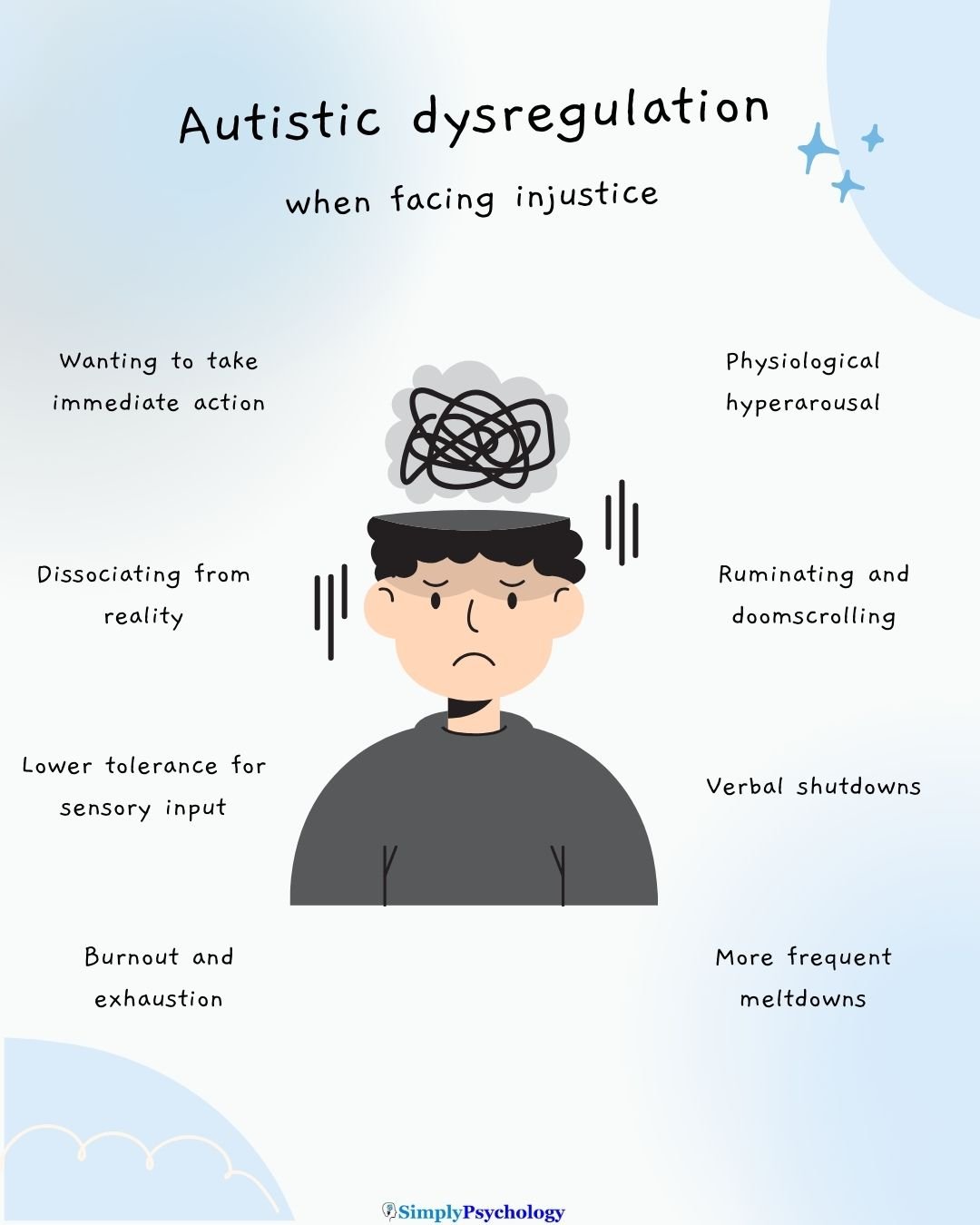
Continuous exposure to injustice without resolution forces the nervous system into a chronic state of high alert. This leads to specific clinical outcomes.
The Nervous System “Ladder”
Ashley Bentley, an integrated coach and hypnotherapist featured in The Neurodivergent Experience, utilizes the “Ladder Within” concept (based on Polyvagal Theory) to explain this state:
- Ventral Vagal (Top of Ladder): The state of safety and social engagement. This is where regulation happens.
- Sympathetic (Middle of Ladder): The state of mobilization. This is the “fight or flight” response triggered by injustice.
- Dorsal Vagal (Bottom of Ladder): The state of shutdown or collapse. When injustice feels insurmountable, the system freezes to preserve energy.
Autistic Burnout
Dr. Megan Anna Neff, a clinical psychologist and researcher, identifies this chronic activation as a primary driver of autistic burnout. This condition is distinct from occupational burnout.
It involves the loss of previously acquired skills and a reduced tolerance for sensory stimuli. Living in a state of constant moral outrage depletes the cognitive resources required for daily functioning.
Clinical Strategies for Self-Regulation
Regulation must be proactive rather than reactive. The goal is to return the nervous system to a state of safety.
1. The Circle of Control
Ashley Bentley recommends a cognitive reframing tool known as the Circle of Control to manage the overwhelm of global injustice.
- Circle of Concern: This includes global events, politics, and other people’s behavior. These are valid worries but are outside your direct influence. Focusing here leads to helplessness.
- Circle of Control: This includes your immediate actions, where you spend your money, and how you treat people in your vicinity.
- The Strategy: visualize moving energy from the outer circle to the inner circle. Validate the pain of the outer circle, but commit action only to the inner circle. This restores a sense of agency.
2. Sensory Anchoring and Stimming
Regulation is often a bottom-up process (body to brain) rather than top-down (thinking your way out of it).
- Stimming as Regulation: Repetitive behaviors (stimming) are essential for processing intense emotions. Stimming should be viewed as a functional mechanism for soothing the nervous system, not a behavior to suppress.
- Somatic Practices: Techniques such as deep pressure therapy, rocking, or vocalizing can manually down-regulate the sympathetic nervous system. Dr. Teresa Regan, a neuropsychologist, notes that recognizing these behaviors as regulation attempts is crucial for recovery.
3. Validating Reality Through Community
Gaslighting is a common experience for autistic people who point out injustice. They are often told they are “overreacting” or “imagining things.”
- The “Double Empathy” Solution: Connecting with other neurodivergent people provides essential validation. Dr. Amy Pearson and Kieran Rose discuss the importance of “neuro-kin” in mitigating the trauma of living in a misunderstood identity.
- Shared Reality: Speaking with others who share the same perception of injustice reduces the cognitive load of constantly questioning one’s own judgment.
4. Strategic Information Consumption
The autistic brain’s pattern-recognition strengths can make “doomscrolling” particularly dangerous. The brain naturally seeks more data to solve the “problem” of the injustice.
- Protocol: meaningful engagement requires limits. Set strict boundaries on news consumption.
- Replacement: Replace the intake of traumatic information with special interest engagement. Special interests are not just hobbies. They are restorative and replenish cognitive reserves.
Summary of action plan
| Trigger | Biological Mechanism | Actionable Strategy |
| Witnessing Injustice | Amygdala activation (Threat Response) | Somatic Disengagement: Physically remove yourself from the source. Engage in intense exercise or deep pressure. |
| Rumination (Looping) | Prefrontal Cortex seeking resolution | Circle of Control: Write down the specific injustice. Categorize it as “Within Control” or “Outside Control.” |
| Gaslighting | Social rejection / Confusion | Community Verification: Discuss the event with neurodivergent peers to validate your perception. |
| Systemic Overwhelm | Dorsal Vagal Shutdown (Freeze) | Sensory Diet: Reduce sensory input (lights, sound) and engage in special interests to recharge. |
This article is provided for informational and educational purposes only. It does not constitute medical advice, diagnosis, or treatment. If you are experiencing severe distress due to autistic burnout, justice sensitivity, or chronic stress, please prioritize your immediate safety and well-being.

