
Seligman and Maier’s dog experiments showed that an animal given shock it cannot control learns, not that shock hurts, but that nothing it does matters.
That makes learned helplessness a cognitive account of learning. The animal picks up a relationship between its behavior and outcomes, not just a strengthened or weakened response.
Key Takeaways
Aim
- To test whether controllability, not the shock itself, determines whether an animal later fails to learn an available escape response.
Method
- A laboratory experiment on dogs strapped in a hammock. Twenty-four dogs formed three groups of eight: Escape, Yoked and Normal.
- Escape dogs had 64 shocks that pressing a panel with the head ended. Yoked dogs had 64 shocks of matching length that nothing they did could end.
- Normal dogs had no hammock shocks. Yoked means matched to the Escape group: shocks of the same length, but no control.
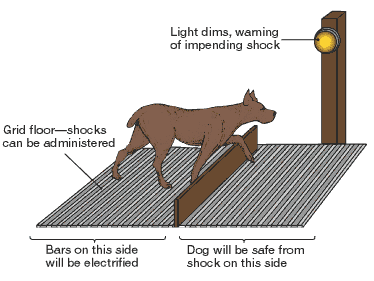
- Next day the Escape and Yoked dogs went into a shuttle box, where jumping a barrier lets a dog escape shock. Normal dogs went straight in.
- The independent variable was the first experience: escapable, inescapable or no shock. The dependent variable was how quickly and how often dogs escaped.
- A second experiment tested whether learning to escape first protects dogs from later inescapable shock.
Results
- Escape and no-shock dogs quickly learned to jump the barrier. About two-thirds of the yoked dogs did not even try, lying down and whining as they accepted shocks they could have avoided.
- Escape dogs took 27.00 seconds on average to jump the barrier, Normal dogs 25.93 and Yoked dogs 48.22.
- Six of the eight Yoked dogs failed to escape on at least nine of ten trials. No Escape dog did, and one Normal dog did.
- Five of those six Yoked dogs still failed every trial a week later.
- In the second experiment, dogs that had first learned to escape were protected from later inescapable shock.
Conclusion
- Control over shock influences whether a dog later fails to escape.
- The authors proposed that Yoked dogs learned that shock ending did not depend on what they did.
Strengths
- Internal validity: Escape and Yoked dogs had the same hammock and shock source and differed only in control, so the failure could be attributed to control, not shock.
- Control group: Escape dogs did as well as Normal dogs, so shock did not by itself harm Escape dogs.
- Testing explanations: earlier escapable shock protected dogs, which fits learning better than adaptation (getting used to shock).
- Transfer: the harness and the shuttle box were different units, so the failure carried over to a new place.
Limitations
- Sample size: groups held eight or nine dogs from one laboratory, and six of the 30 dogs in Experiment I were discarded.
- Control group: Normal dogs were never strapped in, so Yoked against Normal mixes inescapable shock with restraint.
- Inference: the expectation the authors proposed was never measured, and in 2016 they reversed the mechanism.
- Generalisation: the dogs were laboratory dogs in the mid-1960s, so applying the result to pet dogs or people is a further step.
Ethical Issues
- Harm: each dog in the shock groups was restrained and given 64 shocks. Yoked dogs could not end them, one died, and five dogs still failed a week later.
- Alternatives: the 3Rs ask whether fewer animals, milder procedures or none could give the same knowledge (Russell & Burch, 1959).
- Harm as the variable: lasting passivity was the expected result for the Yoked group, so it is hard to call the procedure milder.
Background
Solomon’s group at Pennsylvania studied how fear learned through Pavlovian conditioning, learning that a signal predicts something frightening, affects later learning to act. Dogs were given 64 shocks in a hammock, each preceded by a signal.
The next day they were put in a shuttle box, a box with two compartments and a barrier between them. Jumping the barrier lets a dog escape shock. Many dogs failed to escape: they did not jump (Maier & Seligman, 2016).
Seligman and Maier, then graduate students, set out to explain it.
Overmier and Seligman (1967) published a companion paper. It showed the failure was reliable. It also occurred when shocks were not signalled, and in dogs paralysed with curare, a drug that paralyses the muscles. A stronger test shock did not remove it. It had gone by 48 hours.
Overmier and Seligman suggested the dogs might have learned helplessness, and that control over shock might matter. They did not manipulate control.
Seligman and Maier therefore asked whether control over the first shocks influences whether the failure appears. Helplessness meant that shock was as likely to end whether or not the dog responded.
The idea was cognitive. Maier and Seligman (2016) call it radical for the 1960s, when learning theories held that animals learn pairings of events.
Aim
Seligman and Maier wanted to know whether a dog’s control over its first shocks influences whether it later fails to learn to escape in a different apparatus. A second question followed.
- Experiment I: Does control over the first shocks influence whether a dog later fails to escape in a different apparatus?
- Experiment II: Does earlier experience of escaping shock prevent that failure?
Method
Design and Variables
Both experiments were laboratory experiments on dogs. An independent variable is what the researcher changes. A dependent variable is what the researcher measures.
Experiment I used an independent groups design, meaning each dog was in one group only. There were three groups of eight dogs, and the paper does not say how dogs were allocated.
- Escape: 64 shocks, each ended by pressing a panel with the head.
- Yoked: 64 shocks that pressing did not end. Yoked means tied to the Escape group: each shock was as long as the Escape group’s average shock on that trial, whatever the dog did.
- Normal: no hammock session at all, only the shuttle-box test.
The independent variable was the first experience: escapable shock, inescapable shock or none. The dependent variable was shuttle-box performance 24 hours later. It was measured as the time taken to jump, the failures to escape in ten trials and the percentage of dogs failing on nine or more.
Experiment II asked whether learning to escape first protects a dog. The independent variable was earlier experience, in four groups.
The dependent variables were how quickly and how often dogs escaped in the shuttle box. They also included head presses on the panels during inescapable shock, counted as attempts to respond or struggling.
- Preescape: learned to escape shock in the shuttle box first, then had inescapable shock in the hammock.
- No Pre: no earlier experience, then inescapable shock in the hammock.
- No Inescapable: learned to escape first, then sat in the hammock with no shock.
- Preinescapable: first had shock in the shuttle box that jumping did not end, then hammock shock. This group was run afterwards.
Participants
Experiment I began with 30 mongrel dogs. Six were discarded, which left 24, eight per group. The Limitations section gives the reasons.
Experiment II began with 30 dogs, and three were discarded. The other 27 were assigned by chance to three groups of nine. Nine more dogs formed the group run afterwards. Sixty dogs contributed data across the two experiments.
Apparatus and Procedure
In the hammock, a dog’s legs hung through holes and its head was held between two panels that it could press. Shock came through plates taped to the hind footpads.
The Escape group had 64 unsignalled shocks, on average 90 seconds apart. A head press ended each shock. If none came, it stopped after 30 seconds.
The Yoked group had the same number of shocks, and presses did nothing. Their shocks totalled 226 seconds.
Twenty-four hours later the Escape and Yoked groups had 10 shuttle-box trials. The Normal group had only these.
Each trial began with a signal, the lights dimming. Shock followed 10 seconds later. A jump in that interval ended the signal and avoided shock.
Otherwise shock continued until the dog jumped. The trial ended 60 seconds after the signal began, and that time was scored as 60 seconds. Seven days later, Yoked dogs that had shown the failure had 10 more trials.
Results
Experiment I
Escape dogs learned to end the shock: each dog’s time to press the panel fell between its first eight trials and its last eight. Yoked dogs typically stopped pressing after about 30 trials.
| Group (8 dogs each) | Average time to jump (seconds, 60 maximum) | Dogs failing on 9 or more of 10 trials |
|---|---|---|
| Escape | 27.00 | 0% |
| Normal | 25.93 | 12.5% |
| Yoked | 48.22 | 75% |
The Yoked group was slower and failed more than both other groups, and the gaps were too big to put down to chance. Escape and Normal dogs did not differ.
Six Yoked dogs failed on nine or more trials. Five of those six failed on every trial seven days later.
Experiment II
Dogs with no earlier experience (No Pre) were slower and failed more than the other two groups assigned by chance, which did not differ. The values appear only in graphs.
Dogs that had first learned to escape also pressed the panels more than No Pre dogs during inescapable shock. A dog that had learned control kept trying when control was removed.
Preinescapable dogs behaved like No Pre dogs. So the protection came from the earlier shock being escapable, not from shock in the shuttle box as such.
Figures That Are Often Misquoted
Summaries of the experiment often differ from the paper. These are the points to check.
- Two-thirds of dogs: here six of eight (75 per cent) failed. Two-thirds is a later figure, from Maier and Seligman (1976) for about 150 dogs and Maier and Seligman (2016).
- A no-shock group: the Normal group had no hammock session at all, only the ten shuttle-box trials.
- Dragged 200 times: some accounts say this. Maier and Seligman (1976) report three dogs pulled across the box 20, 35 and 50 times, and all recovered completely.
Why Did the Yoked Dogs Fail to Escape?
The Authors’ Explanation
On the authors’ account, shock first made dogs in both groups respond actively. Yoked dogs then learned that shock ending did not depend on what they did.
A dog’s incentive to start responding, its reason to try, is the expectation that responding will raise the chance of shock ending. Without that expectation, dogs started responding less.
Shock in the shuttle box carried the learning over to the new place. Escape dogs had learned that responding was linked to shock ending, so their incentive stayed.
Rival Explanations the Authors Considered
- Adaptation: Escape dogs had the same shocks and would have got used to them too. A stronger test shock did not remove the failure (Overmier & Seligman, 1967).
- Accidental punishment or competing behaviour: shock might follow a response by chance, or other behaviour might block jumping. Both groups had equal chance of this, and paralysed dogs also failed (Overmier & Seligman, 1967).
- Extinction: the authors also considered extinction in a broad sense, as any procedure that removes the incentive to respond, which they judged only different in wording from their own account.
- A temporary emotional state: the failure had gone by 48 hours (Overmier & Seligman, 1967), yet five of six failing dogs still failed a week later.
The authors proposed a learning factor that appears to cause the effect, and a separate emotional factor that may shape its time course.
Conclusion
The authors drew these conclusions.
- Control Matters: Control over shock in a dog’s first experience influences whether the failure appears. Escape and Yoked dogs differed only in control, so they probably learned different things.
- Earlier Escape Protects: Prior experience of escaping made dogs resistant to inescapable shock. They also kept trying to respond to it.
- Independence Is Learned: The authors proposed that animals also learn about independence between events, as well as learning that events go together or stop going together.
Strengths
The experiment has four main strengths.
- Control Isolated: Escape and Yoked dogs had the same hammock, shock source, shock number and mean shock length. Only control differed, so the failure could be attributed to control, not shock or pain.
- Control Group: Normal dogs showed that Escape dogs were no worse than untreated dogs.
- Explanations Tested: Escapable shock protected dogs, but inescapable shock in the shuttle box first did not. Adaptation would not predict that earlier shuttle-box experience cancels adaptation from the hammock (Maier & Seligman, 1976).
- Transfer Between Situations: The two units differed. The only common elements were the experimenters, shock and white noise (Overmier & Seligman, 1967).
Limitations
The main limitations are:
- Very Small Groups, One Laboratory: Groups held eight or nine dogs, and the early work came from one team.
- The Normal Control Did Not Control for the Harness: Normal dogs were never strapped in.
- The Expectation Was Inferred, Not Measured: The explanation rests on ruling out rivals.
- Dogs, Setting and Era: The sample was laboratory dogs from the mid-1960s.
- Movement, Restraint and Shared Cues: Activity differed between groups, and the two units shared some cues.
Very Small Groups, One Laboratory
Each group held eight or nine dogs. Six of the 30 dogs in Experiment I were discarded. Two Escape dogs failed to learn to escape in the hammock. A third was lost through a procedural error. Two Yoked dogs were too small for the harness. One died.
A footnote says that dropping the two non-learners might look biased. One escaped normally when run 48 hours later, and the other was too ill to be run.
The paper does not say how dogs were allocated in Experiment I, or report blind scoring (scoring without knowing each dog’s group). The early dog work came from one laboratory.
The Normal Control Did Not Control for the Harness
Normal dogs were never strapped in the hammock. So comparing Yoked dogs with Normal dogs mixes inescapable shock with restraint, and that gap alone cannot show which one mattered.
The Escape group is the comparison that controls for the harness, because those dogs were restrained and shocked too. They escaped normally.
Experiment II added a harness-only group, No Inescapable. It had 90 minutes in the hammock with no shock and behaved normally.
The Expectation Was Inferred, Not Measured
The conclusion that Yoked dogs learned independence rests on excluding rival explanations. The authors never measured the expectation itself. That left room for rival accounts. These put the failure down to movement or fear.
It also left room for Maier and Seligman (2016) to keep the behavioural result and reverse the mechanism. On their new view passivity is the default and control is learned.
So “learned helplessness” may describe the behaviour well but not the process behind it.
Dogs, Setting and Era
The dogs were mongrels of 25 to 29 lb, housed in individual cages, in an American laboratory in the mid-1960s. Maier and Seligman (1976) report that about a third of shocked dogs seemed normal. They suggest a dog’s history before it arrived may matter.
The dogs were strapped into a hammock and shocked. The paper reports no tests outside the laboratory.
Generalising to pet dogs, and to people, is a further step. Hiroto and Seligman (1975) found a similar pattern in students, but they note that students saw both tasks as one experiment.
Movement, Restraint and Shared Cues
Escape dogs pressed panels and Yoked dogs stopped, so their activity differed. Two findings bear on the movement worry. The failure occurred in paralysed dogs (Overmier & Seligman, 1967). Dogs taught to escape by holding still, which is incompatible with jumping, did not show it (Maier & Seligman, 1976).
A second worry is shared cues. Maier and Seligman (2016) warn that when the first stressor and the test share cues, fear conditioning can explain a shuttle-box deficit.
The two units differed. Even so, the same laboratory, noise and experimenters were present in both.
Ethical Issues
The dog experiments were animal research with electric shocks. Each dog in the shock groups was restrained and given 64 shocks to the hind feet.
Yoked dogs could do nothing to end them. In Experiment I their shocks totalled 226 seconds. In Experiment II the inescapable hammock shocks were 64 shocks of 5 seconds each, 320 seconds in all.
Lasting passivity was the expected result for the Yoked group, and it lasted.
Five of six Yoked dogs still failed a week later. One Yoked dog died during treatment, and one discarded Escape dog was too ill to test. The paper reports nothing on the dogs’ fate afterwards, or on ethical review.
- Harm as the Variable: Lasting passivity was the expected result for the Yoked group, so it is hard to call the procedure milder.
- The Authors’ Later View: Maier and Seligman (2016) call running dog experiments “a harrowing experience for both of us”.
- Milder Tests on People: Hiroto and Seligman (1975) used a 90 dB tone that students rated moderately unpleasant. Students could leave after hearing samples, and they were debriefed.
- The Benefit Case: One case that the cost was worth it points to the depression model, the reformulation and the 2016 brain work. That brain work is on rodents.
The milder tests show the effect can be studied without shock. They do not show that the dog result could have been found without dogs. That is a separate question.
The 3Rs are principles for humane animal research. They ask whether the same knowledge could come from fewer animals, milder procedures or none (Russell & Burch, 1959).
The Animals (Scientific Procedures) Act 1986, the UK law on animal research, came nearly twenty years after the experiments, which were run in the United States. It is not the rule these researchers worked under.
Later Research
Later work tested the rival explanations. Maier taught one group of dogs to end shock by holding still, which is incompatible with jumping. All later learned to jump, while half the yoked dogs never did in 12 days (Maier & Seligman, 1976).
So holding still as such did not produce the failure. The sections below cover the human evidence, the link to depression and the brain-based reversal.
People: Hiroto and Seligman (1975)
- Aim: To test whether helplessness transfers from one kind of task to another.
- Method: Ninety-six paid undergraduates first heard a tone they could end, could not end or merely heard, or met soluble, insoluble or merely inspected problems. They were then tested on a hand shuttle box or 20 anagrams.
- Findings: Inescapable tone and insoluble problems both impaired shuttle-box escape. Inescapable tone impaired anagram solving.
- Conclusion: The authors suggest inescapability and insolubility both produce an expectancy that responding is independent of reinforcement (the outcome), which may be the rudiment of a “trait”.
This is human evidence that fits the dog result. Students saw both tasks as one experiment, so carry-over outside the laboratory is unknown (Hiroto & Seligman, 1975).
Depression and Attributions
Miller and Seligman (1975) found that depressed students given no noise did far worse on anagrams than nondepressed students. Inescapable noise produced parallel deficits in nondepressed students but did not worsen the depressed. These findings supported the helplessness model of depression.
The hypothesis had a gap. Abramson et al. (1978) said it could not explain when helplessness is general or specific, or chronic or acute.
They proposed that people explain events unconnected to what they do by their causes: stable or unstable, global or specific, internal or external. This reformulation draws on attribution theory.
Alloy and Abramson (1982) found a result contrary to helplessness theory. Nondepressed students given uncontrollable noise showed an illusion of control, a belief that they influenced outcomes they did not, when outcomes were unrelated to their actions but linked to success.
Learned Helplessness at Fifty: Maier and Seligman (2016)
- Aim: To review fifty years of the theory and test its two premises, that animals detect uncontrollability and expect later shock to be uncontrollable, against evidence from the brain.
- Method: A review of fifty years of work by the two original authors, drawing mainly on Maier’s rat experiments.
- Findings: Inescapable shock activates serotonin neurons in one brain structure, and equal escapable shock does not. This activation is reported as necessary and sufficient for passivity and heightened fear. A prefrontal region detects control and then inhibits the serotonin neurons.
- Conclusion: The original theory “got it backwards”: passivity is the unlearned default, and control is what is learned. They speculate this matters for treating depression.
This keeps the 1967 behavioural result and re-specifies its mechanism. It is by the originators, tests nothing new and uses rats, not dogs. The authors call the translation to the psychological level a hypothesis that could be falsified.
On the 1967 reading, shock without control teaches a belief. On the 2016 reading, shock activates a default circuit that control switches off.
Conoscenti and Fanselow (2019), a review of rat work, add that the amount of stress matters. In rats, 100 inescapable tailshocks produced a depression-like escape deficit. Fifteen footshocks enhanced fear learning without one. Many deficits were gone by 72 hours.
That fading loosely resembles the dogs’ recovery by 48 hours (Overmier & Seligman, 1967), although neither paper makes the comparison.
Patel et al. (2026) found that mice that witnessed another mouse receive inescapable shocks developed avoidance deficits, anhedonia (loss of pleasure) and anxiety like direct shock. It is one mouse study awaiting replication.
References
Abramson, L. Y., Seligman, M. E. P., & Teasdale, J. D. (1978). Learned helplessness in humans: Critique and reformulation. Journal of Abnormal Psychology, 87(1), 49-74. https://doi.org/10.1037/0021-843X.87.1.49
Alloy, L. B., & Abramson, L. Y. (1982). Learned helplessness, depression, and the illusion of control. Journal of Personality and Social Psychology, 42(6), 1114-1126. https://doi.org/10.1037/0022-3514.42.6.1114
Conoscenti, M. A., & Fanselow, M. S. (2019). Dissociation in effective treatment and behavioral phenotype between stress-enhanced fear learning and learned helplessness. Frontiers in Behavioral Neuroscience, 13, Article 104. https://doi.org/10.3389/fnbeh.2019.00104
Hiroto, D. S., & Seligman, M. E. P. (1975). Generality of learned helplessness in man. Journal of Personality and Social Psychology, 31(2), 311-327. https://doi.org/10.1037/h0076270
Maier, S. F., & Seligman, M. E. P. (1976). Learned helplessness: Theory and evidence. Journal of Experimental Psychology: General, 105(1), 3-46. https://doi.org/10.1037/0096-3445.105.1.3
Maier, S. F., & Seligman, M. E. P. (2016). Learned helplessness at fifty: Insights from neuroscience. Psychological Review, 123(4), 349-367. https://doi.org/10.1037/rev0000033
Miller, W. R., & Seligman, M. E. P. (1975). Depression and learned helplessness in man. Journal of Abnormal Psychology, 84(3), 228-238. https://doi.org/10.1037/h0076720
Overmier, J. B., & Seligman, M. E. P. (1967). Effects of inescapable shock upon subsequent escape and avoidance responding. Journal of Comparative and Physiological Psychology, 63(1), 28-33. https://doi.org/10.1037/h0024166
Patel, S., Kushwaha, R., Sinha, D., Soren, K., Kumar, A., & Chakravarty, S. (2026). Vicarious learned helplessness: A translationally relevant novel model of stress contagion elucidating sex-dependent prefrontal cortex pathology. Frontiers in Behavioral Neuroscience, 20, Article 1788847. https://doi.org/10.3389/fnbeh.2026.1788847
Russell, W. M. S., & Burch, R. L. (1959). The principles of humane experimental technique. Methuen.
Seligman, M. E. P., & Maier, S. F. (1967). Failure to escape traumatic shock. Journal of Experimental Psychology, 74(1), 1-9. https://doi.org/10.1037/h0024514