Like many great scientific advances, Pavlovian conditioning (aka classical conditioning) was discovered accidentally. Ivan Petrovich Pavlov (1849–1936) was a physiologist, not a psychologist.
During the 1890s, Pavlov researched salivation in dogs in response to being fed.
He inserted a small test tube into the cheek of each dog to measure saliva when the dogs were fed (with a powder made from meat).
Pavlov expected his dogs to salivate for food, but noticed they began salivating at the mere sound of his assistant’s approaching footsteps.
Pavlov realized these were learned responses to incidental stimuli associated with feeding, which he termed ‘psychic secretions’.
To investigate this phenomenon scientifically, Pavlov designed a controlled experiment to see if he could teach a dog to respond to a neutral stimulus that had no natural connection to food, such as a bell, a metronome, a light, or a touch on the leg.

Pavlov’s Dog Experiment
Pavlov (1902) started from the idea that there are some things that a dog does not need to learn. For example, dogs don’t learn to salivate whenever they see food.
This reflex is ‘hard-wired’ into the dog.
Pavlov showed that dogs could be conditioned to salivate at the sound of a bell if that sound was repeatedly presented at the same time that they were given food.
The Experimental Setup
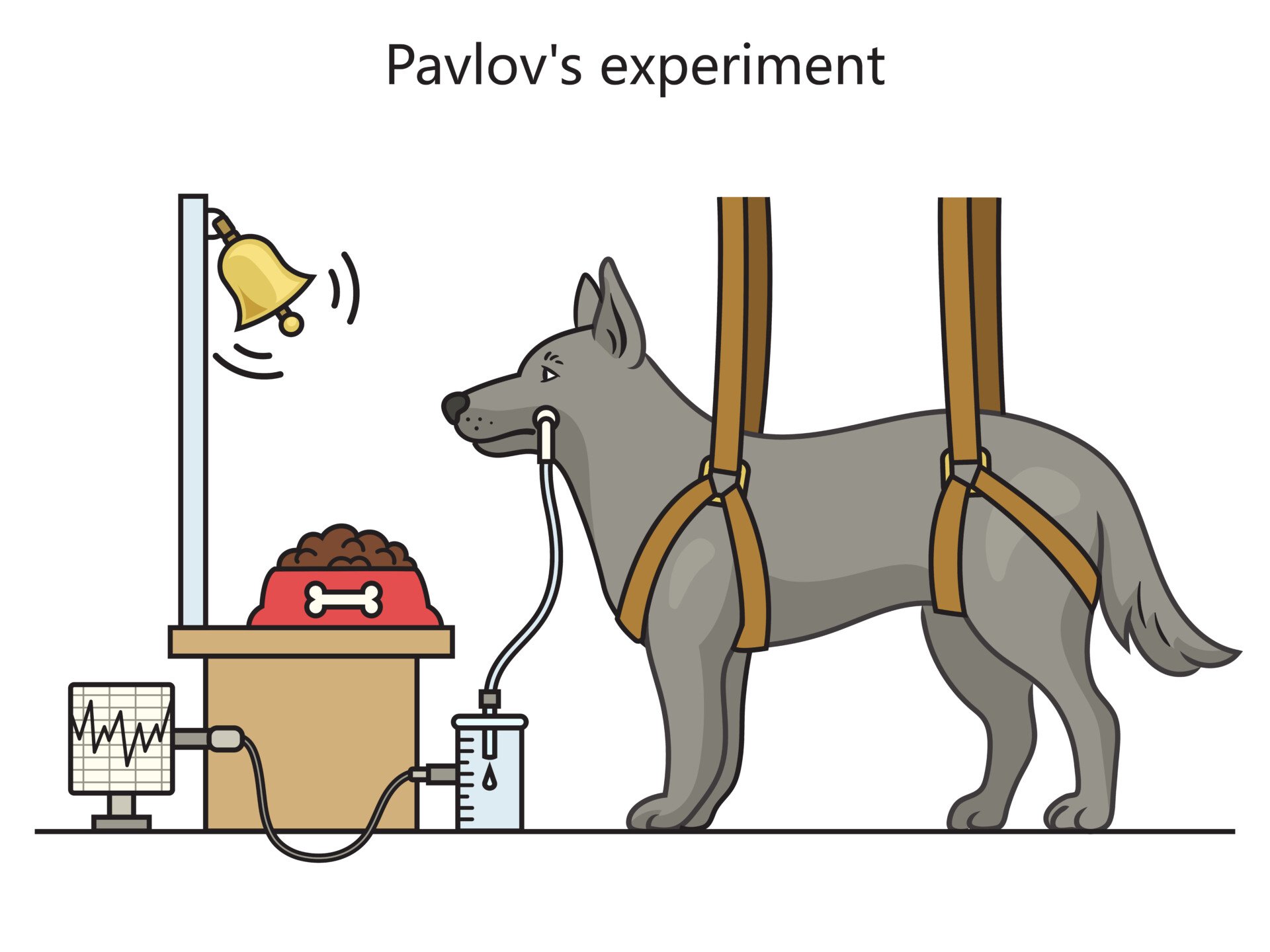
To maintain scientific rigor, Pavlov situated his dogs in secluded environments, secured within harnesses to minimize distractions.
-
The Apparatus: A food bowl was placed before the dog. Pavlov surgically attached a tube (fistula) directly to the dog’s salivary glands. This allowed the liquid to be diverted away from the throat and into a measuring container.
-
Data Collection: Measurements were recorded onto a rotating drum (a kymograph), allowing Pavlov to meticulously monitor salivation rates in real-time.

Classical Conditioning
Classical conditioning (also known as Pavlovian conditioning) is a theory of learning that posits behaviors are acquired through the association between an environmental stimulus and a naturally occurring stimulus.
As later developed by behaviorists like John B. Watson, this process involves pairing a neutral signal with a reflex to trigger a specific response. The process unfolds in three distinct stages:
1. Before Conditioning: Establishing the Baseline
In this stage, we identify two unrelated elements:
-
Unconditioned Stimulus (UCS): A stimulus that naturally and automatically triggers a response without any prior learning. In Pavlov’s lab, this was the food.
-
Unconditioned Response (UCR): An automatic, innate reaction to the UCS. For the dogs, this was the physiological act of salivating.
-
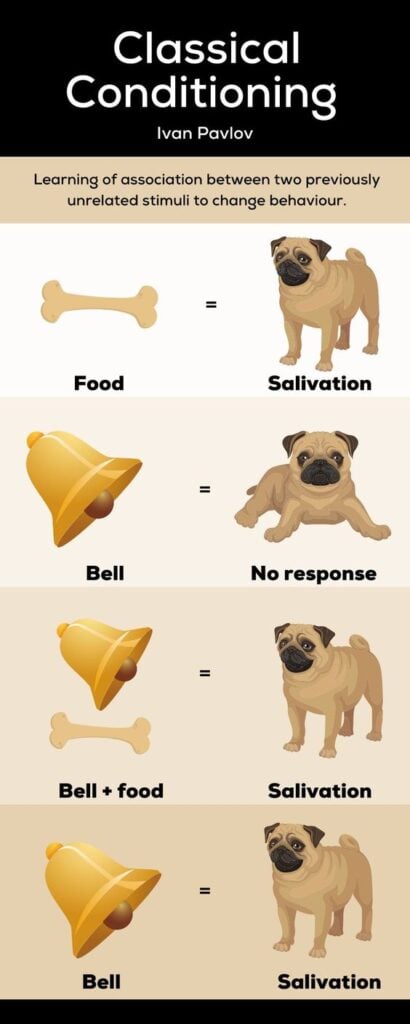
Neutral Stimulus (NS): A stimulus that initially elicits no relevant response or reflex action. Pavlov used a metronome (or bell), which initially had no effect on the dog’s salivation.
The Baseline State:
Unconditioned Stimulus (Food) > Unconditioned Response (Salivate)
Neutral Stimulus (Metronome) > No Response
2. During Conditioning: The Acquisition Phase
This is the learning stage, where the association is built through a series of Trials.
Pavlov repeatedly introduced the Neutral Stimulus (Metronome) immediately before presenting the Unconditioned Stimulus (Food).
Through temporal contiguity (the closeness in time of the two events), the dog begins to link the sound of the metronome with the arrival of food.
During these trials, the dog is still salivating because of the food, but the connection is being “acquired.”
The Trial Phase:
- NS (Metronome) + UCS (Food) > Unconditioned Response (Salivate)
3. After Conditioning: The Learned Response
After a sufficient number of pairings, the neutral stimulus loses its neutrality and becomes the Conditioned Stimulus (CS).
The dog now salivates upon hearing the metronome alone, even if the food is not presented.
This learned reaction is called the Conditioned Response (CR).
While the CR looks identical to the original UCR (salivation), it is distinguished by the fact that it is now triggered by a learned signal rather than a biological necessity.
The Conditioned State:
- Conditioned Stimulus (Metronome) > Conditioned Response (Salivation)

| Term | Definition | Pavlov’s Example |
| UCS | Natural trigger for a reflex | Food / Meat Powder |
| UCR | The innate, unlearned reflex | Salivation (to food) |
| NS | A stimulus with no initial effect | Metronome / Bell |
| CS | The learned trigger (formerly the NS) | Metronome / Bell (after trials) |
| CR | The learned response to the CS | Salivation (to the sound) |
Related Principles
Temporal contiguity
Pavlov found that for associations to be made, the two stimuli had to be presented close together in time (such as a bell).
He called this the law of temporal contiguity. If the time between the conditioned stimulus (bell) and the unconditioned stimulus (food) is too great, then learning will not occur.
‘Unconditioning’ through experimental extinction
In extinction, the conditioned stimulus (the bell) is repeatedly presented without the unconditioned stimulus (the food).
Over time, the dog stops associating the sound of the bell with the food, and the conditioned response (salivation) weakens and eventually disappears.
In other words, the conditioned response is “unconditioned” or “extinguished.”
Spontaneous recovery
Pavlov noted the occurrence of “spontaneous recovery,” where the conditioned response can briefly reappear when the conditioned stimulus is presented after a rest period, even though the response has been extinguished.
This discovery added to the understanding of conditioning and extinction, indicating that these learned associations, while they can fade, are not completely forgotten.
Generalization
Subjects often respond to stimuli that are similar to the original CS. For example, a dog conditioned to a bell might also salivate at the sound of a buzzer.
However, the response tends to be more pronounced when the new stimulus closely resembles the original one used in conditioning.
This relationship between the similarity of the stimulus and the strength of the response is known as the generalization gradient.
This principle has been exemplified in research, including a study conducted by Meulders and colleagues in 2013.
Impact of Pavlov’s Research
Ivan Pavlov’s research did more than explain why dogs drool; it fundamentally transformed psychology from a subjective study of the mind into an objective, experimental science.
By focusing on “psychic secretions” (observable, measurable physiological responses), he provided a rigorous methodology that still anchors modern research.
1. The Foundation of Behaviorism
Before Pavlov, psychology relied on introspection (reporting inner thoughts).
Pavlov initially hesitated to study psychology because it lacked “exactness.” However, his work proved that:
-
Observable Behavior is Key: Complex actions could be reduced to simple stimulus-response units.
-
Environmental Dominance: His findings heavily influenced John B. Watson, who argued that psychology should focus exclusively on observable behavior rather than hidden mental states. This shift launched Behaviorism as the dominant psychological school of the 20th century.
2. Clinical Applications and Therapy
Pavlovian principles are the active ingredients in several evidence-based treatments used today:
-
Systematic Desensitization: Developed by Joseph Wolpe, this therapy treats phobias by counter-conditioning. Patients pair a feared stimulus (e.g., a spider) with relaxation techniques, breaking the old fear association.
-
Exposure Therapy: Used for PTSD and anxiety, this involves repeatedly presenting the conditioned stimulus (the trigger) without the unconditioned stimulus (the danger) until the response is extinguished.
-
Aversion Therapy: Maladaptive behaviors (like alcohol use) are paired with unpleasant stimuli (like nausea-inducing drugs) to create a learned avoidance.
3. Understanding Human Emotion: The “Little Albert” Experiment
In 1920, Watson and Rayner applied Pavlov’s principles to a human infant, Little Albert.
-
Conditioning: They paired a neutral white rat with a loud, frightening noise (UCS).
-
Generalization: Albert soon feared not only the rat but also a rabbit, a dog, and even a Santa Claus mask.
-
Significance: This proved that emotions like fear are learned through environmental associations, rather than being the result of deep-seated unconscious conflicts.
4. Health, Neuroscience, and the “Garcia Effect”
Pavlov’s influence extends into the very biology of our bodies:
-
Psychoneuroimmunology: Ader and Cohen (1975) showed that the immune system can be conditioned. They paired saccharin water with an immunosuppressive drug; eventually, the water alone suppressed the rats’ immune responses.
-
The Garcia Effect (Taste Aversion): John Garcia found that organisms are biologically “prepared” to learn certain associations. A single instance of sickness after eating a specific food creates a lifelong aversion: a survival mechanism that happens even if there is a long delay between the taste and the illness.
-
Neural Basis of Learning: Neuroscientists like Eric Kandel identified Long-Term Potentiation (LTP), the cellular process where “neurons that fire together, wire together”, providing the physical evidence for Pavlov’s associative theories.
5. Modern Marketing and Everyday Life
Pavlov’s “bell” is ringing everywhere in the 21st century:
-
Marketing: Advertisers pair products with unconditioned stimuli like catchy music, attractive people, or beautiful scenery to elicit a positive emotional response (CR) toward the brand.
-
Educational Strategies: Rote memorization and repetitive learning use the association between a cue (question) and a response (answer) to reinforce memory.
-
Predictive Brain: Modern learning theory (like the Rescorla-Wagner model) explains that our brains are constantly calculating “prediction errors”, the difference between what we expect to happen and what actually happens, to update our understanding of the world.
Critical Evaluation
Artificial Settings:
Pavlov’s experiments were conducted in highly controlled laboratory environments (e.g., soundproof rooms, harnesses).
Critics argue that these artificial settings lack ecological validity, meaning the findings may not perfectly translate to the messy, uncontrolled variables of the real world.
Lack of Complexity:
While Pavlov’s principles explain involuntary reflexes (like salivation or fear responses), they are less effective at explaining voluntary, complex human behaviors, which are better addressed by operant conditioning or social learning theories.
Instinctive Drift:
Work by the Brelands showed that animals would eventually drift back toward their instinctive behaviors, overriding their conditioning.
For example, raccoons conditioned to drop coins into a box would eventually start rubbing them together (washing behavior) instead, illustrating that biological instincts can inhibit or override conditioned behaviors.
The Garcia Effect (Taste Aversion):
John Garcia’s research on taste aversion fundamentally challenged Pavlov’s rules regarding timing.
Pavlov asserted that the CS and UCS must occur within seconds of each other.
Garcia found that rats (and humans) could learn to avoid a food (CS) even if the nausea (UCR) occurred up to eight hours later.
Furthermore, this conditioning could happen after a single exposure, contradicting Pavlov’s requirement for repeated pairings.
Biological Preparedness:
Researchers like Martin Seligman argued that animals and humans are evolutionarily prepared to fear certain stimuli that pose survival threats, such as snakes or heights, much more easily than neutral objects like flowers.
This challenges Pavlov’s notion that all stimuli are equally capable of becoming conditioned stimuli.
Prediction vs. Contiguity:
Pavlov believed conditioning occurred simply because the conditioned stimulus (CS) and unconditioned stimulus (UCS) were paired close together in time (contiguity).
However, later research by Rescorla and Wagner (1972) demonstrated that prediction and expectation are more critical than simple pairing.
If a stimulus does not provide new information or reliably predict the outcome (a concept known as “blocking”), conditioning does not occur, suggesting an underlying cognitive calculation rather than a simple mechanical association.
Modern Perspectives on Pavlovian Conditioning
While traditional descriptions focus on simple stimulus-response (S-R) chains, contemporary research suggests that Pavlovian conditioning is a sophisticated information-processing system.
1. The Functional Perspective: Evolution and Ecology
Traditional lab studies often use arbitrary stimuli (like a bell). However, as Domjan (2005) argues, conditioning evolved to serve an adaptive function in the natural world.
-
Ecological Relevance: For conditioning to occur naturally, the Conditioned Stimulus (CS) is rarely arbitrary. It is usually a precursor or a feature of the Unconditioned Stimulus (US) itself—such as the scent of prey before an attack or the taste of a plant before illness.
-
Preparatory Function: Conditioning is not just about mimicking a reflex; it prepares the organism for biological events. It often produces compensatory responses that allow the organism to cope with the coming US more effectively.
-
Modifying the UR: The most critical change in conditioning may not be the new response (CR), but rather the modification of the original response (UR) to make the interaction with the environment more efficient.
2. The Informational Perspective: Beyond Simple Pairing
Rescorla (1988) famously challenged the idea that mere “pairing” creates learning. Instead, he proposed that conditioning is about contingency and information.
-
Mental Representations: Organisms do not just link two things; they build complex mental maps of their environment.
-
Predictive Value: Conditioning only occurs if the CS provides reliable information about the US. If a sound happens all the time without food, the dog learns that the sound is “noise” and ignores it.
-
Encoding Relationships: Modern theory views conditioning as the rapid encoding of relationships among a broad range of stimuli, allowing for a multifaceted representation of the world.
The HeiDI Model: A Modern Framework
To address the limitations of older models (like Rescorla-Wagner), Honey, Dwyer, and Iliescu (2020, 2022) developed the HeiDI model.
The name reflects both the authors and the model’s core mechanism: Bi-directional (reciprocal) associations.
How HeiDI Differs from Traditional Models
HeiDI differs by allowing reciprocal CS-US and US-CS associations. It uses consistent learning rules applied to all stimulus pairs.
The simulations suggest HeiDI explains Rescorla’s results via two mechanisms:
- Changes in US-CS associations during compound conditioning, allowing greater change in some US-CS links
- Indirect influences of CS-CS associations enabling compounds to recruit associative strength from absent stimuli
HeiDI integrates various conditioning phenomena and retains key Rescorla-Wagner insights about surprise driving learning.
However, it moves beyond the limitations of Rescorla-Wagner by providing a framework to address how learning translates into performance.
| Feature | Traditional Models (e.g., Rescorla-Wagner) | The HeiDI Model |
| Direction | One-way ($CS \rightarrow US$) | Reciprocal/Bidirectional ($CS \leftrightarrow US$) |
| CS-CS Links | Often ignored | Central; allows stimuli to “recruit” strength from absent cues |
| Learning Rule | Driven primarily by “surprise” | Consistent rules applied to all stimulus pairs |
| Focus | Predicting the response | Explaining how learning translates into performance |
References
- Ader, R., & Cohen, N. (1975). Behaviorally conditioned immunosuppression. Biopsychosocial Science and Medicine, 37(4), 333-340.
- Breland, K., & Breland, M. (1961). The misbehavior of organisms. American psychologist, 16(11), 681.
- Domjan, M. (2005). Pavlovian conditioning: A functional perspective. Annu. Rev. Psychol., 56, 179-206.
- Garcia, J., Lasiter, P. S., BERMUDEZ‐RATTONI, F. E. D. E. R. I. C. O., & Deems, D. A. (1985). A general theory of aversion learning a. Annals of the New York Academy of Sciences, 443(1), 8-21.
- Honey, R.C., Dwyer, D.M., & Iliescu, A.F. (2020a). HeiDI: A model for Pavlovian learning and performance with reciprocal associations. Psychological Review, 127, 829-852.
- Honey, R. C., Dwyer, D. M., & Iliescu, A. F. (2022). Associative change in Pavlovian conditioning: A reappraisal. Journal of Experimental Psychology: Animal Learning and Cognition.
- Martinez Jr, J. L., & Derrick, B. E. (1996). Long-term potentiation and learning. Annual review of psychology, 47(1), 173-203.
- Meulders A, Vandebroek, N. Vervliet, B. and Vlaeyen, J.W.S. (2013). Generalization Gradients in Cued and Contextual Pain-Related Fear: An Experimental Study in Health Participants. Frontiers in Human Neuroscience, 7(345). 1-12.
- Pavlov, I. P. (1897/1902). The work of the digestive glands. London: Griffin.
- Pavlov, I. P. (1928). Lectures on conditioned reflexes. (Translated by W.H. Gantt) London: Allen and Unwin.
- Pavlov, I. P. (1927). Conditioned Reflexes: An Investigation of the Physiological Activity of the Cerebral Cortex. Translated and edited by Anrep, GV (Oxford University Press, London, 1927).
- Rescorla, R. A. (1988). Pavlovian conditioning: It’s not what you think it is. American Psychologist, 43(3), 151.
- Pavlov, I. P. (1955). Selected works. Moscow: Foreign Languages Publishing House.
- Rescorla, R. A. (1972). A theory of Pavlovian conditioning: Variations in the effectiveness of reinforcement and non-reinforcement. Classical conditioning, Current research and theory, 2, 64-69.
- Seligman, M. E. (1971). Phobias and preparedness. Behavior therapy, 2(3), 307-320.
- Watson, J.B. (1913). Psychology as the behaviorist Views It. Psychological Review, 20, 158-177.
- Watson, J. B., & Rayner, R. (1920). Conditioned emotional reactions. Journal of experimental psychology, 3(1), 1.
- Weiss, S. J. (1972). Stimulus compounding in free-operant and classical conditioning: A review and analysis. Psychological Bulletin, 78(3), 189.
What was the main point of Ivan Pavlov’s experiment with dogs?
The main point of Ivan Pavlov’s experiment with dogs was to study and demonstrate the concept of classical conditioning.
Pavlov showed that dogs could be conditioned to associate a neutral stimulus (such as a bell) with a reflexive response (such as salivation) by repeatedly pairing the two stimuli together.
This experiment highlighted the learning process through the association of stimuli and laid the foundation for understanding how behaviors can be modified through conditioning.
What is Pavlovian response?
The Pavlovian response, also known as a conditioned response, refers to a learned, automatic, and involuntary response elicited by a previously neutral stimulus through classical conditioning. It is a key concept in Pavlov’s experiments, where dogs learned to salivate in response to a bell.
When did Pavlov discover classical conditioning?
Ivan Pavlov discovered classical conditioning during his dog experiments in the late 1890s and early 1900s. His seminal work on classical conditioning, often called Pavlovian conditioning, laid the foundation for our understanding of associative learning and its role in behavior modification.