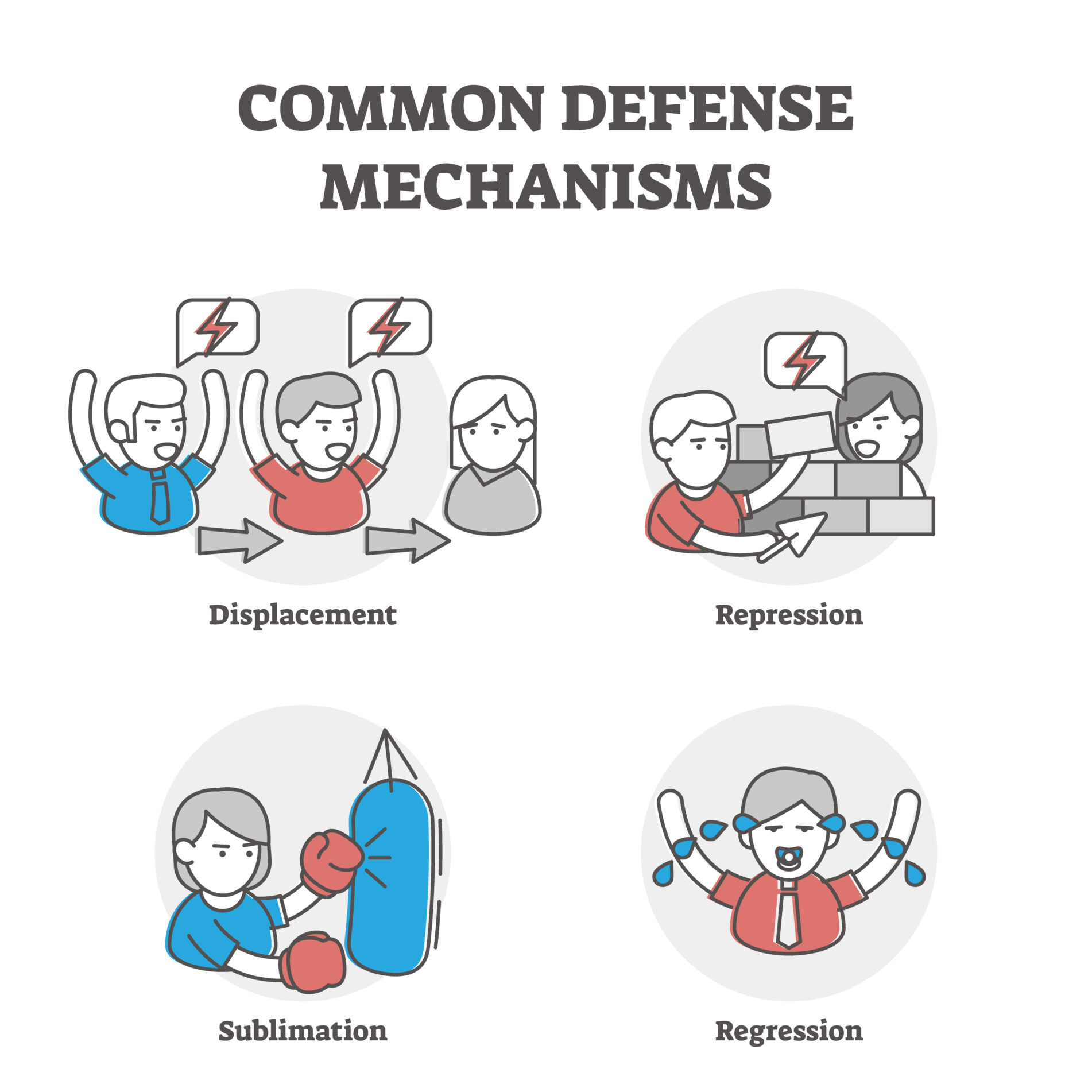
Defense mechanisms are unconscious psychological strategies used to protect the individual from anxiety arising from unacceptable thoughts or feelings.
According to Freudian theory, these mechanisms involve a distortion of reality, allowing the mind to better cope with internal conflict or external stressors.
Function and Development
While defense mechanisms are a natural and normal part of human psychology, they can become maladaptive if used excessively.
-
Healthy Use: They provide temporary relief, allowing the Ego (the mind’s rational, reality-oriented part of personality) to process information at a manageable pace.
-
Overuse: When used with high frequency or intensity, they can lead to the development of neuroses, such as chronic anxiety states, phobias, obsessions, or hysteria.
The same defense can help or harm depending on context. Occasional denial after a bereavement buys time to absorb the loss. Permanent denial of a treatable illness is dangerous.
Historical Origins
The concept was pioneered by Sigmund Freud (1894, 1896). He described “defence” as the ego’s turning away from an intolerable idea.
Freud used “defence” as the general name for these protective techniques. “Repression” was the one method his early work knew best.
His daughter, Anna Freud (1936), gathered her father’s scattered observations into a formal set in The Ego and the Mechanisms of Defence.
She counted nine familiar clinical methods. Then she added sublimation as a tenth. Sublimation channels an unacceptable impulse into a constructive, socially valued activity, and she saw it as the one defense of normal, not neurotic, life.
Anna Freud also proposed a developmental order. Defenses like regression are among the earliest the ego uses.
Repression and sublimation, by contrast, could not appear until relatively late in development. Since then, contemporary psychoanalysts have continued to refine and test these ideas.
Defense Mechanisms With Examples
This table summarizes the main defense mechanisms, with one everyday example of each. The sections below explain each one in turn.
| Defense mechanism | What it does | Example |
|---|---|---|
| Denial | Refuses to accept an unwelcome external reality | Ignoring clear signs of a partner’s infidelity |
| Repression | Pushes distressing thoughts or memories out of awareness | Panicking at a siren without remembering the crime that went with it |
| Projection | Attributes your own unacceptable feelings to someone else | “I hate you” becomes “You hate me” |
| Displacement | Redirects an impulse onto a safer, powerless substitute | Taking out frustration with the boss on the family dog |
| Sublimation | Channels an unacceptable impulse into a valued activity | Turning aggression into competitive sport |
| Regression | Reverts to behavior from an earlier stage under stress | A hospitalized child starts thumb-sucking again |
| Rationalization | Invents a logical cover story for unacceptable behavior | Calling a natural disaster “God’s will” |
| Reaction formation | Acts in the opposite way to the true feeling | Being conspicuously nice to someone you dislike |
| Introjection | Takes on another person’s characteristics | An abandoned child “becomes mum” and reassures her dolls |
| Identification with the aggressor | Adopts the traits of a feared, more powerful person | A frightened child impersonates the dentist |
| Isolation | Separates an idea from its feeling | Describing a trauma with no emotion at all |
| Undoing | Cancels an unacceptable act with a symbolic counter-act | A ritual that “puts right” an offensive impulse |
1. Denial
Denial is a defense mechanism in which a person refuses to accept reality. It blocks external events from awareness altogether.
When a situation feels like too much to handle, the person may simply refuse to perceive it, or deny that it exists at all.
This is a primitive and risky defense. No one can ignore reality forever and get away with it.
Denial rarely works alone. More often it operates alongside other, subtler mechanisms that prop it up. Even so, there is a limit to how much denial a person can use before it becomes obvious.
What is an example of denial?
- Relationship Infidelity: A spouse may ignore physical evidence, unexplained absences, or direct warnings about their partner’s unfaithfulness to avoid the pain of a broken marriage.
- Health Neglect: An individual might ignore a persistent, painful symptom (like a lump or chronic chest pain), refusing to see a doctor because acknowledging the symptom would mean acknowledging a potential illness.
- Intellectualization (High IQ): Instead of simply denying a painful fact, a highly intelligent person may use complex logic to explain it away. By turning an emotional crisis into a cold, abstract debate or a theoretical problem, they make their denial look like “rational thinking” to themselves and others.
2. Repression
Repression is a psychological defense mechanism where the mind pushes distressing thoughts, memories, or impulses out of conscious awareness.
Because these elements remain active in the unconscious mind, they continue to influence behavior and emotions even when the individual is unaware of their origin.
Anna Freud called repression “motivated forgetting”.
This process is driven by the Ego to protect the individual from overwhelming anxiety.
Repression typically targets thoughts that would trigger intense guilt from the Superego or those that stem from socially unacceptable desires within the Id.
Repression is rarely a successful long-term strategy.
Because the disturbing ideas are merely hidden rather than resolved, they remain psychically active, often manifesting as unexplained chronic anxiety or physical symptoms.
How repressed content surfaces
Since repressed material is never truly gone, it often bypasses the mind’s internal censors in altered, symbolic forms:
-
Dreams: Where “latent” (hidden) desires appear as “manifest” (visual) symbols.
-
Freudian Slips: Accidental slips of the tongue that reveal a hidden thought.
-
Phobias: An unexplained fear that may be a displaced version of a repressed trauma.
What is an example of repression?
Oedipus Complex: aggressive thoughts about the same-sex parent are repressed and pushed down into the unconscious.
Trauma: The mind “walls off” severe events, such as abuse, accidents, or disasters, to maintain daily functioning. Because the memory is blocked automatically rather than by choice, it remains entirely inaccessible to the conscious mind.
- The Event: A child witnesses a violent crime accompanied by the sound of sirens.
-
The Repression: The visual and narrative memory of the crime is pushed into the unconscious.
-
The Symptom: As an adult, the sound of a siren triggers a “fight or flight” response (panic, sweating, racing heart). The person feels the affect (the emotion) without the content (the memory).
Distinction Note: Repression vs. Denial
It is important to distinguish repression from denial.
- Denial involves refusing to accept the reality of external sensory data (e.g., refusing to believe a doctor’s diagnosis).
- Repression involves blocking inner states, such as thoughts, impulses, and memories.
- Suppression is the voluntary cousin of repression. A person consciously pushes an unwanted thought out of awareness, which makes it far easier to study in experiments.
3. Projection
Projection is a psychological defense mechanism in which a person attributes their own unwanted thoughts, feelings, and motives to someone else.
It protects self-esteem by externalizing an undesirable part of the self. The forbidden feeling stays real. It just belongs to someone else now.
Anna Freud also called this displacement outward. Displacement redirects an impulse onto a safer substitute, so projection is almost the mirror image of turning aggression against the self.
What is an example of projection?
Thoughts most commonly projected onto another are the ones that would cause guilt such as aggressive and sexual fantasies or thoughts.
For instance, you might hate someone, but your superego tells you that such hatred is unacceptable.
You can ‘solve’ the problem by believing that they hate you.
The subject and object are reversed. “I hate you” becomes “You hate me.” The unacceptable feeling is preserved, but it now belongs to its target, so the conflict dissolves.
4. Displacement
Displacement is the redirection of an impulse, usually aggression, onto a powerless substitute target.
The target can be a person, or an object, serving as a symbolic stand-in.
Displacement occurs when the id wants to do something the superego forbids.
The ego finds another way to release that energy. It lands on a safer, more acceptable object.
Turning against the self is one special form of displacement, in which the person becomes their own substitute target.
It usually involves hatred, anger, or aggression rather than positive feelings.
Freud used it to explain many feelings of inferiority, guilt, and depression.
Not everyone agrees on the mechanism.
But many people, Freudian or not, accept the underlying idea: depression is often anger turned inward and left unacknowledged.
What is an example of displacement?
Someone who feels uncomfortable with their sexual desire for a real person may substitute a fetish.
Someone who is frustrated by his or her superiors may go home and kick the dog, beat up a family member, or engage in cross-burnings.
This is the familiar “kicking-the-cat” pattern. Aggression cascades down a hierarchy of ever-safer targets until it lands on someone powerless.
5. Regression
Regression is a defense mechanism whereby the ego reverts to an earlier stage of development, usually in response to stressful situations.
Regression functions as a form of retreat, enabling a person to psychologically go back in time to a period when the person felt safer.
What is an example of regression?
When we are troubled or frightened, our behaviors often become more childish or primitive.
A child may begin to suck their thumb again or wet the bed when they need to spend some time in the hospital.
Teenagers may giggle uncontrollably when introduced into a social situation involving the opposite sex.
Adults under strain regress too. They may lose their temper, comfort-eat, or sleep more.
6. Sublimation
Sublimation is similar to displacement, but takes place when we manage to displace our unacceptable emotions into behaviors which are constructive and socially acceptable, rather than destructive activities.
Freud described sublimation as sexual energy diverted into higher achievement. Freud (1910) wrote that in Leonardo da Vinci the libido “evades the fate of repression” by being sublimated into curiosity and the instinct for research.
Anna Freud (1936) later placed sublimation apart from the neurotic defenses. For her, it was the healthiest defense of all.
For Freud, sublimation was the cornerstone of civilized life: arts and science, he argued, are all sublimated sexuality. This is a value-laden idea, rooted in the aspirations of European society at the end of the 1800s.
What is an example of sublimation?
- Art, music, and sport: Many great artists and musicians led unhappy lives. They channeled that pain into art or music instead. Sport works the same way, turning aggression into something constructive.
- Oral stage: Fixation at the oral stage may later surface as oral pleasure-seeking, such as thumb-sucking, chewing a pen, or smoking.
- Anal stage: Fixation at the anal stage may surface instead as an adult enjoyment of pottery.
7. Rationalization
Rationalization is a defense mechanism that distorts “the facts” to make an event or an impulse feel less threatening.
Ordinary excuse-making shades into it. We all do this consciously sometimes.
But for people with sensitive egos, making excuses comes so easily that they never notice they are doing it. They are quite prepared to believe their own lies.
What is an example of rationalization?
When a person finds a situation difficult to accept, they will make up a logical reason why it has happened.
For example, a person may explain a natural disaster as “God’s will”.
Other common cover stories include “being cruel to be kind” and “I only did it because I love you.” The real motive stays hidden. Even the person offering the excuse may not see it.
8. Reaction Formation
Reaction formation, which Anna Freud called “believing the opposite,” is a psychological defense mechanism. A person goes beyond denial and behaves in the opposite way to how they actually think or feel.
Conscious behavior overcompensates for the anxiety of an unacceptable unconscious thought or feeling. The tell is its exaggerated, showy, or compulsive quality.
By using it, the id is satisfied while the ego stays ignorant of the true motive. Therapists often see this in patients who insist strongly on a belief and grow angry at anyone who disagrees.
What is an example of reaction formation?
- Prejudice: Freud claimed that some men who are prejudiced against homosexuals are defending against their own homosexual feelings. A harsh anti-homosexual attitude helps convince them of their own heterosexuality.
- The “dutiful daughter”: She lavishes love on her mother, but may really be reacting against an unconscious Oedipal hostility toward her.
- Everyday niceness: Going out of your way to be nice to someone you actually dislike is the ordinary form.
9. Introjection
Introjection, sometimes called identification, involves taking into your own personality characteristics of someone else, because doing so solves some emotional difficulty.
Introjection is very important to Freudian theory as the mechanism by which we develop our superegos.
What is an example of introjection?
- Becoming “mom”: A child left alone frequently may try to become “mom” to lessen his or her fears. You can sometimes catch them telling their dolls or animals not to be afraid.
- Imitating idols: The older child or teenager imitates a favorite star, musician, or sports hero in an effort to establish an identity.
Both examples show introjection solving an emotional difficulty.
10. Identification with the Aggressor
Identification with the aggressor is a defense mechanism.
Sándor Ferenczi (1933) proposed it. Anna Freud (1936) developed it further.
It involves the victim adopting the behavior of a person who is more powerful and hostile towards them.
By identifying with the aggressor, the victim shifts from a passive, frightened role into an active one. Becoming like the feared figure partly disarms the threat; it does not, as such, make the aggressor feel empathy.
What is an example of identification with the aggressor?
Identification with the aggressor is a version of introjection focused on adopting a negative or feared trait, not a general or positive one.
Becoming more like a feared person is one way to partly conquer the fear of them.
In its most extreme form this appears as Stockholm Syndrome, where hostages bond emotionally with their captors and adopt their behavior.
The much-cited case is Patty Hearst. Abused by her captors, she joined their Symbionese Liberation Army and took part in a bank robbery. She was later acquitted, on the grounds that she was suffering from Stockholm Syndrome.
Anna Freud’s Catalogue of Defenses
Anna Freud (1936) gathered the defenses her father had described piecemeal and stated them as a set. Her original text clarifies what the list contains. It also adds several mechanisms the sections above do not cover.
The Nine Methods and a Tenth
She was completing “the enumeration of the ego’s defensive methods as described in Freud’s other writings.” The methods were her father’s. The cataloguing was hers.
She counted nine methods of defense “very familiar in the practice” of analysis: regression, repression, reaction formation, isolation, undoing, projection, introjection, turning against the self, and reversal.
To these she added a tenth, which “pertains rather to the study of the normal than to that of neurosis”: sublimation, or displacement of instinctual aims. That placement is the root of the claim that sublimation is the healthiest defense.
She also demoted repression. It became “a special method of defence” rather than the single master mechanism, one of several serving the same purpose: protecting the ego against instinctual demands.
Isolation and Undoing
Two of the nine methods are prominent in obsessional neurosis, a pattern of intrusive thoughts and compulsive rituals. Neither has a section above.
- Isolation (of affect): Separating a thought from its feeling, sealing contradictory contents into “logic-tight” compartments. A trauma may be recounted with no emotion at all.
- Undoing: Symbolically cancelling an unacceptable thought or deed with a counter-act. Many compulsive rituals “put right” an offensive impulse this way.
Together with regression and reaction formation, isolation and undoing are the defenses characteristic of obsessional neurosis (Freud, 1936).
Developmental Order and Additions
Developmental Order of Defenses
Anna Freud also ordered defenses by development. Sublimation “presupposes the existence of the superego,” so repression and sublimation “could not be employed until relatively late” in development.
Regression, reversal, and turning round upon the self were different. They are “as old as the instincts themselves,” she argued, and among the very earliest defenses the ego uses.
She admitted this chronology remained “one of the most obscure fields of analytic theory.” The principle still shaped later maturity hierarchies, including Vaillant’s.
Anna Freud’s Own Additions
Her most original contribution concerns identification with the aggressor. She read it developmentally. It is “a by no means uncommon stage in the normal development of the superego.” By internalizing other people’s criticisms, the child supplies “material from which the superego may take shape.”
Her clinical illustration is a small boy who was frightened at the dentist. Afterwards, at play, he sharpened and snapped pencils indefatigably. He was identifying, she wrote, “not with the person of the aggressor but with his aggression.”
She also added defenses of her own, shifting the list toward normal development.
- Altruistic surrender: The person renounces their own instinctual wish but lives it out through someone better qualified to fulfil it.
- Asceticism: An adolescent defense, a “flat prohibition of instinct,” that guards against the pubertal upsurge of drives by renouncing gratification wholesale.
- Intellectualization: Mastering instinctual processes by connecting them to ideas the mind can handle consciously. She counted it one of the ego’s most necessary acquirements.
Together with identification with the aggressor, these are the additions most often credited to Anna Freud rather than to Sigmund Freud.
How Do Defense Mechanisms Work?
Defense mechanisms function as unconscious psychological strategies employed by the ego to manage anxiety and maintain self-image. They operate by distorting reality to prevent threatening thoughts, impulses, or memories from entering conscious awareness.
Id, Ego, and Superego
To understand how defense mechanisms work, one must look at the structural model of personality proposed by Sigmund Freud.
Personality is viewed as a conflict between three interacting systems:
- The Id: The unconscious, primitive part of the personality that contains instinctual drives for hunger, sex, and aggression. It operates on the “pleasure principle,” seeking immediate gratification.
- The Superego: The internal moral compass or conscience, developed through social interactions, which judges behavior and strives for perfection.
- The Ego: The rational part of the personality that operates on the “reality principle.” Its job is to balance the impulsive demands of the id with the moralistic constraints of the superego within the context of the real world.
How Conflict Triggers Defenses
When the ego cannot reconcile the opposing demands of the id and the superego, anxiety results.
Freud (1933) distinguished three kinds of anxiety by the source of the danger:
- Realistic anxiety: A response to a genuine threat in the outside world.
- Neurotic anxiety: Fear of being overwhelmed by one’s own instinctual demands, where the danger is internal and not consciously recognized.
- Moral anxiety: Dread of the superego or conscience, a fear Freud saw as indispensable in social relations.
For Anna Freud, it is this superego-generated anxiety that calls the ego’s defenses into play.
To protect itself, the ego resorts to defense mechanisms. These distort reality so a person can keep functioning day to day, without unpleasant feelings or traumatic memories taking over conscious awareness.
Everyone uses these mechanisms to some extent. Overuse, though, can become problematic and lead to neuroses or other psychological disorders.
How does the ego decide which defense mechanism to use?
We don’t consciously pick a defense mechanism; our brain selects one based on our age, the situation, and our history.
Here is how that selection process works:
1. The “Maturity” Level
The psychiatrist George Vaillant (1977) ranked defenses into this kind of hierarchy after following men in the Harvard Grant Study across decades.
He found that defense maturity predicts psychological and physical health better than social class or childhood circumstances. As we grow and learn, we typically move from primitive reactions toward mature strategies.
| Type | How it works | Real-world Example |
| Immature | Reflex-like reactions often seen in children or people under extreme stress. | Denial: Ignoring a doctor’s diagnosis because it’s too scary to face. |
| Neurotic | Shifting or “tricking” your emotions to make them more tolerable. | Displacement: Snapping at your spouse because you had a bad day at work. |
| Mature | Productive, healthy ways to handle stress without ignoring reality. | Sublimation: Going for a long run to burn off anger instead of starting an argument. |
Vaillant’s full scheme has four levels. They run from the most pathological to the most adaptive.
- Psychotic defenses: Radically alter reality, such as delusional projection or denial of external reality. Others experience them as “crazy.”
- Immature defenses: Projection, acting out, regression, fantasy, and passive aggression. They ease interpersonal threat but tend to distress those nearby.
- Neurotic defenses: Repression, displacement, reaction formation, intellectualization, and rationalization. Others see them as quirks or hang-ups.
- Mature defenses: Sublimation, humor, altruism, anticipation, and suppression. Others tend to experience them as virtues.
Vaillant also found that people can mature in their defenses over the life course, shifting from immature toward mature styles.
2. The Type of Threat (How You See the Problem)
The way you “size up” a threat changes how you react to it.
-
Internal Threats: Your self-esteem might feel hurt. You might lash out at others through projection, to protect your ego.
-
External Threats: A crisis, like a natural disaster, changes things. You are likely to seek help and use communal coping.
-
Control: If you feel helpless, you might use emotion-focused defenses like denial. If you feel you can fix the problem, you are more likely to use active, problem-solving strategies.
3. Habits and Past Learning
Like any other skill, your mind “learns” what works.
-
Reinforcement: If you successfully avoided a scary situation as a child by pretending it wasn’t happening, your brain remembers that “win.”
-
Habitual Patterns: Over time, these successful escapes become your “default settings.” You develop a signature “coping style” that triggers automatically when things get tough.
Critical Evaluation
Defense mechanism theory has generated real scientific debate. Critics question whether the idea can be tested at all. A large body of research has tried to test it anyway.
Strengths and Limitations
Strengths
- Explanatory reach: One economical account covers phobias, self-sabotage, prejudice, denial at diagnosis, and obsessional rituals as solutions to a single problem: anxiety.
- Research tradition: Modern work has partly confirmed several defenses (Baumeister et al., 1998), tracked their development (Cramer, 1987), and built clinical measures (Di Giuseppe & Perry, 2021).
- Clinical legacy: The concept underpins psychodynamic technique, Vaillant’s (1977) hierarchy, and the Defense Mechanisms Rating Scales still used today.
- Neuroscientific hints: Anosognosia cases and suppression neuroimaging give indirect support to repression (Ramachandran, 2011; Wickelgren, 2012).
Limitations
- Unfalsifiability: Defenses are unconscious and can produce an outcome or its opposite, so core claims resist decisive test.
- Measurement difficulty: Telling a true defense from ordinary coping, self-presentation, or reporting bias is intrinsically hard.
- Weak clinical evidence: Much of the classic theory rests on case interpretation, and several defenses fare poorly when tested (Baumeister et al., 1998).
- Cultural and gender bias: The maturity hierarchy and gendered accounts of identification encode Western, individualist, period-bound assumptions.
The Falsifiability Problem
The classic objection is that defense mechanisms are unfalsifiable. On the philosopher Karl Popper’s criterion, a claim that can never be proven wrong is not scientific.
Reaction formation is the textbook example. A person’s behavior can go either way. A psychoanalyst can then argue the unconscious wish showed itself directly, or that it came out as its opposite. No single observation can settle the question.
The deeper problem is definitional. Because defenses are unconscious by definition, no one can observe one operating directly. Telling a genuine defense from ordinary coping is hard.
Still, treating reaction formation as typical of the whole theory is a mistake. Psychoanalysis is better read as a collection of separate hypotheses that vary in testability.
Early Experimental Evidence
Contrary to the “untestable” verdict, defense mechanisms generated a large experimental literature well before the 2000s.
Baumeister, Dale and Sommer (1998) re-examined seven Freudian defenses against modern social-psychology findings. The seven were reaction formation, projection, displacement, undoing, isolation, sublimation, and denial.
Several held up in modified form. Reaction formation, projection, isolation, and denial fared best. Others fit the evidence poorly.
Projection received particular attention. Holmes (1978) reviewed the older evidence skeptically.
Newman, Duff and Baumeister (1997) later offered a cognitive alternative. Suppressing an unwanted trait, they showed, makes that trait chronically accessible in the mind. A person then over-perceives that same trait in others.
This gave “defensive projection” a testable, laboratory-supported explanation.
Paulhus, Fridhandler and Hayes (1997) reviewed this earlier theory-and-research field more broadly.
Neuroscience and Repression
Repression carries special weight in this debate. As Kline (1989) put it, “if no evidence could be found for repression, this would alter considerably the nature of psychoanalysis.” That is a high bar. Supporting evidence here matters more than it would for a peripheral claim.
Case studies of anosognosia, a denial of paralysis following right-hemisphere brain damage, offer indirect support. Ramachandran (2011) described a paralyzed patient who briefly acknowledged her paralysis after vestibular stimulation.
The effect was brief. Once it wore off, she reverted to believing her arm was normal. She also forgot admitting, minutes earlier, that it was paralyzed at all. The episode reads like repression compressed into a single afternoon.
Neuroimaging work on deliberate memory suppression (consciously pushing an unwanted memory out of mind) tells a similar story. It appears to be a real, measurable brain process, not merely a psychoanalytic myth (Wickelgren, 2012; Berlin & Koch, 2009).
Alternative Accounts
Two rival accounts explain the same behavior differently. Both challenge how defenses are identified and tested.
- Cognitive distortions: Beck (1976) replaced the unconscious defense with conscious, correctable thinking errors such as overgeneralization.
- Empirical hierarchy: Vaillant (1977) ranked defenses from decades of cohort data, not from clinical interpretation of unconscious material.
Beck’s cognitive theory rejects the idea of an unconscious ego warding off anxiety. Biased processing is instead a conscious habit. It shows up as selective abstraction, arbitrary inference, dichotomous thinking, and overgeneralization (see cognitive distortions in CBT).
On this account, “denial” is really the minimizing of unwelcome evidence, and “rationalization” is a specific reasoning error. These are testable, consciously reportable habits that can be changed directly. That is the falsifiability advantage the psychodynamic account lacks.
The interventions differ too. CBT identifies and challenges the distortion. Psychodynamic technique slowly uncovers unconscious material.
Vaillant’s account differs in method rather than content. Freud and Anna Freud built their catalogue from clinical case observation.
Vaillant derived four levels from the Harvard Grant Study and treated maturity as a measurable, outcome-predicting dimension. The two accounts broadly agree on which defenses exist. They differ on how a defense’s adaptive status is established.
Contemporary Research
Two strands of recent work update, rather than overturn, the classical picture. One tests whether defenses can be measured and follow the developmental sequence Anna Freud predicted. The other tests whether defensive maturity tracks real symptoms.
Do Defenses Develop in Sequence?
Cramer’s (2015) forty-year research program tested Anna Freud’s untested claim. Cramer built a coding manual that scores projective story-telling tests for three defenses of rising cognitive complexity: denial, projection, and identification.
- Cramer (1987): Four age groups, preschool to late adolescence. Denial fell after preschool, projection peaked in the middle groups, and identification rose through adolescence.
- Porcerelli et al. (1998): An independent replication in a different part of the United States found the same pattern.
- Cramer (1997): Children followed from age 6½ to 9½ showed the same trend. Denial declined, projection rose sharply, and identification increased.
Together, these studies gave Anna Freud’s developmental ordering its first sustained empirical confirmation.
Do Defenses Respond to Stress?
Further studies tested whether defense use behaves as the theory predicts.
- Cramer and Gaul (1988): Children given a rigged failure on a laboratory task told stories with more denial and projection than children given a rigged success.
- Dollinger and Cramer (1990): After boys saw a teammate killed by lightning, higher defense scores predicted lower, not higher, clinician-rated distress in the following weeks.
- Blatt and Ford (1994): Hospitalized psychotic patients relied less on the immature defense of denial over 15 months of treatment, most of all those rated most improved.
Can the Hierarchy Be Measured?
Di Giuseppe and Perry (2021) turned the clinician-rated Defense Mechanisms Rating Scales into a Q-sort version, the DMRS-Q. It reliably ranks a person’s defenses along the immature-to-mature continuum.
Vaillant first proposed that continuum on clinical grounds alone. Nearly half a century later, it has a quantitative, validated measure.
Do Mature Defenses Predict Fewer Symptoms?
The strongest recent test comes from a large network-analysis study during the first COVID-19 lockdown.
- Aim: Di Giuseppe et al. (2024) modeled defense mechanisms as an interconnected system, rather than a simple ranked list, to find which individual defenses matter most clinically.
- Method: 655 Italian adults with high depression and anxiety symptoms completed a 30-item self-report measure of 16 defenses and standard symptom scales during the first COVID-19 lockdown. The defenses were analyzed as a network, not as independent scores.
- Results: The 16 defenses formed one interconnected network, with the mature defense self-assertion as its most central node. Mature defenses like humor and sublimation correlated with fewer symptoms; immature defenses correlated with more.
- Conclusion: This is the first demonstration that defensive functioning behaves as an interconnected system, the authors argue. Targeting central defenses like self-assertion may work better than treating each mechanism alone.
It is a single large survey, not a randomized trial. It was also gathered under the unusual conditions of a pandemic lockdown. So it confirms Vaillant’s original claim; it does not prove it.
Cultural and Gender Bias
The maturity hierarchy carries cultural assumptions. What counts as a “mature” defense, such as individual sublimation or self-reliant humor, reflects Western, individualist values.
Behavior read as immature in one culture may be normal and adaptive in another.
Early psychoanalytic accounts also tied specific defenses to gender. Identification with the aggressor was linked to boys resolving the Oedipus complex; a parallel process, anaclitic identification, was linked to girls and the Electra complex.
Later work has treated these gendered claims with considerable caution.
Modern measurement research has begun testing whether defense profiles, and their links to health, hold up across cultures and genders. So far, the cross-cultural evidence base remains thinner than the evidence for the underlying idea that everyone uses defenses.
Defense Mechanisms in Therapy and Daily Life
Defense mechanisms matter outside the textbook. They shape how therapy works, how people react to health warnings, and how modern psychology thinks about coping.
Defenses in Psychodynamic Therapy
In psychodynamic therapy, the goal is to make the unconscious conscious.
The therapist helps bring repressed material, and the habitual defenses that protect it, into awareness. The ego can then face the underlying conflict directly. It no longer needs distortion.
As Anna Freud (1936) explains, once the analyst has accomplished a piece of ego analysis, the task is “to undo what has been done by the defence.” That means restoring what repression omitted, rectifying displacements, and returning isolated material to its true context.
Defenses also reappear inside therapy itself as resistance, the patient’s obstacles to free association. The analyst interprets these alongside transference. The work is slow, because defenses are unconscious and run against the patient’s own protective machinery.
Defenses Beyond the Clinic
Defenses are not confined to therapy. People often minimize, counter-argue, or dismiss a personally relevant health warning precisely because it is threatening.
- Liberman and Chaiken (1992): After reading the same threatening message, people for whom the threat was relevant were less likely to believe it. They processed its threatening parts in a biased way.
- Witte (1992): A fear appeal that convinces people a threat is real but leaves them unable to act triggers defensive avoidance. A doable response tends to avoid it.
Together, these findings help explain why frightening public-health campaigns can backfire, why people rationalize risky behavior, and why denial is common at the point of diagnosis.
Defense mechanisms are also the historical ancestor of the modern psychology of coping. Later frameworks recast the largely unconscious defenses as more conscious, situation-specific coping strategies. They distinguish problem-focused from emotion-focused coping.
The two differ in degree. Defenses are involuntary and distort reality. Coping is relatively voluntary and reality-oriented. Where exactly the line falls remains contested, and some theorists treat them as ends of a single continuum.
Appraisal theory adds a cognitive account. It locates the trigger in a person’s evaluation of an event as threatening and of their own resources to meet it.
Key Takeaways
- Unconscious Protection: Defense mechanisms are unconscious strategies the ego uses to protect itself from anxiety, distorting reality to make a threat feel more bearable.
- Short-Term Coping: Used briefly, defenses are a normal part of coping. Relying on them permanently is linked to neuroses such as chronic anxiety or phobias.
- Ten Methods: Anna Freud (1936) systematized her father’s scattered observations into nine core methods, plus sublimation as a tenth and healthiest defense.
- Maturity Hierarchy: Vaillant (1977) ranked defenses from psychotic and immature through neurotic to mature, and found mature defenses like sublimation predict better long-term health.
- Modern Evidence: A 2024 network-analysis study linked mature defenses like humor and sublimation to lower depression and anxiety, updating rather than overturning the classic hierarchy.
- Testability Debate: Critics argue the theory is hard to test because defenses work unconsciously, though some, like projection, have found support in modern experiments.
References
Baumeister, R. F., Dale, K., & Sommer, K. L. (1998). Freudian defense mechanisms and empirical findings in modern social psychology: Reaction formation, projection, displacement, undoing, isolation, sublimation, and denial. Journal of Personality, 66(6), 1081-1124.
Beck, A. T. (1976). Cognitive therapy and the emotional disorders. International Universities Press.
Berlin, H. A., & Koch, C. (2009). Neuroscience meets psychoanalysis. Scientific American Mind, 20(2), 16-19.
Blatt, S. J., & Ford, R. Q. (1994). Therapeutic change: An object relations perspective. Plenum.
Cramer, P. (1987). The development of defense mechanisms. Journal of Personality, 55(4), 597-614.
Cramer, P. (1997). Evidence for change in children’s use of defense mechanisms. Journal of Personality, 65(2), 233-247.
Cramer, P. (2015). Defense mechanisms: 40 years of empirical research. Journal of Personality Assessment, 97(2), 114-122.
Cramer, P., & Gaul, R. (1988). The effects of success and failure on children’s use of defense mechanisms. Journal of Personality, 56(4), 729-742.
Di Giuseppe, M., Lo Buglio, G., Cerasti, E., Boldrini, T., Conversano, C., Lingiardi, V., & Tanzilli, A. (2024). Defense mechanisms in individuals with depressive and anxiety symptoms: A network analysis. Frontiers in Psychology, 15, 1465164. https://doi.org/10.3389/fpsyg.2024.1465164
Di Giuseppe, M., & Perry, J. C. (2021). The hierarchy of defense mechanisms: Assessing defensive functioning with the defense mechanisms rating scales Q-sort. Frontiers in psychology, 12, 718440.
Dollinger, S. J., & Cramer, P. (1990). Children’s defensive responses and emotional upset following a disaster: A projective assessment. Journal of Personality Assessment, 54(1-2), 116-127.
Ferenczi, S. (1933). Confusion of tongues between adults and the child (pp. 156-67).
Freud, A. (1937). The ego and the mechanisms of defence (C. Baines, Trans.). Hogarth Press. (Original work published 1936)
Freud, S. (1894). The neuro-psychoses of defence. In The standard edition of the complete psychological works of Sigmund Freud (Vol. 3, pp. 41-61). Hogarth Press.
Freud, S. (1896). Further remarks on the neuro-psychoses of defence. In The standard edition of the complete psychological works of Sigmund Freud (Vol. 3, pp. 157-185). Hogarth Press.
Freud, S. (1910). Leonardo da Vinci and a memory of his childhood. In J. Strachey (Ed. & Trans.), The standard edition of the complete psychological works of Sigmund Freud (Vol. 11, pp. 57-137). Hogarth Press.
Freud, S. (1933). New introductory lectures on psycho-analysis. Hogarth Press.
Freud, S. (1936). Inhibitions, symptoms and anxiety. The Psychoanalytic Quarterly, 5(1), 1-28.
Holmes, D. S. (1978). Projection as a defense mechanism. Psychological Bulletin, 85(4), 677.
Kline, P. (1989). Objective tests of Freud’s theories. In A. M. Colman & J. G. Beaumont (Eds.), Psychology survey 7. British Psychological Society / Routledge.
Liberman, A., & Chaiken, S. (1992). Defensive processing of personally relevant health messages. Personality and Social Psychology Bulletin, 18(6), 669-679.
Newman, L. S., Duff, K. J., & Baumeister, R. F. (1997). A new look at defensive projection: Thought suppression, accessibility, and biased person perception. Journal of personality and social psychology, 72(5), 980.
Paulhus, D. L., Fridhandler, B., & Hayes, S. (1997). Psychological defense: Contemporary theory and research. In R. Hogan, J. A. Johnson, & S. R. Briggs (Eds.), Handbook of personality psychology (pp. 543-579). http://dx.doi.org/10.1016/B978-012134645-4/50023-8
Porcerelli, J. H., Thomas, S., Hibbard, S., & Cogan, R. (1998). Defense mechanisms development in children, adolescents, and late adolescents. Journal of Personality Assessment, 71(3), 411-420. https://doi.org/10.1207/s15327752jpa7103_9
Ramachandran, V. S. (2011). The tell-tale brain: A neuroscientist’s quest for what makes us human. W. W. Norton.
Vaillant, G. E. (1977). Adaptation to life. Little, Brown.
Wickelgren, I. (2012). Trying to forget. Scientific American Mind, 22(6), 32-39.
Witte, K. (1992). Putting the fear back into fear appeals: The extended parallel process model. Communication Monographs, 59(4), 329-349. https://doi.org/10.1080/03637759209376276
Further Reading
- Name the Defense Mechanism Activity
- BPS Article on Repression
- Cramer, P. (2015). Understanding defense mechanisms. Psychodynamic Psychiatry, 43(4), 523-552.
- Freudian Defense Mechanisms and Empirical Findings in Modern Social Psychology: Reaction Formation, Projection, Displacement, Undoing, Isolation, Sublimation, and Denial
- Defense Mechanisms Summary Table
- Suppression
- Repression vs. Suppression