The Braun et al. (2002) tested whether an advertisement can change what people think happened to them as children. Students who read an advertisement about meeting a Disney character became more sure that they had really met one. It supports the idea that memory is rebuilt and can be changed by suggestion.
Key Takeaways
Aim
- To find out whether an advertisement about a childhood event makes people more sure that it happened to them, even an event that could not have happened.
Method
- This was an experiment. Different people did each condition (independent measures). There were two experiments, with different American undergraduates, who are university students.
- Experiment 1 had 107 undergraduates and Experiment 2 had 167. Each person saw one advert, such as a Disney advert or a control advert, which is a comparison advert not about Disney.
- In week 1 people rated how likely 20 childhood events were. In week 2 they read the advert, imagined it, and rated the events again.
- The independent variable was the advert seen. The dependent variable was the change in how sure people were that the target event, the event the advert suggested, happened.
Results
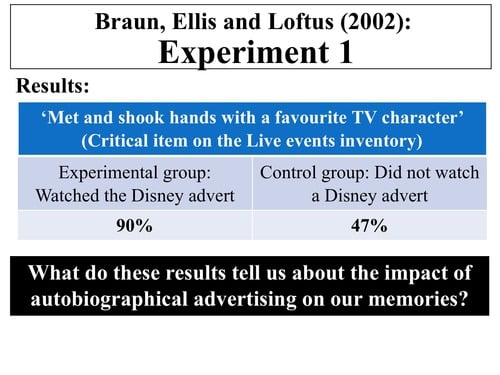
- In Experiment 1, 90% of the Disney group became more sure they had shaken hands with a TV character, against 47% of the control group. These are percentages of those not already sure at week 1.
- In Experiment 1, 65% of those who saw the Disney advert mentioned memories of Disney World.
- In Experiment 2 the advert named Bugs Bunny, who could not have been at the park. 16% of that group said they remembered shaking his hand, against 7% of the others.
Conclusion
- Adverts that include impossible events can make people believe those events happened to them. The authors added that there is no direct evidence Disney’s own campaign changed anyone’s memories.
- This supports the Theory of Reconstructive Memory: memory is rebuilt, and suggestion can add false details.
Strengths
- High control: a distraction task between the advert and the test can reduce demand characteristics (clues that tell people what the study is about).
- Standardised procedure: everyone did the same tasks and ratings, so the study is easy to repeat and reliable (gives consistent results).
- Independent measures: each person did one condition only, so there are no order effects (changes caused by doing one condition after another).
Limitations
- Individual differences: different people were in each condition, and natural differences in memory could change the results.
- Age and cultural bias: all the people were American undergraduates, so the findings may not apply to other people or countries.
- Ecological validity (how true to real life a study is): reading an advert on paper and writing about it is not like seeing an advert in real life.
Ethical Issues
- Deception: people were not told the real aim, and a pretend coding problem was used. A way of dealing with it: debrief them afterwards.
- Informed consent: students may not have been told it was a memory study. A way of dealing with it: tell them the full aim as soon as the study ends.
- Protection from psychological harm: the risk was low, but a false belief could stay. A way of dealing with it: debrief everyone.
- The paper does not say how any of this was handled.
Exam Use
- In the exam you get marks for the experimental method, independent measures design, the sample (107 and 167, American undergraduates) and the advert seen as the independent variable.
- In the exam, strengths and weaknesses of the method need a detail from the study. “Adverts” alone earns nothing.
- The long answer worth 13 marks asks you to pair it with a study from a different topic.
Background
Advertisers sometimes use ads that refer to your own past, to make you feel nostalgic about a product. This is called autobiographical advertising. A Disney campaign called “Remember the Magic” showed people meeting Mickey Mouse and riding rides.
The study builds on two ideas. The first is reconstructive memory. Memory is not like a video recording. It is rebuilt each time from what a person already knows, so it can change.
The second is imagination inflation. Earlier studies had found that imagining a childhood event makes people more confident that it really happened. The researchers thought an advert could work in the same way. It gives people images to imagine.
Researchers call a belief in something that did not happen a false memory. The idea that an advert could cause one had hardly been tested.
Aim
The researchers asked a question. Could an advert like this change what people remember about their own childhood?
The aim of the study was to see whether an advertisement about a childhood event can make people more sure that it happened to them. This included an event that could not have happened.
In Experiment 1, one group saw a Disney advert. Another group saw a control advert, a comparison advert that was not about Disney.
A hypothesis for the study is a prediction. People who see the Disney advert will rate it as more likely that they shook hands with a character as a child. They will rate it higher than people who see the control advert.
Method
Design and Variables
Braun, Ellis and Loftus (2002) ran two experiments. The research method was the experimental method: the researchers changed one thing and measured its effect.
The design was independent measures. This means different people took part in each condition. Each person saw one advertisement only. In Experiment 1, people were randomly assigned, which means put into a group by chance, to the Disney advert or the control advert. The two experiments used different people.
Everybody rated the events in both weeks. That was the measuring, not a second condition. Each person still saw only one advert, so this is independent measures.
The independent variable was the advertisement the person saw.
- In Experiment 1 it was a Disney advert or a control advert that was not about Disney.
- In Experiment 2 it was one of three adverts: a Bugs Bunny advert, an Ariel advert or an ordinary Disney advert.
The dependent variable was the change in how sure people were that the target event had happened to them as a child. The target event was the event the advert suggested. In Experiment 2 the researchers also asked who said they remembered shaking hands with the characters.
Comparing with the control advert shows what the autobiographical advert added.
Sample
In Experiment 1 there were 107 undergraduates, who are university students, from a university in the American Midwest. 64 were female and 43 were male. The paper gives 46 who saw the Disney advert and 51 who saw the control advert.
In Experiment 2 there were 167 psychology undergraduates from a different university in the west of the United States. 104 were female and 63 were male.
The two experiments used different people. Students took part for course credit.
The sample features to learn are the size, the ages (students), the sexes and the place (America).
Materials
- The life events inventory: a list of 20 childhood events. People rated how likely each had been before the age of 10, from “definitely did not happen” to “definitely did happen”.
- The target item: one event on the list was meeting and shaking hands with a favourite TV character at a theme resort. This was the target event.
- The Disney advert: a printed advert that began “Remember the Magic”. It described a day in the park from a child’s point of view, and ended with shaking hands with Mickey Mouse.
- The control advert: an advert that was not about Disney.
- Experiment 2 adverts: an advert about meeting Bugs Bunny, one about meeting Ariel, and a Disney advert that was not about the person’s own past.
Procedure
- In week 1 people rated the 20 childhood events on the life events inventory. This was done among several other tasks.
- In week 2 each person was given one advert. They were asked to imagine themselves in it. They had 5 minutes to write down how it made them feel.
- They rated the advert, and then did a 5-minute distraction task. This is a filler task to take their mind off the advert.
- A researcher then came in and appeared panicked. They said there had been a problem coding the first answers, and asked people to fill out the life events inventory again. The problem was pretend.
- People then did a second distraction task and filled out a questionnaire about their memories of Disney.
- Finally they were asked what they thought the study was about, and whether the advert had changed their memories.
Experiment 2 followed the same basic procedure.
The measure was how sure people were, not what they could recall. A rise in confidence could mean an old true memory had come back. In Experiment 1 the researchers could not tell if it was a true memory or a false one.
Results
Experiment 1
Of the 46 people who saw the Disney advert, 30 mentioned memories of Disney World. That is 65%. A total of 34, which is 74%, said the advert made them imagine the experience.
The main result is about people who were not already sure at week 1 that they had shaken hands. Of these people, 90% in the Disney group became more sure that they had shaken hands with a TV character. In the control group, 47% became more sure.
The gap between the two groups was too big to be just luck. The Disney advert had an effect.
No one correctly guessed that the aim was to change childhood memories. Most said the advert had little or no effect on their memories.
Experiment 2
In Experiment 2 there were three adverts: one about Bugs Bunny, one about Ariel and an ordinary Disney advert.
Bugs Bunny is a Warner Brothers character, so he could not have been at a Disney park. Ariel is a Disney character who had not yet been introduced in the students’ childhood.
Neither character could have been at the park. So a student who said they remembered shaking hands with Bugs or Ariel could not be remembering a real event.
- Became more sure about shaking hands with a cartoon character in a theme park: Bugs advert 78%, Ariel advert 76%, ordinary Disney advert 62%.
- Remembered shaking hands with Bugs Bunny: 16% of the Bugs group, against 7% of each other group.
- Remembered shaking hands with Ariel: 7% of the Ariel group.
The first list item shows that every group became more sure. The rise was bigger after the two adverts about the student’s own past.
Some students in every group claimed to remember shaking hands with Bugs, even with no Bugs advert. So 7% is the starting level. The Bugs advert raised it to 16%.
The Bugs advert worked better. The authors suggested that this was because Bugs is better known and so easier to imagine. One student wrote that they were confused about why Bugs was in a Disney advert.
Conclusion
The study shows that including impossible events in autobiographical advertising can cause people to believe they have experienced them.
This supports the Theory of Reconstructive Memory. Memory is rebuilt, not replayed. So suggestion, such as an advert, can add false details to a memory.
The authors added a caution. There was no direct evidence that Disney’s own campaign changed anyone’s memories. They said it was at least possible.
They also said people did not know they had been influenced. Most said the advert had little or no effect on their memories.
OCR’s theory also covers leading questions, which can change memories through suggestion. The Loftus and Palmer car-crash study is the usual example.
Strengths
- High control: Everyone did the same tasks, with distraction tasks before the test. In the exam you get marks for saying this can reduce demand characteristics, which raises validity (how true results are).
- Standardised procedure: Everyone did the same questionnaires and saw a Disney or non-Disney advert. This makes the study easy to repeat, which raises reliability (consistent results).
- Independent measures: Each person did one condition only. There are no order effects, and people are less likely to work out the aim.
- Blind coding: Two judges sorted what people wrote into categories. They did not know the hypothesis, and their ratings agreed closely. This is called inter-rater reliability.
- A check for demand characteristics: No one correctly guessed the aim of the study.
- A second experiment: Experiment 1 could not tell a revived true memory from a false one. Experiment 2 used impossible events, so it answered that problem.
Strengths Must Link to the Study
In the exam, a strength of the experimental method earns one mark. A second mark needs a detail from the study. “Advertising” alone is not enough, because it is in the question.
Write “all people saw the same Disney or non-Disney advert” and not just “the procedure was standardised”.
Limitations
- Individual differences: Different people were in each condition, so natural differences in memory could affect the results. Random assignment reduces this problem but does not remove it.
- More participants needed: Independent measures needs more people than using the same people twice. The study needed 107 in Experiment 1 and 167 in Experiment 2.
- Age bias: Both samples were undergraduates, so the findings may not apply to older people.
- Cultural bias: Both samples were American, so the findings may not apply in other countries or with other adverts.
- Gender bias: Both samples had more women than men, so the findings may fit women better than men.
- Ecological validity: This means how true to real life a study is. The advert was on paper and people wrote about it for 5 minutes. At home adverts are brief and repeated.
- Construct validity: This means whether a test measures what it claims to. The main measure was one rating of how sure people were.
- Hidden clues: The pretend coding problem and repeated questions could still give demand characteristics, which are clues about what the researchers wanted.
- Small effects: Only a minority, 16% and 7%, said they remembered the handshake.
Construct Validity
The main result rests on one question. It asked how sure people were that they had shaken hands.
A rise in confidence is not the same as a false memory. The authors said it might come from a true memory coming back. Experiment 2 was designed to deal with this.
The Theory, Not the Study
OCR’s named criticism of the Theory of Reconstructive Memory is reductionism. This means explaining something complex by one simple factor. The theory can be said to reduce recall to reconstruction, when other factors such as age and anxiety matter too.
Ethical Issues
The paper does not describe consent, debriefing or ethical approval. The points below show how OCR’s list of ethical issues applies. They are not claims about what the researchers did.
- Deception: People were not told the real aim, and they were given a pretend coding problem. This is deception inside the procedure.
- Lack of informed consent: Students took part for course credit. They may not have been told it was a memory study. Telling them would have spoiled the study.
- Protection from psychological harm: The false suggestions were about a happy, harmless event, so the risk was low. But people could keep a false belief if they were not told afterwards.
Each issue has a way of dealing with it.
- Deception: Debrief people as soon as the study ends. This means telling them the real aim and the truth about the coding problem.
- Consent: Tell people the full aim afterwards, and let them withdraw their results.
- Harm: Debrief everyone, so that nobody leaves with a false belief.
Nothing suggests confidentiality was a problem, because the study reports group results and quotes without names. The authors also asked whether it is all right for marketers to change consumers’ pasts. They said consumers ought to be aware of that power.
Exam Questions
How the Exam Asks About This Study
The exam asks about this study in these ways.
- Method and design (2 marks): name the experimental method and independent measures design, and say how they were used.
- Strength of the experimental method (2 marks): high control or a standardised procedure, linked to the study.
- Strength and weakness of independent measures (2 marks each): no order effects, or individual differences and more people needed.
- Weakness of the sample (2 marks): age bias, because the people were students, and cultural bias, because they were all American.
- Multiple choice (1 mark each): probably a percentage such as 65%, the independent variable, and a type of bias.
- 13-mark essay: a question such as “questionnaires are useful”, using this study and one from a different topic.
Some questions ask about advertising without naming the study. They ask how a company could use cues, repetition, avoiding overload or autobiographical advertising to help people remember a product. Those are about the theory in use. They are not questions on the study.
The examples below are practice questions written in the style of the exam. They are not the exam board’s own wording. Question 2 uses invented numbers.
Practice Question 1: A Strength of Independent Measures (2 marks)
Question: Give one strength of the independent measures design in the study. [2 marks]
Model answer: Each person saw only the Disney advert or only the control advert. So there are no order effects, and people are less likely to work out the aim.
- Mark scheme: 1 mark for a strength, such as no order effects or fewer demand characteristics. 1 mark for linking it to the Disney or non-Disney advert.
Practice Question 2: Calculate a Percentage (2 marks)
Imagine a researcher shows 50 people an advert, and 27 of them mention a childhood memory. The numbers are invented.
Question: Calculate the percentage who mentioned a memory. [2 marks]
Model answer: 27 divided by 50, times 100, is 54%.
- Mark scheme: 1 mark for the working. 1 mark for the correct answer, 54%.
Practice Question 3: A Weakness of the Sample (2 marks)
Question: Give one weakness of the sample in the study. [2 marks]
Model answer: The sample was age biased. All the people were undergraduates. So the findings may not apply to older people.
- Mark scheme: 1 mark for a creditable weakness, such as age bias or cultural bias. 1 mark for explaining it in the context of the study.
- Not credited: a weakness of independent measures, when the question asks about the sample.
Practice Question 4: Describe the Study (5 marks)
Question: Describe the study by Braun, Ellis and Loftus. [5 marks]
Model answer: The researchers did two experiments, with 107 undergraduates in the first and 167 in the second. All were American. They used independent measures, so each person saw one advert.
In the first experiment people rated childhood events in week 1. In week 2 some saw a Disney advert about shaking hands with Mickey Mouse. Others saw a control advert. They rated the events again after a distraction task.
In the Disney group, 90% became more sure they had shaken hands with a TV character. In the control group it was 47%.
In the second experiment, 16% of the Bugs Bunny group said they remembered shaking his hand. He could not have been there.
- Mark scheme: marked by levels. The top level needs both the procedure and the findings, described accurately and clearly.
- Capped: an answer with no procedure or no findings. Evaluation earns no marks in a “describe” question.
The 13-Mark Question
The 13-mark question is the long answer worth 13 marks: 6 for describing and 7 for evaluating, and it ends with a judgement. You need the named study or theory and at least one study from a different area.
This study is in the Memory topic. So do not pair it with another Memory study. For a question about questionnaires or self-report, a study from another topic that used questionnaires fits.
When the question asks about the theory, a description of the study earns no credit. In 2025 the essay was about the Theory of Reconstructive Memory and did not name the study.
Later Research
Oeberst et al. (2021) used parents’ suggestions and repeated interviews to plant detailed false memories in students. False memories rose to 27% with minimal suggestion and 56% with massive suggestion.
Two techniques brought them back down. A year later only 5% remained. So suggestion can plant false memories, with larger effects than a single advert, and the effect can be reversed. This comes from the abstract.
Wade et al. (2025) replied to a claim that very few people form false memories in the “lost in the mall” study. They argued that even low rates matter. Suggestion can cause big memory distortions and plant events that did not happen. This also comes from the abstract.
Neither paper is about advertising. Both support the idea that memory is rebuilt and can be changed by suggestion.
References
Braun, K. A., Ellis, R., & Loftus, E. F. (2002). Make my memory: How advertising can change our memories of the past. Psychology & Marketing, 19(1), 1-23. https://doi.org/10.1002/mar.1000
Oeberst, A., Wachendörfer, M. M., Imhoff, R., & Blank, H. (2021). Rich false memories of autobiographical events can be reversed. Proceedings of the National Academy of Sciences, 118(13), Article e2026447118. https://doi.org/10.1073/pnas.2026447118
Wade, K. A., Riesthuis, P., Bücken, C., Otgaar, H., & Loftus, E. F. (2025). Still lost in the mall: False memories happen and that’s what matters. Applied Cognitive Psychology, 39(1), Article e70028. https://doi.org/10.1002/acp.70028

