The Mandela Effect is a phenomenon where a large group of people remember an event or detail differently from how it actually occurred, often attributing their false memories to alternate realities or universes.
Have you ever misquoted famous movie quotes or felt like masses of people believed in an event that actually did not happen? Indeed, human memory is far from perfect.
We all have experienced the Mandela Effect in one way or another. In fact, a 2020 memory study from the journal Psychological Science found that, when asked to recall information, 76% of adults made at least one detectable error.

The Mandela Effect is a popular and heavily debated type of false memory It refers to the situation in which many people thought that an event occurred when it did not.
The craziest part is that groups are headstrong and can remember an incident or distinctive experience, even when it is absolutely incorrect.
The Mandela effect has three defining features:
- Recalling entire events that never happened.
- Having warped memories where some details are partly or wholly false.
- Several unrelated people sharing almost identical, incorrect memories.
Why Is It Called the Mandela Effect?
Looking at the origin of the Mandela effect, some notable examples and possible explanations for this strange convergence of perceptions can help shed light on this unique phenomenon.
Fiona Broome started a website to observe this phenomenon in more detail. Here is where the origin of the term “Mandela Effect” was coined in 2009.
It happened almost by chance. It all started at a conference, where Broome began talking to other attendees about Nelson Mandela. Many recalled the same false story: that the former South African president had died in prison during the 1980s.
However, with further research, you will find out that President Mandela did not die in the 1980s. Instead, he passed away in his own home in 2013.
Broome talked to other people about her faulty memories but also learned that she was not alone.
The people she spoke to also remembered seeing news coverage of Mandela’s death and a speech made by his widow.
There was quite a shock to Broome when she realized that a large group of people could remember an identical event in such detail, and it never really happened.
Fiona then began her website to discuss what she called the “Mandela Effect” and other incidents similar to this occurrence.
Most of the time, these memories stem from or are based on popular culture.
Some of the most widely recognized examples include forgetting the true color of a favorite snack’s wrapper. Many also insist the classic TV show “Looney Tunes” was originally called “Looney Toons.”
Mandela Effect Examples
The powerful story of Nelson Mandela is not the only instance of this type of false group memory. Lets look into some of the various examples of the Mandela Effect that we have seen in pop culture.
“Luke, I Am Your Father”
Even if you have not seen Star Wars: Episode V — The Empire Strikes Back, you probably know its famous line. Darth Vader says, “Luke, I am your father.”
However, you will possibly be surprised to learn that, at the time, the line was actually, “No, I am your father.”
Many people have distinct memories of the being the first phrase rather than the second phrase. What about you?
“Mirror, Mirror on the Wall”
If you have watched Disney’s Snow White and the Seven Dwarfs, you probably recall this line from the movie: “Mirror, mirror on the wall, who’s the fairest of them all?”
But with further examination, you actually learn that the phrase is “Magic mirror on the wall” instead.
“Oscar Meyer”
For some odd reason, there was great controversy over the spelling of one of the famous hot dog brands – Oscar Mayer wieners.
Some people wholeheartedly claim that they remember the brand being spelled “Meyer” rather than “Mayer” (which is the correct spelling).
“Berenstein Bears”
There is a famous children’s book series called The “Berenstain Bears,” which is definitely not immune to the Mandela Effect.
Many people insist the correct spelling used an “e,” making it “Berenstein” rather than “Berenstain.”
This mirrors the Oscar Mayer mix-up and hints at a shared cognitive pattern behind the Mandela effect, rather than parallel universes.
“Life is like a box of chocolates”
Here is another familiar misquotation that stems from the classic 1994 film Forrest Gump. The main character shares a quote he picked up from his mother.
In the scene, Forrest Gump (Tom Hanks) actually says, “My mother always said life was like a box of chocolates.” You can go back and watch the movie and see for yourself!
“Sex in the City”
Many people swore that the title of a famous show on HBO was Sex in the City when actually the correct name of the show is Sex and the City.
There were claims that people saw legitimate merchandise with the show name spelled otherwise.
“Meet the Flinstones!”
We’ve all probably pronounced (or sung the theme song for) this animated family as the “Flinstones.” The prehistoric family’s real name is actually spelled “Flintstones.”
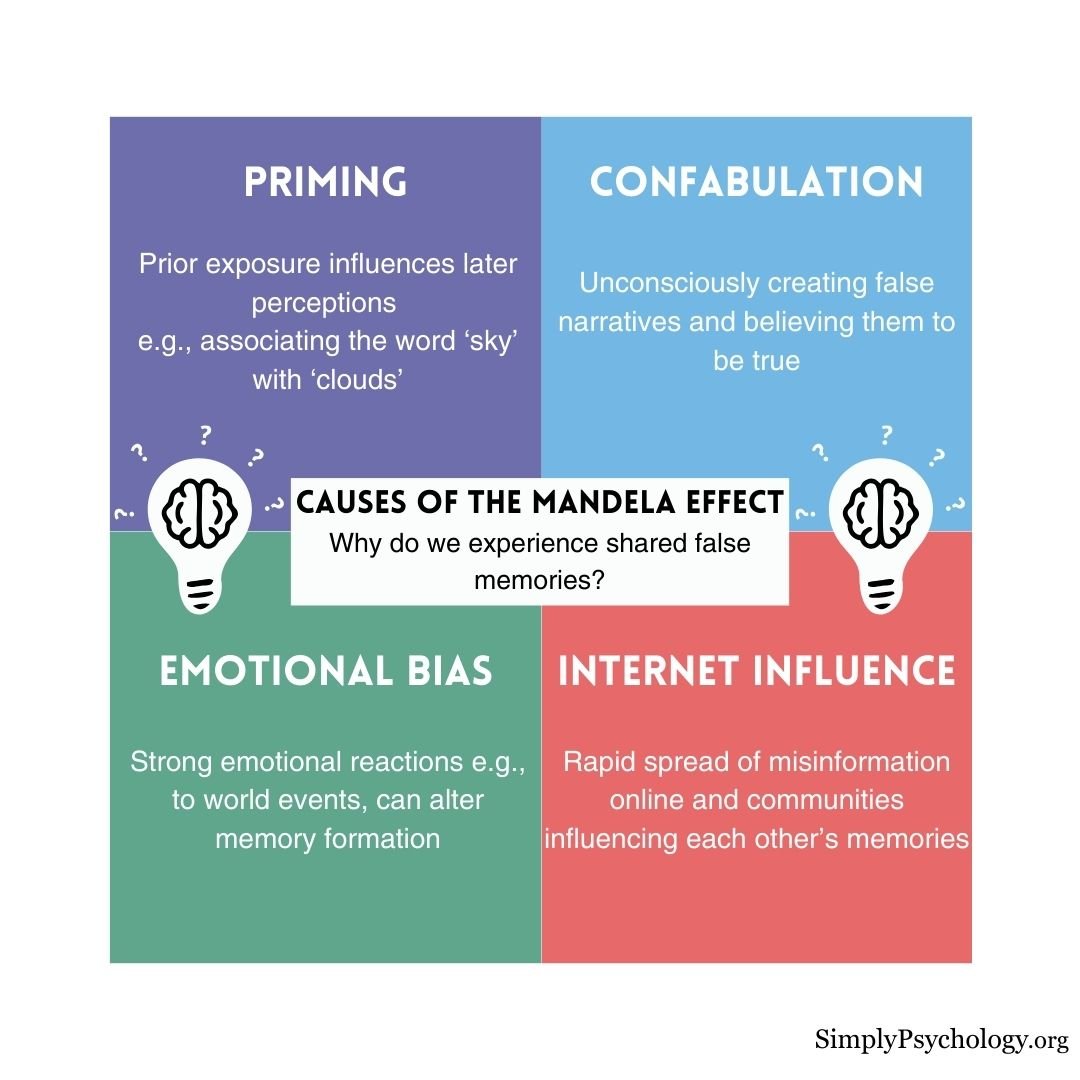
Causes
To learn more about why the Mandela Effect happens and what could possibly trigger it, let us look into the potential causes of the Mandela Effect.
Priming
In psychology, priming means that exposure to one stimulus directly influences how someone responds to a later, related stimulus.
For example, hearing the word “sky” makes people think faster of related words like “cloud” or “stars”.
A monocled Monopoly Man fits this pattern. The character already wears a top hat, cane, bow tie, and suit, so a monocle completes the “formal tycoon” schema people expect.
Suggestibility and leading questions can also affect a person’s memory and reaction.
For instance, “Did you take the green book from the shelf?” is more evocative than “Did you grab anything from the shelf?”
The first question names a specific object, the green book. The second is vague and open-ended, so it primes memory less strongly.
The specific phrasing therefore has a much greater influence on memory than the vaguer question.
False Memories
False memories are untrue, distorted, or outlandish recollections of an event. Some contain elements of fact and closely resemble what actually happened.
Other false memories are entirely wrong. Memory mistakes can feel unsettling, but they are actually quite common.
Memory does not work like a camera or recording device. It does not objectively catalog images or store events in their purest form.
Confabulation
Confabulation is the term for false statements or anecdotes about events that have no factual support or evidence.
The confabulated details are filled with incorrect information, yet the person retelling them believes they are fact.
People do not confabulate on purpose. Most are simply unaware which details are accurate, so they cannot correct the story themselves.
Personal or Emotional Bias
Emotional and personal biases significantly influence memory formation and recall.
For instance, incredibly emotionally arousing events typically produce memories that are incorrect even when vivid.
A large group of people can share similar emotional reactions to a shocking world event. This shared reaction can distort and exaggerate their memories of the details, which then spread and reinforce within a community.
This is a form of social contagion.
This is the same pattern seen in flashbulb memories: vivid, widely shared recollections that still turn out to be inaccurate.
Nelson Mandela’s activism and imprisonment produced a strong emotional response. That response may have led people to misremember him dying in prison, since it fit the narrative of his struggle and sacrifice.
Alternative Realities or Parallel Universes
Broome herself, and many others, have a clear and detailed memory of an event that never actually happened.
One popular explanation borrows from quantum physics and string theory. It suggests that alternate universes exist alongside our own. These universes supposedly “mix” briefly with our timeline, which is why groups of people share the same false memory.
String theory itself is a real, mathematically consistent framework in physics. But the “alternate timelines” explanation for the Mandela effect is a different claim, and it is not one that physics supports.
Essentially, unrelated groups of people have the same memories because the timeline has been altered as we shift between these different realities.
This idea remains unproven and highly controversial among scientists. It persists mainly because it cannot be tested.
Because no observation could ever disprove it, the alternate-realities explanation is unfalsifiable. In science, that counts against a theory, not in its favor: an explanation that fits every possible outcome explains nothing at all.
The reconstructive memory account below is testable, and it has already been tested. That makes it the stronger explanation.
The Impact of the Internet
The internet’s role in impacting the masses’ memories should not be misjudged. It is probably no coincidence that the consideration of the Mandela Effect has grown in this digital age.
The internet is a reliable way to spread information, and with this spreading of data comes the prospect of misinformation and fallacies to acquire traction.
People then begin to build communities based around these falsehoods, and what was once in the imagination starts to seem true to life.
A large-scale study analyzed roughly 126,000 rumor cascades shared on Twitter between 2006 and 2017 (Vosoughi, Roy, & Aral, 2018). False stories, including lies, conspiracies, and rumors, were about 70% more likely to be retweeted than true ones.
This was done by real, verified accounts of real people who were accountable for spreading false information at a much higher pace than the truth.
This concept of the speed at which false information spreads on the internet could assist in explaining the Mandela Effect.
There are whole forums on Reddit for instance where people can submit and discuss newly ‘discovered’ Mandela Effects.
As each person expresses their own experience or memory of an event, those false memories could affect other people’s recollections, thus subconsciously motivating them to remember the events in the same way.
This explanation is backed by evidence that recalling something continually builds your conviction in the memory, even if it grows more inaccurate over time.
As more people delivered incorrect details, these became integrated into other people’s memories as truths and reinforced their confidence that they were correct.
Inducing A False Memory
Researchers discovered a simple method of inducing false memories called the Deese-Roediger-McDermott (DRM) task paradigm.
During the DRM task paradigm, participants read a list of related words. Here is an example of a list below:
- guitar
- piano
- accordion
- harmonica
- flute
After reading the list, researchers ask participants whether they recall a specific lure word. This lure word is a closely related word that was not actually on the list.
A lure word in this example could be “violin.” The term is semantically related to the other list words, but it never appeared.
Some participants report recalling the lure word, even though it was never on the list. In fact, researchers found that these false memories can persist for up to 60 days.
Association alone can create a false memory.
Critical Evaluation
The reconstructive-memory account of the Mandela effect is not just plausible. It has been tested directly, and it holds up well against the alternative explanations, though it is not without limits.
Contemporary Research
The strongest evidence for this account comes from a landmark 2022 study. It is now the field’s key reference point.
Aim: Prasad and Bainbridge (2022) tested whether specific popular images produce a consistent, shared false memory across people. They also tested whether this could be explained by differences in attention or in what people have actually seen.
Method: The study ran four experiments. Participants viewed well-known icons such as the Monopoly Man. Experiment 1 (N = 100) tested which image version people recognized.
Experiment 2 (N = 60) tracked visual attention. Experiment 3 compared people’s actual exposure to correct and incorrect versions. Experiment 4 (N = 50) had participants draw the icons from memory.
Results: The pattern was strikingly consistent. A large majority of participants chose the same incorrect version for several icons, with high confidence.
The same wrong detail even appeared spontaneously when people drew the icons unprompted. Neither attention nor prior visual exposure explained the error.
Conclusion: The shared, specific errors come from something inside memory itself, not from a shared external cause. This directly rules out the need for any “alternate reality” explanation.
Strengths of the Explanation
The reconstructive account adds no new machinery. It rests on mechanisms already well established before anyone applied them to the Mandela effect.
Bartlett’s (1932) schema theory, the DRM paradigm, and source-monitoring research were each demonstrated and replicated independently of this topic. Each was well replicated on its own.
Before 2022, the Mandela effect was discussed almost entirely through anecdote. That changed in 2022.
Prasad and Bainbridge’s study moved it from anecdote to data. It ruled out the two most obvious mundane explanations: differential attention and differential exposure.
The account also explains the harder half of the puzzle: why the error is shared, not just why any one person might misremember.
Shared schemas and priming explain much of it. Faster online spread of striking claims does the rest, so unrelated people land on the identical wrong detail.
Limitations
“Mandela effect” is a folk label, not a scientific one. It has no agreed operational definition.
Usage ranges from one well-documented visual icon to a loosely remembered plot detail, with no threshold for how many people must share an error before it “counts.”
Even the strongest study cannot fully decompose the mechanism. It cannot yet say whether schema completion, association, or priming produced any one person’s specific wrong detail.
The evidence base is also culturally narrow. The foundational studies, and Prasad and Bainbridge’s own samples, draw heavily on Western, educated populations, and the same test has not been run cross-culturally.
Ethics limits the strongest studies too. The paradigms that best demonstrate memory’s malleability must use low-stakes, benign material, so how far this extends to genuinely high-stakes eyewitness memory remains somewhat inferential.
Is it possible to recognize a false memory?
Recognizing a false memory is difficult. Almost everything we “remember” can be muddled, malformed, or inaccurate.
Typically, the most reliable way to know if your memory is fake or not (sadly) is to try to corroborate your story with other people or take on some of your own online research.
A few practical steps can help:
- Check a reliable source: search for the exact phrase or line from the original movie or media.
- Corroborate carefully: people often confirm what they already expect to be true, so a friend’s agreement is not proof.
- Avoid leading questions: “Did Nelson Mandela die in prison?” nudges a “yes.” Ask “Do you know how Nelson Mandela died?” instead.
Most Mandela effect memories are harmless. Misremembering “Berenstain” as “Berenstein” mainly costs you a little pride.
Key Takeaways
- Shared False Memory: Many unrelated people confidently misremember the same detail in the same way, such as the Monopoly Man’s non-existent monocle.
- Not Paranormal: Ordinary memory science, not alternate realities, fully explains the effect.
- Key Evidence: Prasad and Bainbridge (2022) showed that specific images reliably produce the same false memory, ruling out differences in attention or exposure.
- Why Shared: Common schemas, shared cultural exposure, and online reinforcement push independent minds toward the same wrong answer.
- Unfalsifiable: The “alternate universes” explanation cannot be tested or disproven, which counts against it as science.
- Confidence ≠ Accuracy: Even vivid, detailed, and widely shared memories are not guaranteed to be true.
References
Cuncic, Arlin. “What Is the Mandela Effect?” Verywell Mind, Verywell Mind, 11 Aug. 2021, https://www.verywellmind.com/what-is-the-mandela-effect-4589394#:~:text=The%20Mandela%20Effect%20refers%20to,light%20on%20this%20unique%20phenomenon.
“Mandela Effect: How It Works, Causes, and More.” Medical News Today, MediLexicon International, https://www.medicalnewstoday.com/articles/mandela-effect#causes.
Nall, Rachel. “The Mandela Effect: What It Is and How It Happens.” Healthline, Healthline Media, 13 Mar. 2020, https://www.healthline.com/health/mental-health/mandela-effect#why-this-happens.
Phelan, Joe. “What Is the Mandela Effect? and Have You Experienced It?” LiveScience, Purch, 19 Mar. 2022, https://www.livescience.com/what-is-mandela-effect.