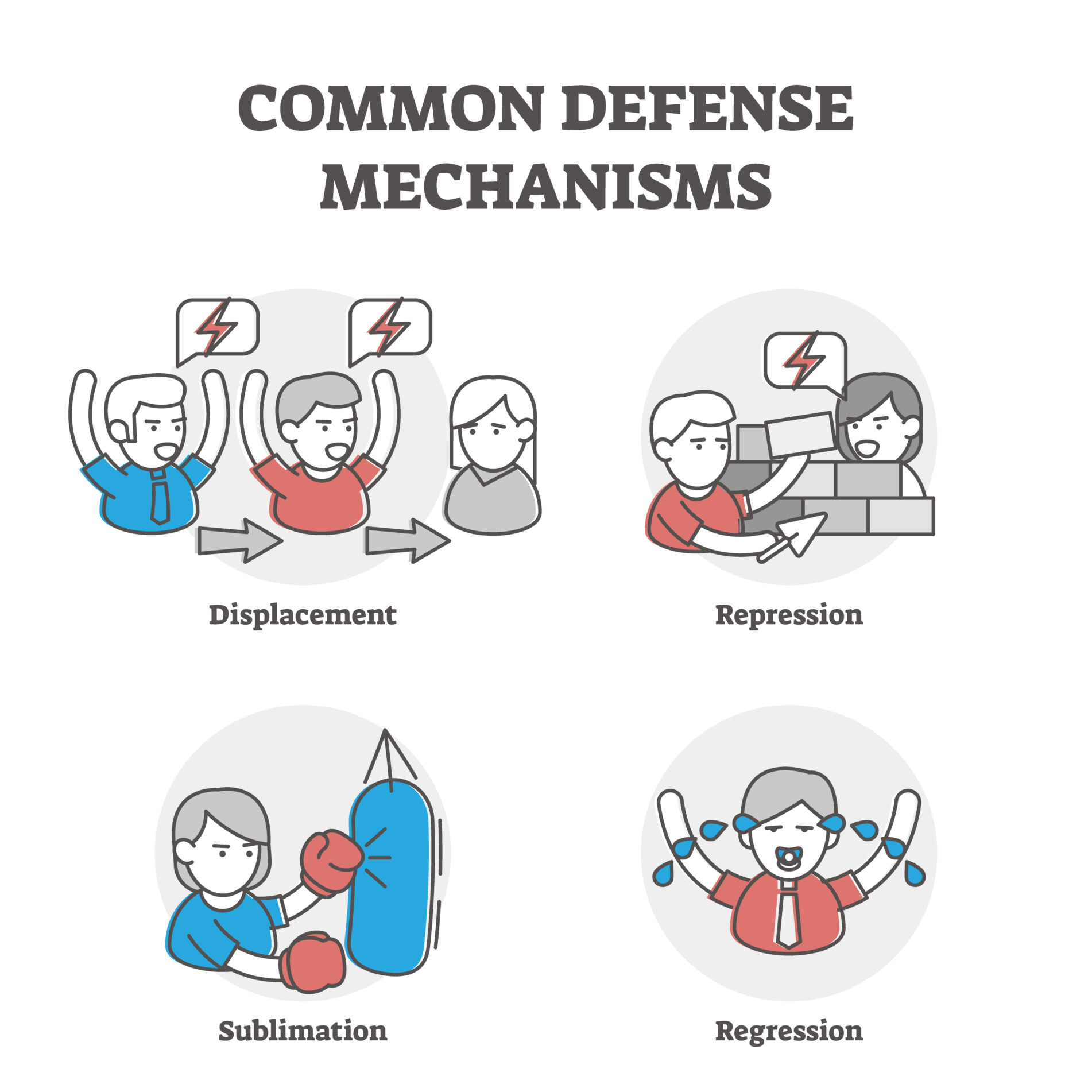
Defense mechanisms are unconscious psychological strategies used to protect the individual from anxiety arising from unacceptable thoughts or feelings.
According to Freudian theory, these mechanisms involve a distortion of reality, allowing the mind to better cope with internal conflict or external stressors.
Function and Development
While defense mechanisms are a natural and normal part of human psychology, they can become maladaptive if used excessively.
-
Healthy Use: They provide temporary relief, allowing the Ego to process information at a manageable pace.
-
Overuse: When used with high frequency or intensity, they can lead to the development of neuroses, such as chronic anxiety states, phobias, obsessions, or hysteria.
Historical Origins
The concept was pioneered by Sigmund Freud (1894, 1896), who identified several “ego defenses” throughout his clinical work.
His daughter, Anna Freud (1936), significantly expanded and systematized these ideas, categorizing ten distinct types and detailing how they function in child development.
Since then, contemporary psychoanalysts have continued to identify and refine further types of ego defenses.
1. Denial
Denial is a defense mechanism proposed by Anna Freud that involves a refusal to accept reality, thus blocking external events from awareness.
If a situation is just too much to handle, the person may respond by refusing to perceive it or denying that it exists.
As you might imagine, this is a primitive and dangerous defense – no one disregards reality and gets away with it for long!
It can operate by itself or, more commonly, in combination with other, more subtle mechanisms that support it.
There is a limit to how much simple denial a person can use before it becomes obvious.
What is an example of denial?
- Relationship Infidelity: A spouse may ignore physical evidence, unexplained absences, or direct warnings about their partner’s unfaithfulness to avoid the pain of a broken marriage.
- Health Neglect: An individual might ignore a persistent, painful symptom (like a lump or chronic chest pain), refusing to see a doctor because acknowledging the symptom would mean acknowledging a potential illness.
- Intellectualization (High IQ): Instead of simply denying a painful fact, a highly intelligent person may use complex logic to explain it away. By turning an emotional crisis into a cold, abstract debate or a theoretical problem, they make their denial look like “rational thinking” to themselves and others.
2. Repression
Repression is a psychological defense mechanism where the mind pushes distressing thoughts, memories, or impulses out of conscious awareness.
Because these elements remain active in the unconscious mind, they continue to influence behavior and emotions even when the individual is unaware of their origin.
Anna Freud called repression “motivated forgetting”.
This process is driven by the Ego to protect the individual from overwhelming anxiety.
Repression typically targets thoughts that would trigger intense guilt from the Superego or those that stem from socially unacceptable desires within the Id.
Repression is rarely a successful long-term strategy.
Because the disturbing ideas are merely hidden rather than resolved, they remain psychically active, often manifesting as unexplained chronic anxiety or physical symptoms.
How repressed content surfaces
Since repressed material is never truly gone, it often bypasses the mind’s internal censors in altered, symbolic forms:
-
Dreams: Where “latent” (hidden) desires appear as “manifest” (visual) symbols.
-
Freudian Slips: Accidental slips of the tongue that reveal a hidden thought.
-
Phobias: An unexplained fear that may be a displaced version of a repressed trauma.
What is an example of repression?
Oedipus Complex: aggressive thoughts about the same sex parents are repressed and pushed down into the unconscious.
Trauma: The mind “walls off” severe events, such as abuse, accidents, or disasters, to maintain daily functioning. Because the memory is blocked automatically rather than by choice, it remains entirely inaccessible to the conscious mind.
- The Event: A child witnesses a violent crime accompanied by the sound of sirens.
-
The Repression: The visual and narrative memory of the crime is pushed into the unconscious.
-
The Symptom: As an adult, the sound of a siren triggers a “fight or flight” response (panic, sweating, racing heart). The person feels the affect (the emotion) without the content (the memory).
Distinction Note: Repression vs. Denial
It is important to distinguish repression from denial.
- Denial involves refusing to accept the reality of external sensory data (e.g., refusing to believe a doctor’s diagnosis).
- Repression involves blocking inner states, such as thoughts, impulses, and memories
3. Projection
Projection is a psychological defense mechanism proposed by Anna Freud in which an individual attributes unwanted thoughts, feelings, and motives to another person.
Projection is generally understood as a defense mechanism that protects self-esteem by externalizing undesirable aspects of the self.
Projection, which Anna Freud also called displacement outward, is almost the complete opposite of turning against the self.
It involves the tendency to see your own unacceptable desires in other people.
In other words, the desires are still there, but they’re not your desires anymore.
What is an example of projection?
Thoughts most commonly projected onto another are the ones that would cause guilt such as aggressive and sexual fantasies or thoughts.
For instance, you might hate someone, but your superego tells you that such hatred is unacceptable.
You can ‘solve’ the problem by believing that they hate you.
4. Displacement
Displacement is the redirection of an impulse (usually aggression) onto a powerless substitute target. The target can be a person or an object that can serve as a symbolic substitute.
Displacement occurs when the Id wants to do something which the Superego does not permit.
The Ego thus finds some other way of releasing the psychic energy of the Id.
Thus there is a transfer of energy from a repressed object-cathexis to a more acceptable object.
Turning against the self is a very special form of displacement, where the person becomes their own substitute target.
It is normally used in reference to hatred, anger, and aggression, rather than more positive impulses, and it is the Freudian explanation for many of our feelings of inferiority, guilt, and depression.
The idea that depression is often the result of the anger we refuse to acknowledge is accepted by many people, Freudians and non-Freudians alike.
What is an example of displacement?
Someone who feels uncomfortable with their sexual desire for a real person may substitute a fetish.
Someone who is frustrated by his or her superiors may go home and kick the dog, beat up a family member, or engage in cross-burnings.
5. Regression
Regression is a defense mechanism proposed by Anna Freud whereby the the ego reverts to an earlier stage of development usually in response to stressful situations.
Regression functions as a form of retreat, enabling a person to psychologically go back in time to a period when the person felt safer.
What is an example of regression?
When we are troubled or frightened, our behaviors often become more childish or primitive.
A child may begin to suck their thumb again or wet the bed when they need to spend some time in the hospital.
Teenagers may giggle uncontrollably when introduced into a social situation involving the opposite sex.
6. Sublimation
Sublimation is similar to displacement, but takes place when we manage to displace our unacceptable emotions into behaviors which are constructive and socially acceptable, rather than destructive activities.
Sublimation is one of Anna Freud’s original defense mechanisms.
Sublimation for Freud was the cornerstone of civilized life, as arts and science are all sublimated sexuality.
(NB. this is a value-laden concept, based on the aspirations of European society at the end of the 1800 century).
What is an example of sublimation?
Many great artists and musicians have had unhappy lives and have used the medium of art of music to express themselves.
Sport is another example of putting our emotions (e.g., aggression) into something constructive.
For example, fixation at the oral stage of development may later lead to seeking oral pleasure as an adult through sucking one’s thumb, pen or cigarette.
Also, fixation during the anal stage may cause a person to sublimate their desire to handle faeces with an enjoyment of pottery.
7. Rationalization
Rationalization is a defense mechanism proposed by Anna Freud involving a cognitive distortion of “the facts” to make an event or an impulse less threatening.
We do it often enough on a fairly conscious level when we provide ourselves with excuses.
But for many people, with sensitive egos, making excuses comes so easy that they never are truly aware of it.
In other words, many of us are quite prepared to believe our lies.
What is an example of rationalization?
When a person finds a situation difficult to accept, they will make up a logical reason why it has happened.
For example, a person may explain a natural disaster as “God’s will”.
8. Reaction Formation
Reaction formation, which Anna Freud called “believing the opposite,” is a psychological defense mechanism in which a person goes beyond denial and behaves in the opposite way to which he or she thinks or feels.
Conscious behaviors are adopted to overcompensate for the anxiety a person feels regarding their socially unacceptable unconscious thoughts or emotions.
Usually, a reaction formation is marked by exaggerated behavior, such as showiness and compulsiveness.
By using the reaction formation, the id is satisfied while keeping the ego in ignorance of the true motives.
Therapists often observe reaction formation in patients who claim to strongly believe in something and become angry at everyone who disagrees.
What is an example of reaction formation?
Freud claimed that men who are prejudiced against homosexuals are making a defense against their own homosexual feelings by adopting a harsh anti-homosexual attitude which helps convince them of their heterosexuality.
Another example of reaction formation includes the dutiful daughter who loves her mother is reacting to her Oedipus hatred of her mother.
9. Introjection
Introjection, sometimes called identification, involves taking into your own personality characteristics of someone else, because doing so solves some emotional difficulty.
Introjection is very important to Freudian theory as the mechanism by which we develop our superegos.
What is an example of introjection?
A child who is left alone frequently, may in some way try to become “mom” in order to lessen his or her fears.
You can sometimes catch them telling their dolls or animals not to be afraid.
And we find the older child or teenager imitating his or her favorite star, musician, or sports hero in an effort to establish an identity.
10. Identification with the Aggressor
Identification with the aggressor is a defense mechanism proposed by Sandor Ferenczi and later developed by Anna Freud.
It involves the victim adopting the behavior of a person who is more powerful and hostile towards them.
By internalizing the behavior of the aggressor the “victim” hopes to avoid abuse, as the aggressor may begin to feel an emotional connection with the victim which leads to feelings of empathy.
What is an example of identification with the aggressor?
Identification with the aggressor is a version of introjection that focuses on the adoption, not of general or positive traits, but of negative or feared traits.
If you are afraid of someone, you can partially conquer that fear by becoming more like them.
An extreme example is Stockholm Syndrome, where hostages establish an emotional bond with their captor(s) and take on their behaviors.
Patty Hearst was abused by her captors, yet she joined their Symbionese Liberation Army and even took part in one of their bank robberies.
At her trial, she was acquitted because she was a victim suffering from Stockholm Syndrome.
How Do Defense Mechanisms Work?
Defense mechanisms function as unconscious psychological strategies employed by the ego to manage anxiety and maintain self-image.
They operate by distorting reality to prevent threatening thoughts, impulses, or memories from entering conscious awareness.
Id, Ego, and Superego
To understand how defense mechanisms work, one must look at the structural model of personality proposed by Sigmund Freud.
Personality is viewed as a conflict between three interacting systems:
- The Id: The unconscious, primitive part of the personality that contains instinctual drives for hunger, sex, and aggression. It operates on the “pleasure principle,” seeking immediate gratification.
- The Superego: The internal moral compass or conscience, developed through social interactions, which judges behavior and strives for perfection,.
- The Ego: The rational part of the personality that operates on the “reality principle.” Its job is to balance the impulsive demands of the id with the moralistic constraints of the superego within the context of the real world.
How Conflict Triggers Defenses:
When the ego cannot reconcile the opposing demands of the id and the superego, anxiety is generated.
To protect itself from being overwhelmed by this anxiety, the ego resorts to defense mechanisms.
These mechanisms work by distorting reality so that the individual can continue daily functioning without unpleasant feelings or traumatic memories dominating their conscious awareness.
While everyone uses these mechanisms to some extent, their overuse can become problematic and lead to neuroses or other psychological disorders.
How does the ego decide which defense mechanism to use?
We don’t consciously pick a defense mechanism; our brain selects one based on our age, the situation, and our history.
Here is how that selection process works:
1. The “Maturity” Level
Psychologists often group defenses into a hierarchy. As we grow and learn, we typically move from primitive reactions to mature strategies.
| Type | How it works | Real-world Example |
| Immature | Reflex-like reactions often seen in children or people under extreme stress. | Denial: Ignoring a doctor’s diagnosis because it’s too scary to face. |
| Neurotic | Shifting or “tricking” your emotions to make them more tolerable. | Displacement: Snapping at your spouse because you had a bad day at work. |
| Mature | Productive, healthy ways to handle stress without ignoring reality. | Sublimation: Going for a long run to burn off anger instead of starting an argument. |
2. The Type of Threat (How You See the Problem)
The way you “size up” a threat changes how you react to it.
-
Internal Threats: If your self-esteem is hurt, you might lash out at others (projection) to protect your ego.
-
External Threats: If you face a shared crisis (like a natural disaster), you are more likely to seek help and use communal coping.
-
Control: If you feel helpless, you might use emotion-focused defenses (like denial). If you feel you can fix the problem, you are more likely to use active, problem-solving strategies.
3. Habits and Past Learning
Like any other skill, your mind “learns” what works.
-
Reinforcement: If you successfully avoided a scary situation as a child by pretending it wasn’t happening, your brain remembers that “win.”
-
Habitual Patterns: Over time, these successful escapes become your “default settings.” You develop a signature “coping style” that triggers automatically when things get tough.
References
Baumeister, R. F., Dale, K., & Sommer, K. L. (1998). Freudian defense mechanisms and empirical findings in modern social psychology: Reaction formation, projection, displacement, undoing, isolation, sublimation, and denial. Journal of Personality, 66(6), 1081-1124.
Cramer, P. (2015). Defense mechanisms: 40 years of empirical research. Journal of Personality Assessment, 97(2), 114-122.
Di Giuseppe, M., & Perry, J. C. (2021). The hierarchy of defense mechanisms: Assessing defensive functioning with the defense mechanisms rating scales Q-sort. Frontiers in psychology, 12, 718440.
Ferenczi, S. (1933). Confusion of tongues between adults and the child (pp. 156-67).
Freud, A. (1937). The Ego and the mechanisms of defense, London: Hogarth Press and Institute of Psycho-Analysis.
Freud, S. (1894). The neuro-psychoses of defence. SE, 3: 41-61.
Freud, S. (1896). Further remarks on the neuro-psychoses of defense. SE, 3: 157-185.
Freud, S. (1933). New introductory lectures on psychoanalysis. London: Hogarth Press and Institute of Psycho-Analysis. Pp. xi + 240.
Freud, S. (1936). Inhibitions, symptoms and anxiety. The Psychoanalytic Quarterly, 5(1), 1-28.
Holmes, D. S. (1978). Projection as a defense mechanism. Psychological Bulletin, 85(4), 677.
Liberman, A., & Chaiken, S. (1992). Defensive processing of personally relevant health messages. Personality and Social Psychology Bulletin, 18(6), 669-679.
Newman, L. S., Duff, K. J., & Baumeister, R. F. (1997). A new look at defensive projection: Thought suppression, accessibility, and biased person perception. Journal of personality and social psychology, 72(5), 980.
Paulhus, D. L., Fridhandler, B., & Hayes, S. (1997). Psychological defense: Contemporary theory and research. In R. Hogan, J. A. Johnson, & S. R. Briggs (Eds.), Handbook of personality psychology (pp. 543-579). http://dx.doi.org/10.1016/B978-012134645-4/50023-8
Further Reading
- Name the Defense Mechanism Activity
- BPS Article on Repression
- Cramer, P. (2015). Understanding defense mechanisms. Psychodynamic Psychiatry, 43(4), 523-552.
- Freudian Defense Mechanisms and Empirical Findings in Modern Social Psychology: Reaction Formation, Projection, Displacement, Undoing, Isolation, Sublimation, and Denial
- Defense Mechanisms Summary Table
- Suppression
- Repression vs. Suppression
- “The Neuro-Psychoses of Defence” (1894) – This early paper introduced the concept of defense mechanisms.
- “Studies on Hysteria” (1895) – Co-authored with Josef Breuer, this book discussed repression as a defense mechanism.
- “The Interpretation of Dreams” (1900) – While primarily about dreams, this book also touched on defense mechanisms.
- “The Psychopathology of Everyday Life” (1901) – This work explored various defense mechanisms in daily life.
- “Three Essays on the Theory of Sexuality” (1905) – This book discussed sublimation as a defense mechanism.
- “Inhibitions, Symptoms and Anxiety” (1926) – This later work provided a more comprehensive theory of defense mechanisms.