The 16PF (Sixteen Personality Factor Questionnaire) is a scientifically validated personality test used to measure 16 distinct, fundamental traits that shape human behavior.
Developed by psychologist Raymond Cattell, it evaluates a person’s everyday personality across broad spectrums (such as warmth, emotional stability, and openness to change) to create a comprehensive psychological profile for career counseling, hiring, and clinical assessment.
Key Takeaways
- 16 Primary Factors: The test measures where a person falls on a continuum for 16 specific traits: such as warmth, reasoning, emotional stability, self-reliance, perfectionism, and tension.
- 5 Global Factors: Most of the sixteen factors combine into five broader scores: Extraversion, Anxiety, Tough-Mindedness, Independence, and Self-Control.
- Scoring: In the widely studied fifth edition, people answer statements true, uncertain or false. Each factor gets a score from 1 to 10, and 5 or 6 is average.
- Human Resources: The 16PF is used mainly at work, for careers advice and for choosing job candidates.
- Clinical & Therapy Use: Psychologists use it to understand a patient’s coping style, anxiety levels, and to assist in therapy planning.
- Key Criticism: TWhen used in isolation for hiring or job performance, the 16PF has shown limited ability to predict actual workplace success. Critics argue it should never replace objective skills assessments or cognitive ability tests.
The 16 Personality Factors
Picture a mixing desk with sixteen sliders. Each slider runs between two opposite ends. Every person has a setting on all sixteen.
That is how the 16PF sees personality. Each of the sixteen traits is a spectrum, a line with one description at one end and the opposite at the other. The test calls each line a factor.
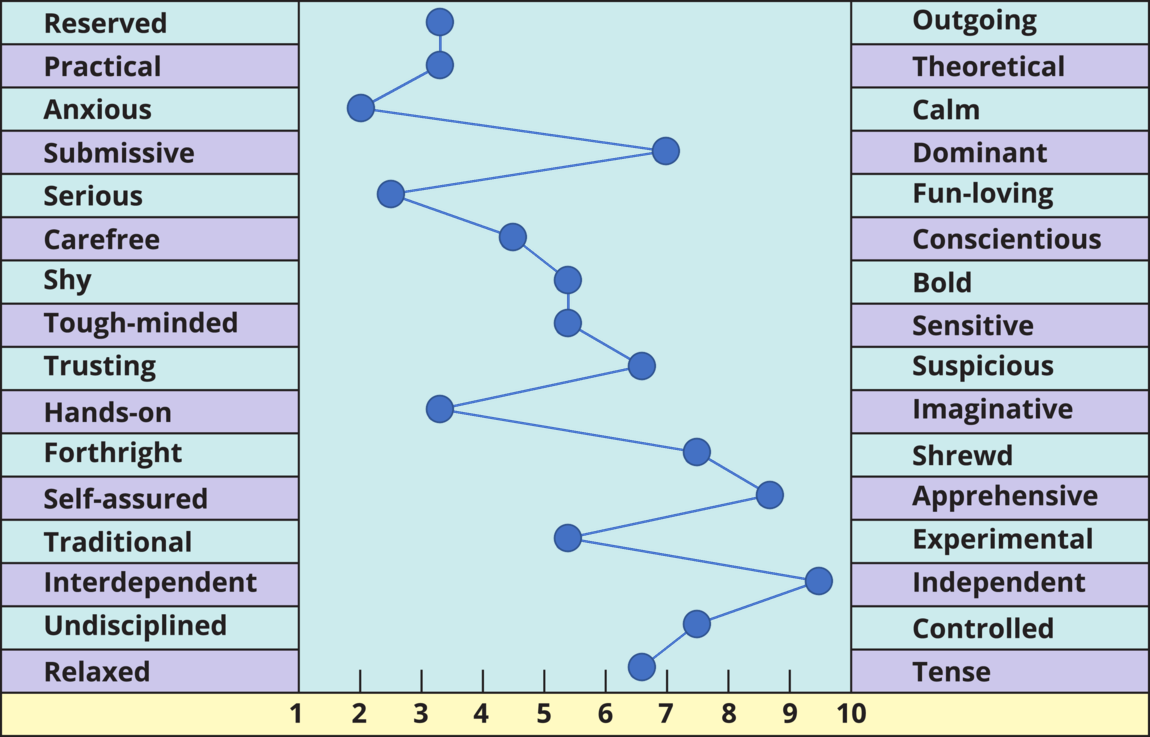
Three of the sixteen are warmth, dominance and perfectionism:
- Warmth: from reserved and detached to warm and outgoing.
- Dominance: from deferential and cooperative to forceful and assertive.
- Perfectionism: from tolerant of disorder to organised and self-disciplined.
A score places a person somewhere along each line. It does not sort anyone into a fixed type, such as a warm person or a reserved person.
A score near the middle means the person is not strongly like either description. Scores at the very ends of a line are rare.
Two people differ in where their sliders sit, not in which sliders they have.
The Sixteen Factors at a Glance
The table gives all sixteen factors. It shows the description that fits people who score low and the one that fits people who score high.
Fifteen are self-descriptions, in which people say what they are like. Reasoning is different. It is a short test of reasoning ability, with right and wrong answers.
| Factor | Lower scorers | Higher scorers |
|---|---|---|
| Warmth | Reserved, impersonal, detached | Warm, outgoing, attentive to others |
| Reasoning | More concrete thinking | More abstract thinking |
| Emotional Stability | Reactive, easily upset | Calm, adaptive |
| Dominance | Deferential (gives way to others), cooperative, avoids conflict | Dominant, forceful, assertive |
| Liveliness | Serious, restrained, careful | Lively, animated, spontaneous |
| Rule-Consciousness | Expedient (does what is convenient), willing to bend rules | Dutiful, conscientious, rule-bound |
| Social Boldness | Shy, timid, easily intimidated | Socially bold, adventurous |
| Sensitivity | Tough-minded, unsentimental | Sensitive, tender-minded |
| Vigilance | Trusting, unsuspecting | Suspicious, wary of others’ motives |
| Abstractedness | Practical, grounded | Imaginative, absorbed in own thoughts |
| Privateness | Forthright, open about motives | Private, discreet |
| Apprehension | Self-assured, unworried | Apprehensive, self-doubting, prone to guilt or worry |
| Openness to Change | Traditional, attached to familiar ways | Experimental, open to change |
| Self-Reliance | Group-oriented, willing to go along with others | Self-reliant, solitary, comfortable deciding alone |
| Perfectionism | Tolerant of disorder, flexible about structure | Perfectionistic, organised, self-disciplined |
| Tension | Relaxed, calm, patient | Tense, driven, impatient |
Five Broader Groups
Sixteen scores are a lot to hold in mind.
So the test also reports five broader scores, which the manuals call global factors. Each is worked out from several of the sixteen, not from extra questions (Conn & Rieke, 1994).
Each group combines high or low scores on four or five of the sixteen factors:
- Extraversion: warm, lively, socially confident, forthright and group-oriented. It combines high Warmth, Liveliness and Social Boldness with low Privateness and low Self-Reliance.
- Anxiety: easily upset, wary, worried and tense. It combines low Emotional Stability with high Vigilance, Apprehension and Tension.
- Tough-Mindedness: unsentimental, practical, detached and resistant to new things. It combines low Warmth, Sensitivity, Abstractedness and Openness to Change.
- Independence: assertive, socially confident, wary of others and open to new ideas. It combines high Dominance, Social Boldness, Vigilance and Openness to Change.
- Self-Control: restrained, dutiful, practical and organised. It combines low Liveliness and Abstractedness with high Rule-Consciousness and Perfectionism.
A factor can feed more than one group. Social Boldness, for example, feeds both Extraversion and Independence. Reasoning feeds none of the five.
Names can mislead. Tough-minded is one end of the Sensitivity line, while Tough-Mindedness is one of the five groups. They are related but not the same.
How Does the 16PF Test Work?
What Taking the Test Is Like
The 16PF, short for Sixteen Personality Factor Questionnaire, is a published questionnaire. People fill it in themselves, and a trained person then reads the result.
Cattell first published it in 1949.
The fifth edition, from 1993, has 185 items. Of these, 170 are statements about the person and 15 are reasoning questions with right and wrong answers (Cattell et al., 1993).
For each statement, the test-taker answers true, uncertain or false.
The Warmth statements, for example, ask in various ways whether a person enjoys close involvement with others or prefers some emotional distance.
Each answer earns 0, 1 or 2 points. Uncertain earns 1. The points for one factor are added up to give a raw total (Murray et al., 2016).
The wording is simple, at about the reading level of a ten- or eleven-year-old (Cattell et al., 1993).
A sixth edition followed in 2018. It has 155 items, is taken online, and keeps the same sixteen factors, five broader groups and 1 to 10 scores (PSI Services LLC, 2018).
How a Score Is Read
On its own, a raw total means little.
So the test compares it with other people. The comparison group might be the general population or a sample of managers.
The result is a score from 1 to 10, called a sten, short for “standard ten”. Every factor then uses the same scale, so Warmth can be compared with Tension.
A raw total can give different stens in different groups.
Here is how to read the numbers:
- 5 or 6: average.
- 4 or 7: moderately low or moderately high.
- 1 or 10: rare, each covering only about the most extreme two per cent of the group.
Scores of 2, 3, 8 and 9 sit between moderate and rare.
A profile shows the scores as a graph across the page. A trained person takes in the whole pattern at a glance.
Reports usually start with the five broader scores. The sixteen then show what lies behind them.
An Example Profile
Imagine a person who answers most of the Warmth statements in the warm, sociable direction.
Against general-population scores, the result might be a Warmth score of 8, which is high.
The same person also scores:
- Liveliness, 7: moderately high, so lively and animated.
- Social Boldness, 6: average, just above the middle.
- Privateness, 3: low, so open about themselves rather than private.
- Self-Reliance, 4: moderately low, so leaning towards the group rather than going it alone.
Warmth, Liveliness and Social Boldness all feed the broader Extraversion score.
So do low scores on Privateness and Self-Reliance, because being open about yourself and preferring company both point towards extraversion. All five scores lean the same way.
The manual combines them using set weights, which fix how much each factor counts, not a simple average.
The result is likely to be a score of 7 or 8 on Extraversion, which is on the high side.
The profile describes someone warm, lively, open about themselves and drawn to company. The Extraversion score alone would say as much.
The sixteen scores let a trained person ask more. Is this person’s extraversion mostly warmth, mostly boldness, or both? That is why the test reports both levels.
Evidence for the 16PF
Not everyone agrees that personality needs sixteen traits.
The Big Five, a rival model, has five broad traits: openness, conscientiousness, extraversion, agreeableness and neuroticism. The psychologist Hans Eysenck argued for three.
Four questions matter most. Do sixteen factors predict better than fewer? Are they really separate? Does the scoring work as intended? Does the structure hold up in large samples?
Do Sixteen Factors Predict Better?
Mershon and Gorsuch (1988)
If sixteen factors are better than a handful, they should predict real-life outcomes more accurately. Mershon and Gorsuch (1988) tested this.
- Aim: To find out whether sixteen factors predict real-life outcomes better than six, because statistical analysis alone had not settled how many factors are needed.
- Method: The authors analysed 16 data sets, each linking personality scores to real-life outcomes. They compared how well six factors and sixteen factors predicted those outcomes.
- Results: Sixteen factors predicted significantly better than six in 88 per cent of the data sets. After correcting for the usual drop in accuracy on new people, they accounted for about twice as much of why outcomes differed.
- Conclusion: The authors concluded that models with five to eight factors have limited usefulness, and that using more factors is strongly supported.
Here, significantly better means better by more than luck alone would explain.
This is among the strongest points in Cattell’s favour, because it tests the practical claim that narrow factors predict more. Three cautions apply.
First, the study’s short published summary does not say what the real-life outcomes were. Second, a model with more factors often predicts better anyway, simply because it has more to work with. The study’s correction for this only partly offsets it.
Third, the Big Five can also be split into narrower scales, for example separate scales for different parts of extraversion. That weakens the contrast between six factors and sixteen.
Are the Sixteen Really Separate?
Noller, Law and Comrey (1987)
If the sixteen factors are separate, each should capture something the others do not. If they overlap, people who score high on one tend to score high, or low, on others too.
- Aim: To see how the 16PF relates to two other personality questionnaires, the Comrey Personality Scales and the Eysenck Personality Inventory, when all three are analysed together.
- Method: A sample of 669 Australians completed all three questionnaires. The scores on all the scales were then analysed together to find which ones formed patterns.
- Results: The scales formed a small number of broad patterns. The 16PF scales overlapped heavily, and many fed several patterns, so fewer than sixteen separate traits seemed to be measured.
- Conclusion: The authors read this as more evidence for five robust factors, a five-trait view of personality, and as showing that the sixteen are not sixteen independent traits.
Because the sixteen scales blended into a few broad patterns, the broader groups of the 16PF look sturdier than the sixteen factors beneath them.
Two limits apply. The sample came from one country. The study also used each scale’s total score, not answers to single questions.
Eysenck (1972), a rival trait theorist, made a related argument from Cattell’s own data.
He took the 16PF scales that feed two broad factors. He set aside what those factors explained, and the random errors in measuring. Very little was left for the scales to measure.
So, he argued, the sixteen scales add little beyond the broad factors. His argument rests on statistical reasoning, not on predicting outside outcomes.
Does the Scoring Work as Intended?
Murray, Booth and Molenaar (2016)
A newer study asked a different question. Does each answer mean what the scoring assumes it means?
- Aim: To test the assumption that the middle answer, uncertain, marks a trait level between the high and low answers.
- Method: The authors used a method that does not assume the three answers run in order from low to high. They applied it to the large US and UK samples used to set up the fifth edition.
- Results: For many questions, people who chose the middle answer had more of the trait than people who chose the answer worth 2 points. For some, they had less than people who chose the answer worth 0.
- Conclusion: The simple scoring that gives the three answers 0, 1 and 2 points is undermined. The authors recommended other ways of scoring.
So the middle answer did not always sit between the other two, as the scoring assumes. It was also chosen more often for some traits, especially ones linked to being easily upset.
The study uses two large samples and a flexible method, which is a real strength. But it tests the scoring, not the theory. It does not show that the sixteen factors are wrong.
What it shows is that raw scores rest on an assumption that does not always hold. So a score may misstate a person’s trait level.
It is also hard to tell whether a middle answer reflects a person’s real level of the trait or just a habit of choosing the middle. That is a problem for any questionnaire in which people describe themselves.
Do Large Samples Back Up the Sixteen Factors?
Irwing et al. (2014) tested the fifth edition in a US sample of over ten thousand adults.
They checked whether the way people’s answers clustered matched the 16PF’s design of sixteen factors grouped into five broader groups.
The sixteen factors fitted well, and the five broader groups only slightly less well. Overall, the structure was supported.
A second analysis of fifth-edition data found reasonable support for the sixteen scales. It found only partial support for the five broader groups (Aluja et al., 2005). So the picture is mixed.
Schermer et al. (2020) studied 1,198 managerial candidates in a real two-day selection process. They split the group into a more intelligent half and a less intelligent half, to test whether more intelligent people differ more from each other in personality.
They found little support for that idea. The same basic pattern of factors appeared in both halves.
But the same score may not have meant the same level of a trait in each half. Comparing the halves needs care.
Gerbing and Tuley (1991) compared the 16PF with the NEO inventory, a questionnaire built to measure the Big Five. The two were strongly related. The authors concluded that they cover overlapping ground.
Taken together, the studies suggest that the 16PF’s structure can be measured, but the evidence for sixteen separate traits is weaker than the name suggests. The scoring is also less tidy than the standard method assumes.
Strengths of the 16PF
The 16PF has four main strengths:
- Two-Level Profile: Five broader scores give a quick overview, and sixteen narrower scores show what lies behind each one (Conn & Rieke, 1994).
- Prediction: In most of 16 sets of data, sixteen factors predicted real-life outcomes better than six did (Mershon & Gorsuch, 1988).
- Long Record of Use: The test has been published and revised since 1949, and its broader scores helped tell apart people with different career interests (Vansickle & Conn, 1996).
- Structure Supported: In a large US sample, the sixteen factors fitted the data well and the five broader groups only slightly less well (Irwing et al., 2014).
Limitations of the 16PF
Before working through each one, here is a one-line summary of the main limitations:
- Judgement Calls: The number sixteen reflects the researchers’ choices as well as the data.
- Overlap: The sixteen factors overlap, so they may not be sixteen separate traits.
- Rarely Tested: Recent studies test the questionnaire, not Cattell’s central claims: that the same traits appear in three kinds of evidence, and that a formula predicts behaviour.
- Self-Report Problems: Answers depend on honest self-description, and the scoring rests on an assumption that does not always hold.
- One Language, Western Samples: The factors began with English words, and the large studies use mostly Western samples.
The Number Sixteen Rests on Judgement
Cattell’s first analysis of ratings of people produced twelve factors. Later questionnaire work added more, and the twelve became sixteen (Howarth, 1976).
Howarth (1976) asked whether those first twelve had been identified correctly. The data, Howarth argued, might have supported six clear factors rather than twelve.
The point is not that six is right. It is that the answer shifts with the researcher’s choices.
Four choices mattered: which traits to include, how many factors to keep, which settings to use in the statistical analysis and what to call each factor.
Cattell’s own safeguard was replication: real factors should appear again in different kinds of evidence, in new samples and in different age groups.
His 1947 check was modest, though. It analysed 133 men, with part of the analysis done by hand, which leaves room for judgement. Most of the earlier factors turned up again (Cattell, 1947).
A check by researchers outside Cattell’s laboratory would have been more convincing.
So the number sixteen reflects the researchers’ choices as well as the data. That is a reason for caution about treating it as a fixed count of personality’s building blocks.
The Sixteen Factors Overlap
Cattell expected his traits to overlap, because in his view real traits tend to go together. So overlap alone is not a flaw. The question is how much overlap is too much for sixteen separate traits.
The evidence suggests that the sixteen can be measured but are not independent.
Their scales overlap heavily (Noller et al., 1987). Eysenck (1972), a rival theorist, argued that little is left for them to add once the broad factors are set aside.
The prediction result does not settle the matter. It shows that sixteen factors beat six in most data sets (Mershon & Gorsuch, 1988), not which narrow factors are best.
A model with five broad traits and narrower scales beneath each could make the same point without Cattell’s particular sixteen.
Even the broader level is not beyond question. One large-sample analysis supported the structure (Irwing et al., 2014), while another supported the five broader groups only partly (Aluja et al., 2005).
So the case for sixteen separate traits is weaker than the name of the test suggests.
Cattell’s Central Claims Are Rarely Tested
Two of Cattell’s central claims have had little recent testing.
The first is that the same traits should show up in three kinds of evidence (Cattell, 1965).
These are life records, such as school grades; questionnaires; and objective tests, which are tasks that hide what they measure.
A factor found in all three kinds is less likely to be an accident of one method.
He looked for this in objective tests (Cattell, 1948). But the 16PF is a questionnaire, so it can speak to only one of the three.
The second is a formula for predicting behaviour.
It adds up a person’s scores on the traits that matter in a situation, each counted by how much it matters (Cattell, 1950).
A trait that does not matter counts for almost nothing. So the same person can act differently in different situations while stable traits still do the predicting.
Estimating those weights takes a great deal of data.
The recent studies of the 16PF test its structure and its scoring (Irwing et al., 2014; Murray et al., 2016; Schermer et al., 2020). They test neither idea.
An open question is whether the sixteen scores still add prediction once five broad traits and their narrower scales are counted. Testing it needs large, culturally varied samples and predictions written down before the results are known.
Self-Report and Scoring Problems
Fifteen of the sixteen scores start as self-report, meaning a person’s own description of themselves. They therefore depend on honesty and self-insight.
In selection, where a job depends on the answers, candidates have a reason to present themselves well.
The fifth-edition manual includes checks meant to flag this (Conn & Rieke, 1994). No such check removes the problem.
The scoring adds a second difficulty. The middle answer does not behave as the scoring assumes, and some traits attract it more than others (Murray et al., 2016).
One Language and Mostly Western Samples
The 16PF began with English.
Cattell started from a list of trait words that the psychologists Gordon Allport and Henry Odbert took from an English dictionary (Allport & Odbert, 1936; Cattell, 1943). A different language might give a different list of factors.
Studies in seven languages that started from the words people use found six factors. The extra one, beyond the Big Five, was honesty-humility (Ashton et al., 2004).
The number of factors seems to depend partly on the language and the methods used.
The samples are mostly Western too.
The studies cited here that name their samples used people from the United States, the United Kingdom, Canada and Australia. Claims that the factors are universal need evidence from other cultures.
One open question is whether the broader scores mean the same thing across cultures. If they do not, average scores cannot be compared fairly.
That matters in practice. The 16PF is used in recruitment, and scores that cannot be compared across groups raise questions of fairness.
How Is the 16PF Used in Real Life?
Careers and Selection
The 16PF is used mainly at work: choosing job candidates, giving careers advice, and developing leaders and managers.
Vansickle and Conn (1996) studied 1,770 people whose college subject or job could be classified.
They compared the five broader scores across six types of job interest, such as Realistic (hands-on work), Investigative (research) and Social (helping people) (Holland, 1985).
The five scores told the types apart. Using only those scores, a statistical test placed roughly 56 per cent of people in their correct type. That is well above the one in six expected by chance.
Profiles also differed by field. Students of counselling and clinical psychology scored high on Extraversion and low on Tough-Mindedness.
This is why the two-level profile helps in careers advice.
A counsellor can see not only that a candidate is extraverted but which of the sixteen factors lie behind that. They can also compare the pattern with the profile typical of a field.
Counselling and Research
The 16PF has a long history of use in counselling and clinical settings, where it describes ordinary personality. It sits beside tests built to pick out clinical problems, such as the Minnesota Multiphasic Personality Inventory.
In schools, Cattell’s group developed versions for children and teenagers. In one study of 563 children, intelligence, personality factors and motivation measures each added to the prediction of school achievement (Cattell et al., 1966).
Researchers have also used the 16PF to study personality differences.
What the 16PF Cannot Do
The 16PF is a research and assessment tool. Its results are not a diagnosis. They are not a substitute for professional judgement.
Scores add information about personality that ability tests do not capture. They are typically used alongside ability tests and structured interviews, not instead of them.
Faking is a risk in selection, because candidates may present themselves favourably. The manual’s checks cannot remove the problem.
A score also says only where a person stands in one comparison group. The same raw total can give different results in different groups.
In the study of managerial candidates, the same score may not have meant the same level of a trait for higher- and lower-ability candidates (Schermer et al., 2020). Comparing candidates across groups therefore needs care.
How Does Cattell’s Work Compare With Other Trait Theories?
Cattell and Eysenck: Many Factors or Few?
Cattell and Hans Eysenck both used a statistical method that finds which traits go together. They disagreed about how many factors personality needs.
Eysenck preferred a few broad factors that do not overlap, and he argued that they have a biological basis. He had three, and two were extraversion and neuroticism, or low emotional stability.
Cattell preferred many factors that overlap.
At the broad level they agreed. Cattell found two especially stable broad factors, close to extraversion and neuroticism, and he took the match as support for both approaches (Cattell, 1965).
At the narrower level they clashed. Eysenck argued that the sixteen were less stable than Cattell claimed, meaning less often found again in new data, and less well justified as separate traits (Eysenck, 1991).
Cattell’s own defence was that squeezing personality into two or three dimensions throws away useful predictive information. Only narrower, overlapping factors can capture it (Cattell, 1965).
The study showing that sixteen factors predict better than six in most data sets suits Cattell’s defence (Mershon & Gorsuch, 1988). The study showing heavy overlap suits Eysenck’s complaint (Noller et al., 1987). Neither side clearly won.
Cattell and the Big Five
The Big Five is a model with five broad traits. They are openness (curious and imaginative), conscientiousness (organised and dependable), extraversion (outgoing), agreeableness (kind and cooperative) and neuroticism (prone to worry and upset).
It grew out of the same approach as Cattell’s work: starting from the words people use to describe personality.
Goldberg (1990) analysed unusually large sets of trait words. He found virtually the same five factors again and again.
That does not show by itself that sixteen is wrong, because the result depends partly on the analysts’ choices.
The 16PF’s broader groups match the Big Five only in part. Extraversion and Anxiety correspond closely to the Big Five’s extraversion and neuroticism. Self-Control matches conscientiousness reasonably well.
Tough-Mindedness and Independence do not match cleanly, because each mixes content that the Big Five keeps apart.
Tough-Mindedness mixes low openness (practical, traditional) with low agreeableness (detached). Independence mixes low agreeableness (dominant, wary), extraversion (socially bold) and openness (open to change) (Conn & Rieke, 1994).
One reason is that the broader groups were built upwards from the sixteen factors, not from Big Five research. Nothing guaranteed that they would divide personality in the same way.
Statistics alone never settled the debate. Costa and McCrae (1992) argued that five factors are basic, and Eysenck (1992) argued that they are not.
Eysenck argued for three, Costa and McCrae for five and Cattell for sixteen. Each could claim part of the evidence.
Cattell and Allport
Gordon Allport and Cattell both held that traits are real and that the dictionary contains what is needed to find them.
Allport and Henry Odbert listed the words that tell people apart. Cattell reduced that list with statistics (Allport & Odbert, 1936; Cattell, 1943).
They differed on what to study.
Allport stressed that each person is unique, so he favoured studying each individual’s own traits, which he called personal dispositions.
Cattell looked for traits that everyone shares, so he treated individuality as a profile of scores on shared factors.
For more on Allport’s approach, see cardinal traits.
What Else Cattell Studied
Cattell’s programme was wider than personality questionnaires. He sorted traits by what they do (Cattell, 1957):
- Ability traits: how well a person can perform, as in general reasoning, verbal skill or spatial skill.
- Temperament traits: the style of behaviour, such as how warm, emotionally steady or assertive a person is.
- Dynamic traits: what drives behaviour, including inborn drives and learned attitudes and interests.
He also applied his approach to intelligence, dividing it into two kinds (Cattell, 1963). Fluid intelligence is the capacity to reason about new problems. Crystallised intelligence is the knowledge and skill built up through education and experience.
With John Horn, he showed that the two follow different courses across adulthood (Horn & Cattell, 1967). The full account is in fluid and crystallised intelligence.
He also designed a non-verbal reasoning test to reduce the effect of language and schooling.
It was first called culture-free (Cattell, 1940). It was later issued as the Culture Fair Intelligence Test, because no test can be entirely free of cultural influence.
How Did Cattell Arrive at Sixteen Personality Factors?
Cattell did not assume sixteen traits in advance. He started from data and let the traits emerge.
He worked in steps. He took a long list of personality words, grouped them, looked for the hidden traits behind them, and checked those traits against other evidence.
From Everyday Words to Groups
Cattell started from a simple idea: the differences between people that matter most become words in everyday language. So trait words are a sensible place to begin.
Gordon Allport and Henry Odbert had worked through a large English dictionary for words that tell people apart. Roughly 4,500 were trait words, such as “friendly” or “shy” (Allport & Odbert, 1936).
That list was only a raw inventory. It did not say which words name separate traits and which are just different words for the same thing.
In the early 1940s Cattell grouped words that mean nearly the same thing, and words that mean the opposite. That cut the list to 171 sets of related terms (Cattell, 1943).
How Factor Analysis Finds Hidden Traits
Factor analysis is a statistical method that lets the numbers show which traits go together.
If people who score high on one thing also tend to score high on several others, something may be driving all of them. Each such hidden driver is called a factor.
Here is a simple example. Suppose that avoiding parties, speaking quietly and preferring small groups tend to occur together in a sample of people.
One hidden factor may lie behind all three. Factor analysis may also link that factor to other behaviours, such as preferring reading to team sports.
Cattell let his factors overlap, because in his view real traits tend to go together. That had a useful side effect. The overlapping factors could themselves be analysed, and this second analysis gave the five broader groups.
His first analysis of ratings of people gave twelve factors. A later study rated new people and found most of them again (Cattell, 1947).
Questionnaire work then added more, and the twelve grew into the sixteen of the 16PF (Howarth, 1976). Deciding how many factors to keep involved judgement, which is one reason the number is still argued over.
Surface Traits and Source Traits
Cattell gave names to two kinds of trait.
A surface trait is a cluster of behaviours that go together and that people readily notice and name, such as sociability or tidiness. A source trait is the hidden factor behind such a cluster (Cattell, 1965).
In the party example, avoiding parties, speaking quietly and preferring small groups make up a surface cluster. The hidden factor behind them would be the source trait.
The difference mattered to Cattell. A cluster of behaviours can have one cause or several, and a source trait is what remains once the analysis has separated them.
The 16PF was built to measure source traits.
He argued that only source traits could carry stable predictions and be linked to heredity, learning and how the body works.
Checking a Trait Three Ways
Statistics alone cannot prove a cause, so Cattell asked for more. A real source trait, he argued, should show up in different kinds of evidence, different samples and different age groups.
He wanted evidence of three kinds:
- Life records: real-life behaviour, such as school grades or ratings by people who know the person well.
- Questionnaires: answers in which people describe themselves.
- Objective tests: tasks that hide their purpose, so the scores are hard to fake.
A factor found in all three kinds is less likely to be an artefact (Cattell, 1965). An artefact is a result created by one method, such as a style of answering questionnaires, and not by personality.
Cattell and colleagues therefore ran separate analyses of objective tests, hoping the three kinds of evidence would agree (Cattell, 1948).
Who Was Raymond Cattell?
Cattell’s Career
Raymond Cattell (1905-1998) was a British-American psychologist. He trained in Charles Spearman’s psychology laboratory in London, where he took his doctorate in 1929. He moved to the United States in 1937 (Horn, 2001).
From 1945 he was a research professor at the University of Illinois, where he founded the Laboratory of Personality Assessment. He remained there until he retired in 1973 (Horn, 2001).
Across more than fifty years he published over forty books and more than five hundred research articles (Horn, 2001).
Beyondism and the 1997 Award Controversy
A full account must include his later writing on Beyondism, his own name for an ethical and social system based on evolution.
The system rested on competition between human groups, and his book of that name set it out (Cattell, 1987).
Critics called it eugenics. They read it as promoting different rates of having children in groups judged more or less successful. Eugenics is the idea of improving a population by controlling who has children.
Mehler (1997) published a detailed critique. It argued that Beyondism was a scientifically presented restatement of eugenic ideology. William Tucker wrote a book on the controversy (Tucker, 2009).
In August 1997 it was announced that Cattell would receive the American Psychological Foundation’s Gold Medal Award for Life Achievement in Psychological Science.
Two days before the ceremony, the Foundation postponed the award because of concerns about his views on racial segregation and eugenics (Tucker, 2009).
Cattell withdrew his name. The award was never presented. He maintained that his views had been distorted by quotations taken out of context.
Two points should be kept apart.
First, the writings and the controversy are documented, and they are central to how Cattell is remembered. Second, the scientific questions about the 16PF stand or fall on the research evidence.
Tucker (2009) himself asks whether a scientist’s views should affect how his technical work is judged. This article therefore evaluates the two bodies of work separately.
References
Allport, G. W., & Odbert, H. S. (1936). Trait-names: A psycho-lexical study. Psychological Monographs, 47(1), i-171. https://doi.org/10.1037/h0093360
Aluja, A., Blanch, A., & García, L. F. (2005). Reanalyzing the 16pf-5 second order structure: Exploratory versus confirmatory factorial analysis. European Journal of Psychology of Education, 20(4), 343-353. https://doi.org/10.1007/BF03173561
Ashton, M. C., Lee, K., Perugini, M., Szarota, P., de Vries, R. E., Di Blas, L., Boies, K., & De Raad, B. (2004). A six-factor structure of personality-descriptive adjectives: Solutions from psycholexical studies in seven languages. Journal of Personality and Social Psychology, 86(2), 356-366. https://doi.org/10.1037/0022-3514.86.2.356
Cattell, R. B. (1940). A culture-free intelligence test. I. Journal of Educational Psychology, 31(3), 161-179. https://doi.org/10.1037/h0059043
Cattell, R. B. (1943). The description of personality: Basic traits resolved into clusters. Journal of Abnormal and Social Psychology, 38(4), 476-506. https://doi.org/10.1037/h0054116
Cattell, R. B. (1947). Confirmation and clarification of primary personality factors. Psychometrika, 12(3), 197-220. https://doi.org/10.1007/BF02289253
Cattell, R. B. (1948). Primary personality factors in the realm of objective tests. Journal of Personality, 16(4), 459-486. https://doi.org/10.1111/j.1467-6494.1948.tb02301.x
Cattell, R. B. (1949). The Sixteen Personality Factor Questionnaire. Institute for Personality and Ability Testing.
Cattell, R. B. (1950). Personality: A systematic theoretical and factual study. McGraw-Hill. https://doi.org/10.1037/10773-000
Cattell, R. B. (1957). Personality and motivation structure and measurement. World Book.
Cattell, R. B. (1963). Theory of fluid and crystallized intelligence: A critical experiment. Journal of Educational Psychology, 54(1), 1-22. https://doi.org/10.1037/h0046743
Cattell, R. B. (1965). The scientific analysis of personality. Penguin.
Cattell, R. B. (1987). Beyondism: Religion from science. Praeger.
Cattell, R. B., Cattell, A. K., & Cattell, H. E. P. (1993). 16PF Fifth Edition questionnaire. Institute for Personality and Ability Testing.
Cattell, R. B., Sealy, A. P., & Sweney, A. B. (1966). What can personality and motivation source trait measurements add to the prediction of school achievement? British Journal of Educational Psychology, 36(3), 280-295. https://doi.org/10.1111/j.2044-8279.1966.tb01881.x
Conn, S. R., & Rieke, M. L. (Eds.). (1994). 16PF Fifth Edition technical manual. Institute for Personality and Ability Testing.
Costa, P. T., Jr., & McCrae, R. R. (1992). Four ways five factors are basic. Personality and Individual Differences, 13(6), 653-665. https://doi.org/10.1016/0191-8869(92)90236-I
Eysenck, H. J. (1972). Primaries or second-order factors: A critical consideration of Cattell’s 16 PF battery. British Journal of Social and Clinical Psychology, 11(3), 265-269. https://doi.org/10.1111/j.2044-8260.1972.tb00812.x
Eysenck, H. J. (1991). Dimensions of personality: 16, 5 or 3? — Criteria for a taxonomic paradigm. Personality and Individual Differences, 12(8), 773-790. https://doi.org/10.1016/0191-8869(91)90144-Z
Eysenck, H. J. (1992). Four ways five factors are not basic. Personality and Individual Differences, 13(6), 667-673. https://doi.org/10.1016/0191-8869(92)90237-J
Gerbing, D. W., & Tuley, M. R. (1991). The 16PF related to the five-factor model of personality: Multiple-indicator measurement versus the a priori scales. Multivariate Behavioral Research, 26(2), 271-289. https://doi.org/10.1207/s15327906mbr2602_5
Goldberg, L. R. (1990). An alternative “description of personality”: The Big-Five factor structure. Journal of Personality and Social Psychology, 59(6), 1216-1229. https://doi.org/10.1037/0022-3514.59.6.1216
Holland, J. L. (1985). Making vocational choices: A theory of vocational personalities and work environments (2nd ed.). Prentice-Hall.
Horn, J. (2001). Raymond Bernard Cattell (1905-1998). American Psychologist, 56(1), 71-72. https://doi.org/10.1037/0003-066X.56.1.71
Horn, J. L., & Cattell, R. B. (1967). Age differences in fluid and crystallized intelligence. Acta Psychologica, 26, 107-129. https://doi.org/10.1016/0001-6918(67)90011-X
Howarth, E. (1976). Were Cattell’s “personality sphere” factors correctly identified in the first instance? British Journal of Psychology, 67(2), 213-230. https://doi.org/10.1111/j.2044-8295.1976.tb01512.x
Irwing, P., Booth, T., & Batey, M. (2014). An investigation of the factor structure of the 16PF, version 5. Journal of Individual Differences, 35(1), 38-46. https://doi.org/10.1027/1614-0001/a000125
Mehler, B. (1997). Beyondism: Raymond B. Cattell and the new eugenics. Genetica, 99(2-3), 153-163. https://doi.org/10.1007/BF02259519
Mershon, B., & Gorsuch, R. L. (1988). Number of factors in the personality sphere: Does increase in factors increase predictability of real-life criteria? Journal of Personality and Social Psychology, 55(4), 675-680. https://doi.org/10.1037/0022-3514.55.4.675
Murray, A. L., Booth, T., & Molenaar, D. (2016). When middle really means “top” or “bottom”: An analysis of the 16PF5 using Bock’s nominal response model. Journal of Personality Assessment, 98(3), 319-331. https://doi.org/10.1080/00223891.2015.1095197
Noller, P., Law, H., & Comrey, A. L. (1987). Cattell, Comrey, and Eysenck personality factors compared: More evidence for the five robust factors? Journal of Personality and Social Psychology, 53(4), 775-782. https://doi.org/10.1037/0022-3514.53.4.775
PSI Services LLC. (2018). 16PF Sixth Edition: Provisional technical manual. PSI Services.
Schermer, J. A., Krammer, G., Goffin, R. D., & Biderman, M. D. (2020). Using the 16PF to test the differentiation of personality by intelligence hypothesis. Journal of Intelligence, 8(1), Article 12. https://doi.org/10.3390/jintelligence8010012
Tucker, W. H. (2009). The Cattell controversy: Race, science, and ideology. University of Illinois Press.
Vansickle, T. R., & Conn, S. R. (1996, April). The global factors of the 16PF Fifth Edition: Contribution to career development and guidance [Paper presentation]. Annual Meeting of the American Educational Research Association, New York, NY.

