ESTJ, a term from the Myers-Briggs Type Indicator (MBTI), stands for Extraversion, Sensing, Thinking, and Judging. ESTJs are organized, pragmatic, nd outgoing, often known for their decisiveness, adherence to tradition, and ability to implement plans and lead others.
ESTJ Meaning
ESTJs are invigorated by engaging with others (Extraversion) and lean towards factual information over abstract theories (Sensing). They base decisions on logical reasoning rather than personal emotion (Thinking) and appreciate structure and planning over spontaneity (Judging).
ESTJs are sometimes referred to as “the Director,” “the Supervisor,” or “the Executive.” INFP is the opposite personality type of ESTJ.
People with this personality type tend to be action-oriented, taking logical approaches to obtain results and solve problems quickly.
They are energetic, charming, and outgoing individuals who enjoy spending time and pursuing adventure with wide circles of friends and acquaintances.
ESTJ is the fifth most common type in the population, and the second most common among men. ESTJs make up:
- 9% of the general population
- 11% of men
- 6% of women
Famous ESTJs include Judge Judy, George Washington, Sanda Day O’Connor, Darth Vader, and Kamala Harris.
| Strengths | Weaknesses |
|---|---|
| Strong leadership skills | Inflexible |
| Reliable | Judgmental |
| Dedicated | Bossy |
| Honest | Stubborn |
| Organized | Difficulty relaxing |
ESTJ Characteristics
ESTJs are assertive individuals
- They like to take charge and make sure that things run smoothly and according to the rules.
- Some may see them as rigid or stubborn, but they excel in leadership positions and can be counted on to put plans into action.
- Hardworking and committed, they see things to completion and defend their ideas and principles relentlessly.
ESTJs place a high value on tradition, principle, and law
They have a strong belief system and expect that others uphold similar standards.
They are rule-abiding and conscientious, often taking an interest in civic duties, government branches, and community organizations.
ESTJs stand for honesty, dedication, and order. They can show real frustration when others act dishonestly or perform incompetently.
They are typically seen in leadership positions, taking pride in bringing people together and maintaining a structured society. Unironically, many of America’s presidents have been ESTJs!
People with this personality type are action-oriented
- They are decisive thinkers, quickly assessing situations and devising immediate solutions when confronted with a problem as opposed to spending a great deal of time planning.
- Objectivity and fact matter more to them than personal feelings or emotion when making decisions.
- Straightforward, rational information appeals to them, while abstract theories or concepts tend to bore them.
ESTJs are often described as practical and realistic
- They tend to be very direct and straightforward when sharing their opinions, but can sometimes be seen as too harsh or critical.
- Facts carry more weight with them than abstract ideas or opinions, and they tend to approach projects in a systematic, methodical way.
ESTJs are excellent organizers
- They are orderly and scheduled, often found imposing structure in their own lives and the lives of those around them.
- Creating order and security in their environment matters to them, often through strict rules and regulations.
- ESTJs are planners and list makers, always punctual, and have no problem distributing tasks and responsibilities to others, making them accomplished leaders and administrators.
Cognitive Functions
The MBTI suggests that the four different cognitive functions (thinking, feeling, intuition, and sensing) form a hierarchy where each function is either directed outwardly (extroverted) or inwardly (introverted). The order of these functions determines one’s personality.
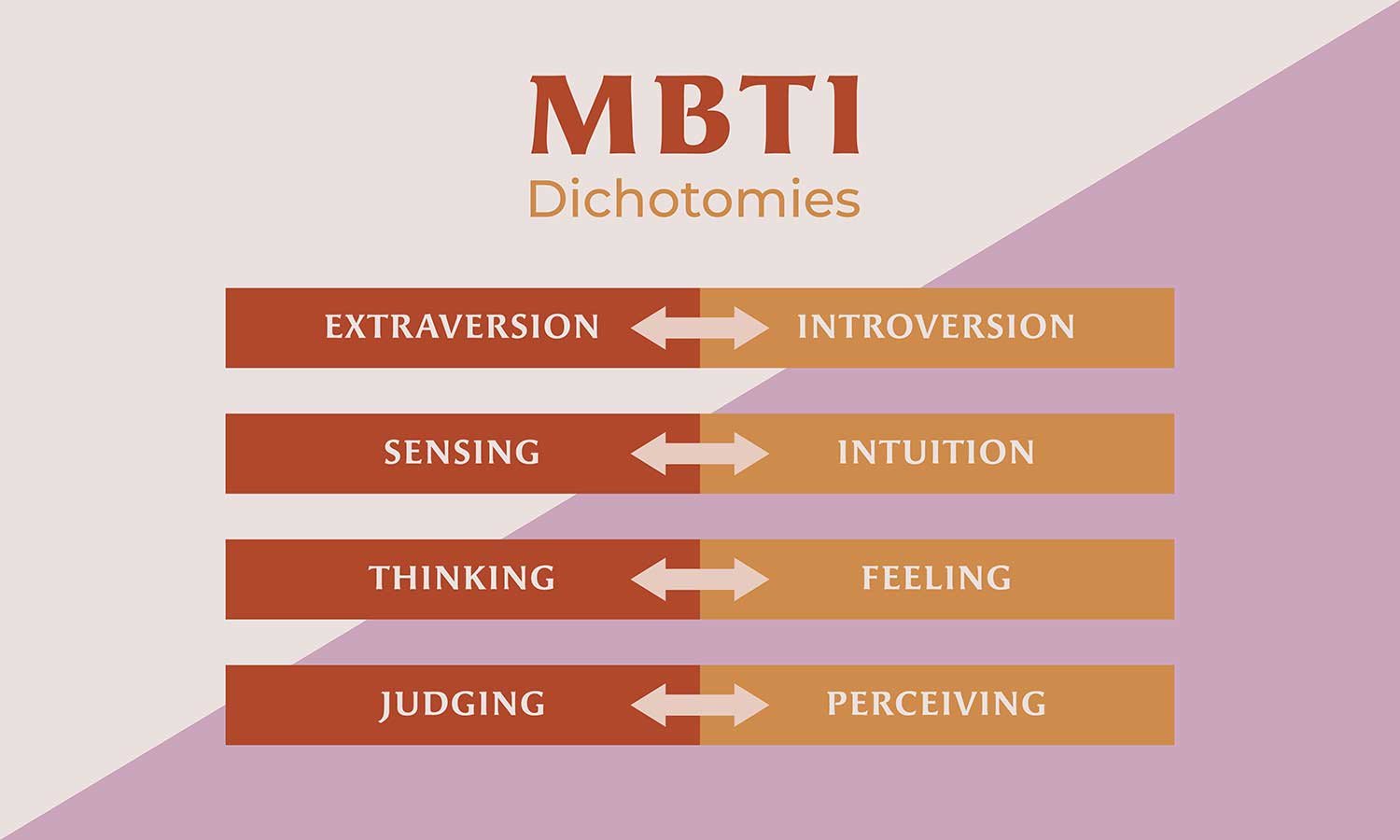
The dominant function is the primary aspect of personality, while the auxiliary and tertiary functions play supportive roles.
Dominant: Extroverted Thinking
- As objective, practical thinkers, ESTJs rely on facts and logic rather than personal feelings when making judgments.
- They do not enjoy abstract information or subjectivity as they prefer to make impersonal and impartial decisions.
- They prefer learning about things with immediate, real-world implications and tend to lose interest in ideas that are theoretical or speculative.
- As the “dominant” function, extraverted thinking is the most conscious and habitually used part of an ESTJ’s personality, the core that the other three functions support.
Auxiliary: Introverted Sensing
- ESTJs tend to have impressive memories. Their memories of past events can be detailed and vivid and they often utilize these recollections to make connections with present events.
- As their sensing function is focused inwardly, ESTJs are typically less concerned with novelty and more interested in familiarity.
- They tend to be creatures of habit, relying on their sense of stability, predictability, and routine.
Tertiary: Extraverted Intuition
- This aspect of the ESTJ personality is less prominent but still influences people with this personality type to explore their creativity.
- As they seek out novel ideas and new information, ESTJs may explore deeper meanings to discover unique connections, patterns, or interpretations.
- Psychologists describe the tertiary function as the personality’s “backup”: less developed than the dominant and auxiliary functions, it tends to become more fully available in mid-life.
Inferior: Introverted Feeling
- This function is not used as often for ESTJs, but in some situations, it may allow an ESTJ to make decisions based more on subjective feelings than pure logic.
- This function typically operates on an unconscious basis as ESTJs tend to give significant thought to their own emotions, but just do not express them externally.
- Psychologists call the inferior function the personality’s “blind spot”: the least conscious and least controlled function, and a common source of stress for the person who has it.
ESTJ Hobbies, Interests, and Careers
ESTJs’ organizational strengths carry over into both their careers and how they spend their free time.
Careers
Because of their structured, conventional nature, ESTJs tend to succeed in supervisory roles or any position that lets them exercise their gift for organization and order.
They are committed to enforcing the rules and traditions set by higher authorities. ESTJs prefer roles where they can make decisions and put policies into action.
They rarely shy away from responsibility. ESTJs make effective, dependable managers, bringing real enthusiasm for organization and principle to the role.
Because of their love of structure, efficiency, and thoroughness, suitable careers include financial officer, school administrator, business manager, agent, and auditor.
ESTJs value established institutions. Their loyalty and admiration for tradition can draw them toward respected government organizations, including law, policing, the judiciary, the military, and politics.
Hobbies and Free Time
In their free time, ESTJs favor hands-on activities.
This fits the same preference for structure and visible results that shows up in how they work.
Common hobbies include building and repairing things around the home, and gardening, both of which reward steady effort with a concrete result.
They are equally drawn to organized group activity, such as volunteering, community service, and playing or watching sports.
Free time still has a purpose, not just an outlet.
Even in leisure, ESTJs tend to favor activities with a clear goal, a defined role, or a visible outcome over open-ended or purely reflective pursuits.
A gardening project ends with a finished bed, a repair job ends with a fixed appliance, and a team sport ends with a scoreboard.
ESTJ Work Environments
ESTJs strongly prefer environments that emphasize strict rules and procedures. They respect workplaces that value tradition and stability and have clear sets of expectations and organized authority structures.
They struggle in disorganized, poorly managed environments, and they do not like to work alongside lazy, irresponsible employees or colleagues. They enjoy being surrounded by people who also hold themselves to high standards and are equally dedicated to the tasks at hand.
They appreciate being a part of a team, but they take the most pleasure from organizing, and sometimes even micromanaging, other members of their group.
The ideal workplace for ESTJs is one that enables them to use their organizational skills and progress along a path to increased responsibility.
ESTJ Personal Relationships
ESTJs bring the same directness to friendships and romance that they bring to work.
Social Style
As extroverts, ESTJs are outgoing and sociable. They enjoy being the center of attention and spending time with others.
They are also dependable, loyal friends. ESTJs typically form their strongest connections with people who share their values, traditions, and institutions.
ESTJs tend to struggle finding common ground with people who disagree with their principles and beliefs. Because of this, they do not usually befriend people who consistently express alternate viewpoints.
Shared ground matters to them.
They are always open to trying a new activity or attending a social event. The one condition is company.
In Romantic Relationships
In relationships, ESTJs are straightforward and honest about who they are, what they want from a partner, and what their goals are. This tends to produce stable, long-term relationships.
ESTJs take their relationships seriously. They are willing to put in significant effort to be a strong, committed partner.
ESTJs tend to struggle with expressing emotions and putting love into words. They show affection more tangibly instead, such as taking a partner out on dates or trying new activities together.
Tips for Interacting With ESTJs
Friendships
As ESTJs are outgoing and personable, they enjoy spending time with friends partaking in activities that they enjoy.
They also value loyalty and dependability, so ESTJs will form the closest friendships with stable friends who stick to their commitments and show up when they are supposed to.
Relationships
As partners, ESTJs take their commitments seriously. They value honesty and security and tend to dedicate themselves to relationships long-term.
They appreciate routine and family traditions and want a sense of stability in their home and love lives.
They struggle with emotions and feelings, so it is important to remember that they will find other, more tangible ways to express their affection.
Parenting
ESTJ parents tend to set clear roles and expectations of their children. They can be strict and controlling, enforcing rules and standards they have established and assigning jobs and duties to family members.
They want to raise their children to grow into hardworking, well-respected, and successful adults, continuing the example they’ve set as traditionalists.
Critical Evaluation
ESTJ is one of sixteen types produced by the Myers-Briggs Type Indicator (MBTI), a popular but heavily criticized personality test. Four problems stand out most in the research.
- Low reliability: people often get a different four-letter type when they retake the test, sometimes within weeks.
- Weak predictive validity: the type does not reliably predict job performance or other real-world outcomes.
- Dichotomization: the test forces continuous, normally distributed traits into artificial either/or categories.
- The Barnum effect: flattering, generic type portraits feel personally accurate to almost anyone.
Low Test-Retest Reliability
People often score a different type when they retake the MBTI, sometimes after only a few weeks. Pittenger (1993) reviewed the evidence and found that a substantial share of test-takers change on at least one letter when they retest.
This instability follows directly from how the test is scored.
A small shift in a handful of answers can flip someone from 51% Thinking to 51% Feeling, changing their whole four-letter type even though their underlying preference barely moved.
A dependable psychometric tool should return a consistent result. The MBTI often does not, and that inconsistency is one of the main reasons psychologists rate it poorly against basic standards of test quality.
The type someone is given can therefore depend on chance as much as personality.
Weak Predictive Validity
The MBTI also has limited predictive validity: it does not reliably forecast job performance or other important outcomes (Pittenger, 2005).
That is a problem. The instrument is often marketed for exactly these high-stakes decisions.
Reviews of the evidence base do not support using type scores to select, promote, or develop staff.
A test that cannot predict how well someone will do a job gives employers no defensible basis for choosing between candidates on type alone.
Type is not a hiring filter.
Despite this, many organizations still use MBTI results informally in hiring and team-placement conversations. Researchers argue the test is better treated as a conversation-starter for self-reflection than as a selection tool.
The evidence does not support that use, however common the practice still is.
Dichotomizing Continuous Traits
Perhaps the deepest problem is dichotomization. As psychologist Saul McLeod explains, personality traits are “more likely to be continuously distributed,” so sorting people into either/or types oversimplifies real differences (McLeod, 2024).
The MBTI ignores this. It splits each continuous trait at the midpoint and assigns everyone to one pole or the other. Two people who scored almost identically, say 51% and 49% Thinking, can therefore end up sorted into opposite categories.
Dimensional models avoid this problem entirely.
Researchers generally prefer dimensional models such as the Big Five, which place a person along a spectrum instead of forcing an either/or label. The Big Five was built from statistical analysis of how people’s traits actually vary, not from a single theorist’s clinical observations.
The Barnum Effect
Much of the MBTI’s persuasive power comes from psychology, not accuracy. The Barnum (or Forer) effect describes how people rate vague, flattering, generic statements as excellent descriptions of themselves personally.
Forer proved this directly in 1949.
He gave students an identical personality sketch, taken from a newspaper astrology column, and told each one it was written just for them. On average, students rated the sketch as a highly accurate description of their own personality.
MBTI portraits work the same way. Flattering, broadly worded descriptions trigger the same effect.
Once someone accepts a label, confirmation bias takes over, and people notice whatever fits it while discounting what does not.
The label starts to feel true simply because it was never really tested.
Contemporary Research
Recent work has kept testing the same questions rather than settling them.
Furnham (2022) re-examined how the MBTI relates to the Big Five at a finer level of detail. He mapped all four MBTI scores against the 30 individual facets of the NEO-PI-R personality inventory, rather than just the five broad traits.
Francis and Village (2022) took a different approach.
They built and validated a new instrument, the Francis Psychological Type Scales, and tested its factor structure, internal consistency, and agreement with people’s actual MBTI results.
Neither study rescues the MBTI’s central claims. Both confirm the same pattern seen for decades: modest overlap with well-established trait models, but no proof that people truly sort into the sixteen discrete “types” the test assigns.
Take the MBTI (Paper Version)
Key Takeaways
- ESTJ Meaning: Extraversion, Sensing, Thinking, and Judging: one of 16 Myers-Briggs types, nicknamed the Executive.
- Key Traits: Assertive, organized, and rule-abiding, ESTJs value tradition, structure, and decisive action.
- Strengths: Reliable, honest, and natural leaders who see plans through to completion.
- Watch-outs: Can come across as inflexible, judgmental, or bossy under pressure.
- Careers: Suit structured roles with clear authority, from management to law and the military.
- Test Reliability: The MBTI itself has weak test-retest reliability and predictive validity, so treat the ESTJ label as a starting point for reflection, not a fixed diagnosis.
Sources
Forer, B. R. (1949). The fallacy of personal validation: A classroom demonstration of gullibility. The Journal of Abnormal and Social Psychology, 44(1), 118–123. https://doi.org/10.1037/h0059240
Francis, L. J., & Village, A. (2022). The Francis Psychological Type Scales (FPTS): Factor structure, internal consistency reliability, and concurrent validity with the MBTI. Mental Health, Religion & Culture, 25(9), 931–951. https://doi.org/10.1080/13674676.2022.2041584
King, S. P., & Mason, B. A. (2020). Myers‐Briggs Type Indicator. The Wiley Encyclopedia of Personality and Individual Differences: Measurement and Assessment, 315-319.
McCrae, R. R., & Costa, P. T. (1989). Reinterpreting the Myers-Briggs Type Indicator from the perspective of the five-factor model of personality. Journal of Personality, 57(1), 17–40. https://doi.org/10.1111/j.1467-6494.1989.tb00759.x
Myers, I. B. (1962). The Myers-Briggs Type Indicator: Manual (1962).
Myers, K. D., & Kirby, L. D. (2015). Introduction to type: A guide to understanding your results on the MBTI assessment. Sunnyvale, CA: CPP.
Myers-Briggs Type Indicator. (2019, May 28). New World Encyclopedia, . Retrieved from https://www.newworldencyclopedia.org/p/index.php?title=Myers-Briggs_Type_Indicator&oldid=1020015.
Myers, Isabel B.; Myers, Peter B. (1995) [1980]. Gifts Differing: Understanding Personality Type. Mountain View, CA: Davies-Black Publishing. ISBN 978-0-89106-074-1.
Pittenger, D. J. (1993). The utility of the Myers-Briggs Type Indicator. Review of Educational Research, 63(4), 467–488. https://doi.org/10.3102/00346543063004467
Pittenger, D. J. (2005). Cautionary Comments Regarding the Myers-Briggs Type Indicator. Consulting Psychology Journal: Practice and Research, 57(3), 210-221.
Stein, R., & Swan, A. B. (2019). Evaluating the validity of Myers-Briggs Type Indicator theory: A teaching tool and window into intuitive psychology. Social and Personality Psychology Compass, 13(2), e12434. https://doi.org/10.1111/spc3.12434
The purpose of the Myers-Briggs Type Indicator®. The Myers & Briggs Foundation: MBTI Basics. (n.d.). Retrieved from https://www.myersbriggs.org/my-mbti-personality-type/mbti-basics/