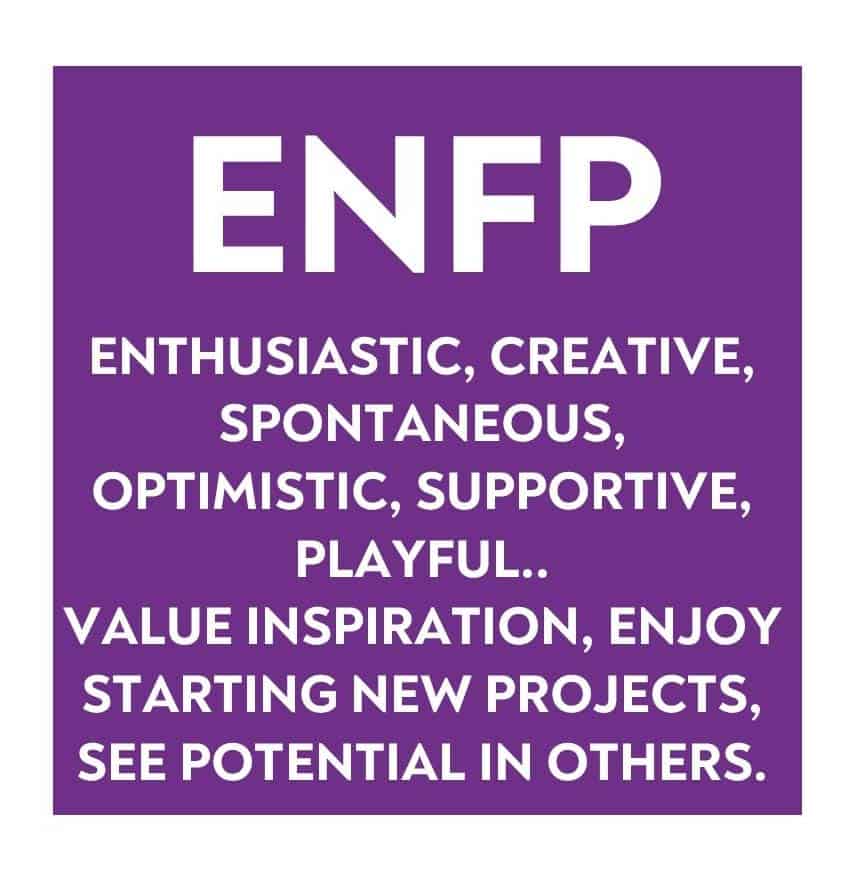
ENFP, an acronym from the Myers-Briggs Type Indicator (MBTI), stands for Extraversion, Intuition, Feeling, and Perceiving.
ENFPs are warm, imaginative and people-centered, drawn to new possibilities and guided by personal values rather than impersonal logic. Often nicknamed the Campaigner, they inspire others easily but can struggle with routine, detail and follow-through.
ENFP Meaning
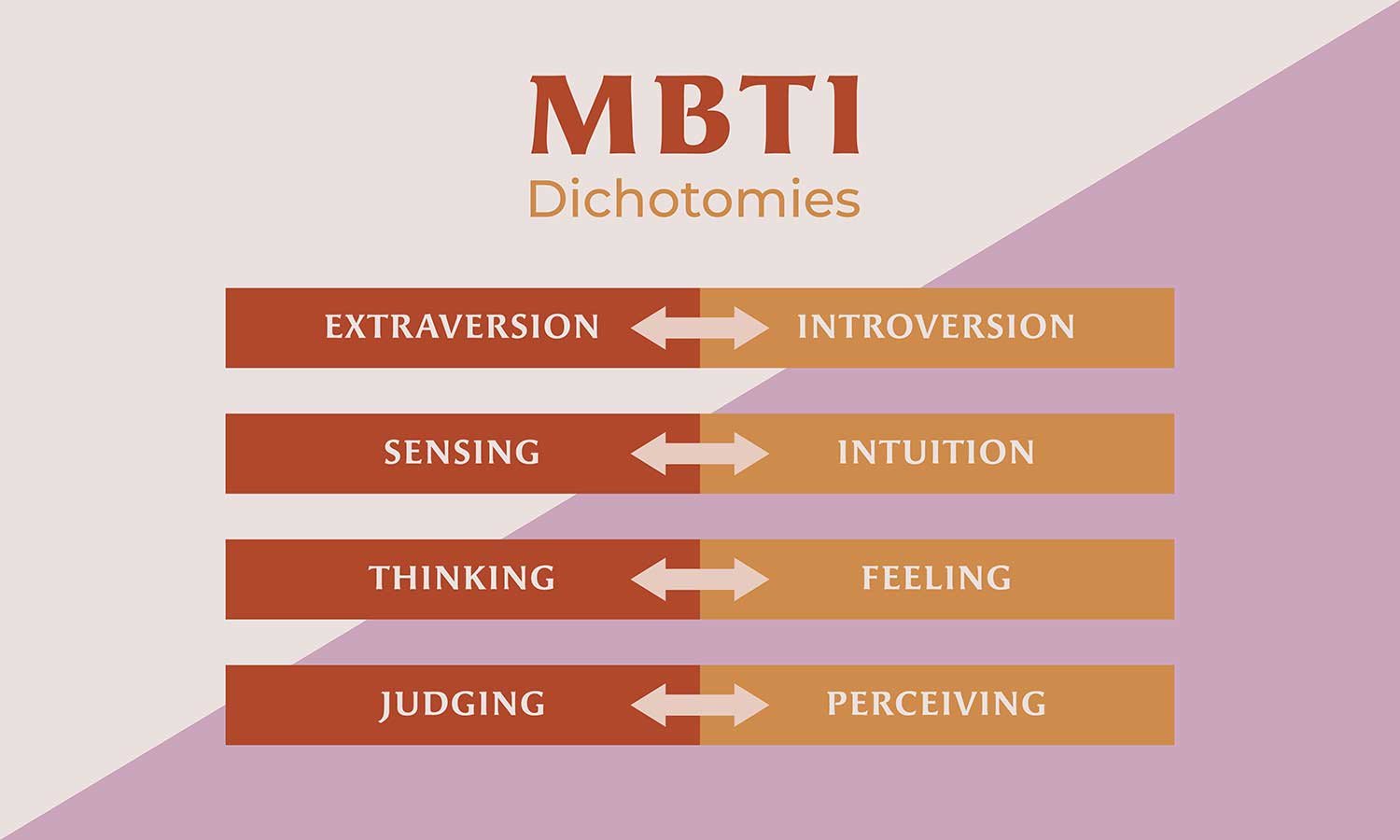
ENFPs thrive on social engagement (Extraversion). They lean towards visionary thinking and possibilities rather than concrete specifics (Intuition).
They prioritize personal values and emotional impact in their decision-making (Feeling). They cherish flexibility and openness to new experiences (Perceiving).
ENFPs are often described as warm, enthusiastic, and creative individuals. They are passionate about their interests, values, and ideas, and they have a natural ability to inspire and motivate others.
ENFPs are supportive and appreciative of their loved ones. People often describe them as charismatic and charming. Many have a strong artistic side and a unique mastery of language.
They have excellent people and communication skills. Being around others energizes them. They are free spirits with an optimistic and lively approach to life.
However, they might also struggle with overthinking, become easily stressed, and may tend to neglect routine or practical matters. They can be highly emotional and sensitive to criticism.
ENFP is a fairly common personality type, and is the fifth most common among women. ENFPs make up:
- 8% of the general population
- 6% of men
- 10% of women
ENFPs are sometimes referred to as “the Champion” or “the Campaigner.” Their opposite type is ISTJ, which reverses all four preferences.
| Strengths | Weaknesses |
|---|---|
| Outgoing and carefree | Disorganized |
| Empathetic | Hypersensitive |
| Warm and enthusiastic | Overthinks |
| Highly creative | Seek approval from others |
| Strong social and communication skills | Struggle to follow through on their ideas |
ENFP-A vs ENFP-T
Free online tests often report ENFP-A (Assertive) or ENFP-T (Turbulent). The official Myers-Briggs questionnaire does not use it.
It comes from 16Personalities, a free adaptation that borrows the MBTI letters but measures a hybrid model containing elements of the Big Five. The extra axis stands in for Neuroticism, the emotional-stability trait the MBTI itself never measures.
Assertive sits at the calm, self-assured end of that trait. Turbulent sits at the more self-critical, stress-sensitive end.
Free versions like this lack the standardized validation of the official instrument. Treat the extra letter as a rough label, not a measurement.
ENFP Characteristics
People with the ENFP personality type are highly imaginative and innovative
- They thrive where they have creative freedom and excel at generating original ideas. They are expressive communicators who enjoy finding deeper meaning in people and ideas.
- They can be quite introspective, contemplating the creative possibilities of life.
- They are always looking for a novel way to do things and refuse to follow the traditional path.
ENFPs are enthusiastic, people-centered individuals
- They are energized by time spent with other people and have a unique passion for helping others explore their potential.
- They love to talk with just about anyone, learning about what motivates and inspires them and what their dreams and aspirations are.
- They crave meaningful, deep connections with people and are highly attuned to other people’s feelings and needs.
- They are excellent communicators, and their warmhearted, approachable personalities enable them to have captivating conversations with all types of people.
ENFPs are known to be laid-back and easy going
- They are non-judgmental and open-minded and like to use their banter and quick wit to analyze and understand other people.
- They deal well with change and are able to adapt well to any circumstances that might arise throughout their lives.
- However, ENFPs are also disorganized and seemingly untethered.
ENFPs are natural-born leaders, standing up for what they believe in without hesitation or apology
- They are confident in their abilities to handle demanding responsibilities and will eagerly assume leadership positions.
ENFPs are spontaneous and highly adaptable to change
- They strongly dislike routine and prefer having freedom and flexibility in their everyday lives.
- They often struggle to see things through to completion. Their interests are ever-evolving, so an old project quickly becomes boring and stressful.
ENFP Cognitive Functions
Cognitive functions are the mental habits people use to take in information and to reach decisions. The MBTI works with four of them: thinking, feeling, intuition, and sensing.
Each function is directed either outwardly (extroverted) or inwardly (introverted). Their order forms a hierarchy, and that hierarchy is what the type describes.
The dominant function is the primary aspect of personality, while the auxiliary and tertiary functions play supportive roles.
The order below is not measured. It is worked out from the four letters, using a model of psychological types set out by Carl Jung and extended by Isabel Briggs Myers. Reviewers treat this part of the theory as one of the hardest to test (Stein & Swan, 2019).
Dominant: Extraverted Intuition
Intuition is a way of taking information in. Instead of stopping at the facts in front of them, ENFPs read the patterns, meanings and possibilities behind those facts.
Turning that function outward is what makes it extraverted. ENFPs generate ideas in the world rather than in private, thinking out loud, in conversation, and by trying things.
As the dominant function it is the driver. It is the most conscious and most trusted of the four, and it sets the tone for everything else in the stack.
In practice, ENFPs are abstract, creative thinkers who chase the infinite possibilities of life and skip the trivial detail. They have a knack for spotting unique connections among people, places, and ideas.
Auxiliary: Introverted Feeling
Feeling here does not mean emotion. In this model it is a rational way of deciding, one that weighs values and human impact instead of impersonal logic.
The introverted direction sets where that standard comes from. ENFPs check a choice against their own internal system of values rather than against group consensus.
Acting against those principles feels wrong. It matters to ENFPs that they stay true to themselves and their principles.
As the auxiliary it is the co-pilot, and it balances the driver. Extraverted Intuition gathers information and points outward; Introverted Feeling reaches decisions and points inward. Each supplies what the other lacks.
Tertiary: Extraverted Thinking
Thinking is the other way of reaching a decision. It works by impersonal logic and objective analysis, weighing evidence and looking for consistency.
Pointed outward, it goes to work on the external world. That is the function behind organizing information, working through problems, and enforcing order in a practical way.
Third place means less developed. Myers’ model expects this function to emerge more fully in mid-life.
The model uses that ranking to explain a familiar part of the ENFP portrait. Structure, deadlines and follow-through take deliberate effort, because the function that supplies them sits low in the stack.
Inferior: Introverted Sensing
Sensing takes in concrete, present, observable information.
Turned inward, it works from stored impressions rather than fresh ones. ENFPs use it by recalling past experiences to form expectations about what is coming, though it stays a minor influence.
Last place is the blind spot. This is the least conscious and least controlled of the four functions, and Myers’ model treats it as a common source of stress reactions.
That places routine, upkeep and fine detail furthest from an ENFP’s comfort zone. Under sustained pressure, the model predicts that difficulty shows up here first.
ENFP Hobbies, Interests, and Careers
Because of their creative nature and need for flexibility, ENFPs are commonly found in careers in religion, entertainment, and the arts. They are driven, inspired individuals who enjoy taking on problems that call for imaginative, original solutions.
They make great journalists, actors, musicians, and politicians. Additionally, ENFPs often choose careers in nonprofits, public service, counseling, education, customer or public relations as these jobs tend to align with their core values.
They are highly sensitive to people’s feelings and needs. The careers they care most about are the ones that let them help others reach their full potential.
In their free time, ENFPs enjoy writing, creating art, playing musical instruments, listening to music, participating in community theater, and reading fiction.
One caution belongs beside any career list. According to David Pittenger’s reviews of the evidence, a four-letter type is far too weak a predictor to steer who gets which job (Pittenger, 1993, 2005). Use the list as a prompt for exploring options.
ENFP Work Environments
The ideal work environment for an ENFP is one that is relaxed and flexible with few restrictions on creativity. They dislike predictability, regimentation, and repetitions and tend to avoid careers that involve completing a lot of detailed, routine tasks.
They prefer a workplace where they can set their own schedule and explore new ideas. Unstructured time lets them use their imaginations.
They enjoy working on a team and establishing connections with the other employees.
ENFPs often treat colleagues as friends rather than just coworkers. A workplace that treats everyone as equals suits them. Micromanagement and tight control do not.
ENFP Personal Relationships
ENFPs love spending time with other people. Socializing energizes them, and they can draw just about anyone into a conversation.
ENFPs as Friends
ENFPs are not too particular about who they befriend. Their approachable personalities draw in a wide variety of people, from the confidently outgoing to the shy and reserved.
What they look for is openness. They gravitate towards friends who are curious and adventurous, and who will talk about something that matters.
They also enjoy the drawing-out. Pulling a quiet person into a conversation and watching them gradually open up is genuinely satisfying for an ENFP.
Empathy is the engine underneath all of this. ENFPs read people quickly, notice what drives them, and tend to bring out the best in almost everyone they meet.
If you want to be closer to an ENFP, open up emotionally and be a support system. They give a great deal. They notice when it is returned.
ENFPs in Romantic Relationships
ENFPs fall in love fast and hard. They are dedicated partners, generous and considerate, and they will go to great lengths for the people they love.
The honeymoon stage suits them. It is exciting and unpredictable, and that is exactly the register an ENFP is most energized by.
The Perceiving preference explains why. ENFPs like keeping options open and are comfortable with last-minute change, so a settled routine can feel like the romance has gone quiet.
Finding new ways to bring excitement and adventure into the partnership matters to them. A partner who keeps the romance alive is what they need.
There is a vulnerable side to that intensity. Because they long for deep emotional connection, ENFPs can become insecure when a partner’s ardor does not seem to match their own.
ENFPs as Parents
As parents, ENFPs typically have deep, loving relationships with their kids. They encourage their children to embrace their passions and express themselves freely.
Discipline is the harder part. ENFPs tend not to be strong disciplinarians, and household rules stay light.
What they hand on instead is a value system. Feeling types reach decisions by weighing values and human impact rather than by applying an impersonal rule. An ENFP parent is therefore more likely to explain the reasoning behind a choice than to state the rule.
The Perceiving preference pulls the same way. An open-ended, flexible home suits an ENFP better than a planned and tightly scheduled one.
Warmth and freedom are the result. The trade-off is the routine side of family life, which ENFPs are more likely to let slide.
How Accurate Is the ENFP Type?
Type portraits are enjoyable, but psychologists have questioned the Myers-Briggs for decades. The criticisms below apply to every four-letter type, ENFP included.
Reliability and Predictive Validity
A useful test has to clear two bars: reliability, giving the same answer twice, and predictive validity, forecasting something real. The MBTI struggles with both.
People frequently receive a different four-letter type when they retake the questionnaire, sometimes only weeks apart. The label is not stable (Pittenger, 1993).
As David Pittenger concludes in his review of the evidence, there is not enough support for the test’s claimed uses.
Type scores predict job performance and similar outcomes poorly. A result like ENFP should never decide who gets hired or promoted (Pittenger, 1993, 2005).
Why Four Letters Oversimplify
The deeper problem is dichotomization: sorting a continuous trait into an either/or box. Scores on preferences such as extraversion are normally distributed, so most people cluster near the middle rather than at the poles.
Imagine someone whose answers fall 51% toward Feeling. They are recorded as an F and reported as ENFP. A near-twin at 49% is reported as ENTP, a different type, despite an almost identical profile.
Taking only the higher pole throws away the very thing that matters: how close to the midpoint the person actually sits.
Why the Description Feels So Accurate
Part of the appeal is a bias, not accuracy. The Barnum effect, also called the Forer effect, describes how readily people accept vague, generic statements as uniquely true of themselves.
Forer (1949) handed students an identical personality sketch assembled from a newspaper astrology column and asked how well it described them. They rated it about 4.3 out of 5. ENFP portraits are flattering and broadly worded, so they invite the same “that’s so me” reaction.
Confirmation bias does the rest. Once labeled, people notice what fits the description and quietly discount what does not.
Vague Language and Commercial Interests
Type portraits are also criticized as too vague to pin down. The wording is loose enough that almost any behaviour can be read as fitting the description (McLeod, 2024).
That flexibility comes at a cost. A theory that can explain anything becomes hard to prove wrong. That unfalsifiability is exactly what critics point to when they call the MBTI a pseudoscience rather than a science (Stein & Swan, 2019).
A separate criticism concerns money, not language. The MBTI is a commercial product, and official use requires paid certification, with a large training-and-materials industry built around the instrument.
As David Pittenger (2005) explains, the people promoting the test have a financial stake in its continued popularity, so its marketing has outrun the independent evidence supporting it.
Very little support for the MBTI appears in peer-reviewed journals, despite how often it gets used in coaching, team-building, and hiring conversations.
Contemporary Research
Personality researchers have largely set type models aside in favor of traits measured on continuous scales. Three lines of work show why.
McCrae and Costa (1989) gave the MBTI and the NEO Personality Inventory to 468 adults aged 19 to 93. They found no support for genuinely dichotomous types: the instrument measured four broadly independent dimensions that lined up with four of the Big Five factors.
Furnham (2022) pushed the comparison further, mapping the four MBTI scores onto all 30 facets of the NEO-PI-R. The same gap appears in both studies. Neither can find a Myers-Briggs dimension for Neuroticism, the emotional-stability trait that predicts a great deal of real-world behavior.
Francis and Village (2022) took a different route. They built the Francis Psychological Type Scales as an alternative measure.
That paper reports the new scale’s factor structure, reliability and agreement with the MBTI.
None of this has restored the type model. Reviews of the theory keep reaching the same conclusion (Stein & Swan, 2019).
References
Forer, B. R. (1949). The fallacy of personal validation: A classroom demonstration of gullibility. The Journal of Abnormal and Social Psychology, 44(1), 118–123. https://doi.org/10.1037/h0059240
Francis, L. J., & Village, A. (2022). The Francis Psychological Type Scales (FPTS): Factor structure, internal consistency reliability, and concurrent validity with the MBTI. Mental Health, Religion & Culture, 25(9), 931–951. https://doi.org/10.1080/13674676.2022.2041584
Furnham, A. (2022). The Big Five facets and the MBTI: The relationship between the 30 NEO-PI-R facets and the four Myers-Briggs Type Indicator (MBTI) scores. Psychology, 13(10), 1504–1516. https://doi.org/10.4236/psych.2022.1310095
King, S. P., & Mason, B. A. (2020). Myers-Briggs Type Indicator. In The Wiley encyclopedia of personality and individual differences: Measurement and assessment (pp. 315–319). Wiley. https://doi.org/10.1002/9781119547167.ch123
McCrae, R. R., & Costa, P. T. (1989). Reinterpreting the Myers-Briggs Type Indicator from the perspective of the five-factor model of personality. Journal of Personality, 57(1), 17–40. https://doi.org/10.1111/j.1467-6494.1989.tb00759.x
Myers, I. B. (1962). The Myers-Briggs Type Indicator: Manual. Educational Testing Service.
Myers, I. B., & Myers, P. B. (1980). Gifts differing: Understanding personality type. Consulting Psychologists Press.
Myers, K. D., & Kirby, L. D. (2015). Introduction to type: A guide to understanding your results on the MBTI assessment. CPP.
Pittenger, D. J. (1993). The utility of the Myers-Briggs Type Indicator. Review of Educational Research, 63(4), 467–488. https://doi.org/10.3102/00346543063004467
Pittenger, D. J. (2005). Cautionary comments regarding the Myers-Briggs Type Indicator. Consulting Psychology Journal: Practice and Research, 57(3), 210–221. https://doi.org/10.1037/1065-9293.57.3.210
Stein, R., & Swan, A. B. (2019). Evaluating the validity of Myers-Briggs Type Indicator theory: A teaching tool and window into intuitive psychology. Social and Personality Psychology Compass, 13(2), e12434. https://doi.org/10.1111/spc3.12434
The purpose of the Myers-Briggs Type Indicator. (n.d.). The Myers & Briggs Foundation. https://www.myersbriggs.org/my-mbti-personality-type/mbti-basics/