Kahneman’s capacity model says attention is a limited pool of mental effort that every task draws on. Two tasks can run together only if their combined demand stays inside that pool. Hard or unpractised tasks cost more, and being alert raises the supply. It explains divided attention, doing more than one thing at once.
Key Takeaways
- The Pool: Attention is a limited pool of mental effort shared by every task (Kahneman, 1973).
- Fit or Clash: A task costs more when it is hard or unpractised, and alertness generally enlarges the supply. Two tasks run together only if their combined cost fits.
- Practice: Skill cuts a task’s cost. Underwood (1974) and Spelke et al. (1976) found results that fit, though Spelke et al. trained only two people.
- Weak Points: Capacity is hard to measure apart from performance, and experiments point to more than one limit.
- Real Life: Phone conversation, not the handset, costs driving performance (Strayer & Johnston, 2001; Caird et al., 2018).
- Newer Evidence: Habitual media multitasking shows only a small link with cognitive control (Parry & Le Roux, 2021).
- Overall: The model fits the practice and driving findings. Laboratory experiments favour a general limit plus task-specific interference, but cannot say how large each is.
How Does Kahneman’s Capacity Model Explain Doing Two Things at Once?
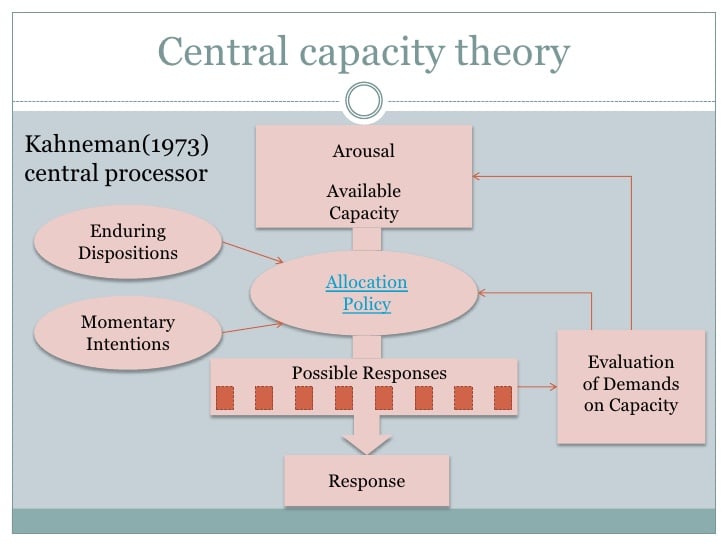
One Shared Pool of Mental Effort
A cheap task takes only a little from the pool, so plenty is left for a second task. An expensive task takes most of it and leaves almost nothing spare (Kahneman, 1973).
Kahneman set the model out in his book Attention and Effort. He called the pool of effort capacity.
Every task draws on the same capacity, whatever its kind. Listening, reading and typing all compete for one supply.
The pool is not a fixed size. Kahneman saw arousal, how awake and alert you are, as central. More effort is generally available when you are alert than when you are tired and lethargic (Kahneman, 1973).
The wider link between arousal and performance is covered under the Yerkes-Dodson law.
This model is about sharing attention between tasks. Choosing one message and ignoring the rest is a different question, covered in theories of selective attention.
What Makes a Task Cost More: Difficulty and Practice
Two things set how much effort a task costs: how difficult it is, and how much experience you have of it (Kahneman, 1973).
A harder task costs more than an easy one. A task you have done many times costs less than one you have never tried.
That gives the model its practice prediction. As skill grows, a task needs less capacity, and that frees capacity for other tasks (Kahneman, 1973).
Practice cuts the cost by making a task automatic, meaning it needs very little attention. Automatic processing has its own page.
Who Decides Where the Effort Goes?
A central processor is in charge of sharing out the effort.
It keeps demand under review. When demand runs too high, it rules on where the remaining effort should go (Kahneman, 1973).
Its rules are called the allocation policy, and they draw on three things:
- Enduring Dispositions: Lasting rules outside your voluntary control. Something new, or hearing your own name in another conversation, draws effort towards it.
- Momentary Intentions: Voluntary shifts of attention. You decide to listen to one voice rather than another.
- Evaluation of Demands: Rules for overload. You decide to finish one task rather than fail at two.
So effort is shared out partly automatically, partly by choice, and partly by a judgement made under pressure.
When Two Tasks Fit and When They Clash
The model turns all this into a simple test for a pair of tasks.
First, each task has a cost, set by its difficulty and your experience of it. Next, add the two costs together. Then compare the total with the effort you have right now. That supply depends on how alert you are.
If the total stays inside the supply, both tasks run together without loss. That happens when both tasks are cheap. Practice can make a task cheap.
If the total is bigger than the supply, there is not enough effort for both. At least one task suffers. The central processor must rule on where the remaining effort goes.
This is how the model explains findings from dichotic listening, where a different message plays in each ear.
In shadowing, a person repeats one message aloud as they hear it.
Shadowing uses almost all the available effort. That leaves too little for the message in the other ear, so very little of it gets through (Kahneman, 1973).
Everyday Scenarios Compared
The table below contrasts four everyday situations. They illustrate the model’s rule and are not research findings. Each row changes one thing, named in the first column: difficulty, practice, the second task or alertness.
| What changes | Fits inside the pool | Runs short |
|---|---|---|
| Task difficulty | Chatting to a friend while folding the washing. The washing costs little effort. | Chatting to a friend while filling in a complicated form. The form costs a lot. |
| Practice | Cooking a meal you know by heart while the news plays. | Cooking from a new recipe while the news plays. |
| The second task | Reading a magazine while the radio plays quietly. | Reading a magazine while a friend asks you a string of questions. |
| Alertness | Following a podcast while tidying, when you feel fresh and alert. | The same pair late in a long, tiring day. |
In every row the same rule applies. Add the two costs and compare the total with the supply. Changing one thing can tip a pair of tasks from one column to the other.
An Example: Two People, One Page of Copying
Take two people who each have to copy out a page of text while a friend reads a story aloud nearby. Here is how Kahneman’s model reasons about each of them.
Priya has typed for years. Copying costs her little effort, so most of her pool is spare. The model says the story fits into that spare effort, so both tasks can run together.
Sam has only just learned to type. Every word takes thought, so the copying uses most of his pool. Little is left over, and the story slips past him.
Next, someone says Sam’s name. He notices at once, although he did not choose to listen. That is an enduring disposition at work: effort goes to his own name outside his voluntary control.
Then Sam decides to follow the story. That is a momentary intention, and his copying gets worse.
When the friend speeds up, demand is too high for both tasks. Sam judges that finishing the page matters more, and stops listening. That is the evaluation of demands: finishing one task rather than failing at two.
The page is the same for both people. What differs is experience, and so how much of the pool the copying takes.
What’s the Evidence for Kahneman’s Capacity Model?
The model makes two predictions. A pair of tasks should run together without loss when their combined cost fits the pool, and practice should cut a task’s cost.
The Dual-Task Method: Splitting Attention on Purpose
Psychologists test divided attention with the dual-task method. People do two tasks at the same time, and researchers measure how much doing one costs performance on the other. That drop is the dual-task cost.
Shadowing does the opposite. It narrows a person’s attention onto one message.
A dual-task study splits attention on purpose, which is informative about a person’s processing limits. This is the study of the division of attention: how far attention can be shared between tasks.
On Kahneman’s model, a pair with no cost fitted inside the pool, and a pair with a large cost did not.
Can Two Skilled Tasks Run Together?
Yes, and two early studies showed it.
Allport, Antonis and Reynolds (1972) asked skilled pianists to sight-read unfamiliar music, which means playing it without having seen it before. At the same time, the pianists repeated speech played through headphones.
They did both with essentially no measurable cost.
Shaffer (1975) found the same with one professional copy typist. The typist touch-typed text while repeating spoken prose, with very few errors on either task.
Both results rule out a strict single-channel model, in which all information must pass through one channel (Allport et al., 1972; Shaffer, 1975).
They also became central evidence for capacity theories like Kahneman’s. A module account such as Allport’s (1980, 1989, 1993) also fits these results: tasks that use different specialised mechanisms do not compete. The comparison section returns to that view.
Does Practice Free Up Capacity? Spelke, Hirst and Neisser (1976)
The first studies paired unlike tasks. Spelke, Hirst and Neisser (1976) asked a harder question. Can practice let people combine two tasks that both rely on reading and language?
- Aim: To test whether practice lets people combine two demanding tasks that both involve reading and language.
- Method: Two university students trained for about five hours a week over several months. They read short stories for comprehension while writing down words dictated to them. Later they wrote each word’s category instead, such as “animal” for “dog”.
- Results: At first, both tasks suffered. After about six weeks, they read as fast and understood as much while writing as without it. With more practice, the harder task showed no cost either.
- Conclusion: Practice appeared to cut the capacity each task needed, so two tasks that once interfered could be combined without cost. This fits Kahneman’s claim that a task’s demand falls with experience.
There were only two participants. Both were highly motivated and intensively trained, so it is unclear whether the effect would hold for other people.
The pair remembered almost none of the words they wrote. The dictation was processed only shallowly, just enough to write it down. That may have made the tasks unusually easy to automate.
The study also cannot rule out a narrow, task-bound skill, such as writing without close attention, in place of a general fall in capacity demand.
The Direct Test: Practised Shadowers (Underwood, 1974)
Underwood (1974) tested the same prediction in a different way. Does extended shadowing practice really free up capacity, or does it just make shadowing feel easier?
- Aim: To test whether highly practised shadowers, unlike novices, can shadow one message and also register information in the other, unattended message.
- Method: People with extensive shadowing practice were compared with relatively naive shadowers. Two different messages played at once, one to each ear. Everyone shadowed one message, and detection of material in the other was measured.
- Results: The practised shadowers noticed and reported information from the other ear, including material that novices reliably missed, while still shadowing accurately. Novices showed near-total unawareness of the other message.
- Conclusion: Extended practice frees capacity that can be redirected to a second source of information, as Kahneman’s model predicts. So a task’s demand is not fixed. It falls as the task is done more efficiently.
This is a direct test of the practice prediction. It asks whether practice frees capacity, not just whether a task feels easier.
The groups were different people.
The study shows what practised shadowers could do. It does not show how much capacity was freed. That is a wider problem, taken up under the limitations.
Does Media Multitasking Change Attention? Parry and Le Roux (2021)
Kahneman’s prediction is about practice at one task. A newer question is whether a habit changes attention itself.
Media multitasking means using more than one media stream at once, such as texting while watching television.
An early study found that habitual media multitaskers scored worse on laboratory measures of cognitive control (Ophir et al., 2009). That covers skills such as sustaining attention and working memory, the ability to hold information in mind.
- Aim: To measure how strongly media multitasking relates to cognitive control, and whether this depends on how control is measured.
- Method: A meta-analysis, which pools the results of many studies into one overall figure. It combined 118 estimates of the link from 32 studies published between 2009 and 2019, mostly with university students.
- Results: The overall link was small (z ≈ .14, where 0 means no link). Self-report questionnaires showed a somewhat stronger link than performance tasks. Only sustained attention and working memory showed reliable links, and these were small.
- Conclusion: The evidence does not support strong claims that heavy media multitasking impairs cognitive control in general. Measurement method was the biggest source of variation between studies.
A pooled analysis of 32 studies outweighs the single early study it revisits. The picture is uncertain. The overall effect is small, not a strong decline in control.
Uncapher and Wagner (2018) reached a similar verdict in a wider review: findings are mixed and often small.
Most of this research is correlational. It cannot say which way the link runs (Uncapher & Wagner, 2018). Heavy multitasking might weaken control, or people with weaker control might gravitate towards multitasking.
These studies measure a habit, not the cost of one particular pair of tasks.
Strengths
Kahneman’s model has three main strengths:
- Flexible Capacity: Because effort depends on difficulty, skill and arousal, the model is more flexible than the single-channel filter models (Kahneman, 1973).
- Dichotic Listening: It explains why shadowing leaves little capacity for the message in the other ear (Kahneman, 1973).
- Testable Prediction: It predicted that skill frees capacity, and Underwood (1974) and Spelke et al. (1976) found results that fit.
Limitations
Before working through each one, here is a one-line summary of the main limitations:
- Capacity Is Hard to Measure: Effort has proved hard to measure apart from the performance it should explain, so the idea risks being unfalsifiable (Navon, 1984).
- More Than One Limit: Experiments suggest a general limit plus task-specific interference (Bourke et al., 1996; Treisman & Davies, 1973).
- Laboratory Pairings: The task pairs used in the laboratory are artificial, and everyday multitasking is harder to study.
- Individual Differences: A few people show no dual-task cost, and costs rise with age (Watson & Strayer, 2010; Thönes et al., 2018).
Capacity Is Hard to Measure
The model explains poor dual-task performance by saying the pool ran out. But poor performance is the main sign that it ran out.
Navon (1984) pressed this point. A resource that cannot be measured apart from the performance it explains risks becoming unfalsifiable: no possible result could show it wrong.
Navon aimed this objection at resource theories in general. Whatever the results, a suitable set of resources can be proposed afterwards to fit them.
The weakness is the flip side of the model’s flexibility. Because capacity shifts with difficulty, skill and arousal, it is hard to pin down.
The model is not entirely untestable. Underwood (1974) and Spelke et al. (1976) put its practice prediction to the test. Even so, neither study measured capacity itself.
Norman and Bobrow (1975) add a warning that flat performance may not reflect capacity at all, as the comparison section explains.
The Evidence Points to More Than One Limit
Kahneman’s model says total demand is what matters. Several experiments suggest the picture is more complicated.
One finding supports a shared pool.
Bourke, Duncan and Nimmo-Smith (1996) chose four unlike tasks to avoid obvious overlap such as a shared sense, then combined them two at a time. The most demanding task, generating random letters, disrupted every partner. The least demanding, detecting tones, disrupted partners least.
So a general factor affects dual-task performance even across unlike tasks (Bourke et al., 1996). Other findings show that similarity matters too.
Treisman and Davies (1973) found more interference when attention was divided between two auditory sources than between an auditory and a visual source. Some cost remained even across senses.
Hegarty, Shah and Miyake (2000) expected paper folding to suffer more than figure matching from a task taxing central capacity. They found the opposite.
Figure matching, which involves more explicit response selection (choosing which response to make), suffered more.
Lehle, Steinhauser and Hübner (2009) asked 28 healthy participants to handle two tasks either one after the other or together. One after the other gave better performance. It also felt more effortful.
The authors suggest people usually run tasks together as a compromise between performance and effort.
So how a person approaches the tasks shapes the result, not only how demanding the tasks are. A single pool cannot be the whole story. The synthesis accounts described below add specific systems to it.
Laboratory Pairings Are Not Everyday Multitasking
The laboratory experiments used artificial pairings.
Bourke et al. (1996) combined tasks such as generating random letters and detecting tones. Spelke et al. (1976) asked students to write the categories of dictated words while reading. Such pairs were chosen to isolate particular demands cleanly.
That is exactly what makes them poor guides to everyday multitasking. Real tasks overlap messily, and few people train at a pair of tasks for months.
Applied studies narrow the gap.
The driving studies use a simulated drive with real-world stakes (Strayer & Johnston, 2001; Watson & Strayer, 2010). The media-multitasking studies that Parry and Le Roux (2021) pooled went further and measured naturally occurring media habits, not an assigned pair of tasks.
The price is a noisier measure. That may help explain why the pooled effect for media multitasking is small.
One Pool Does Not Fit Everyone
Kahneman’s model does not say how capacity differs between people.
Watson and Strayer (2010) tested around 200 drivers in a high-fidelity driving simulator. They drove alone and while doing a demanding auditory working-memory task.
Most showed the expected cost. About 2.5% showed no measurable cost at all and were called supertaskers.
Age matters too. Thönes, Falkenstein and Gajewski (2018) compared 36 young adults with 138 healthy older adults (mean age 70) on a dual-task procedure.
They then split the older adults by dual-task cost. The cost rose in clear steps from the young adults to the low-performing older group.
That graded pattern (Thönes et al., 2018) is consistent with a pool that shrinks gradually with age, not one that breaks down suddenly.
Together, these results suggest that capacity varies between people and across life. It is not one number that everyone shares. A single shared pool is therefore a simplification.
Where Does Divided Attention Matter in Real Life?
Driving and Phone Calls: Strayer and Johnston (2001)
Driving while phoning is a real-life dual-task pair. Strayer and Johnston (2001) tested it directly.
- Aim: To find out whether holding a phone conversation, rather than just holding a phone, is what harms driving-related attention.
- Method: Participants did a simulated driving task, responding to occasional red and green traffic lights. They drove alone, while listening to the radio or a book on tape, or while in conversation on a hand-held or hands-free phone.
- Results: Radio and book on tape caused little disruption. Conversation on either type of phone doubled the missed traffic signals and slowed reactions to the signals that were seen. Hand-held and hands-free made no meaningful difference.
- Conclusion: The cost came from the conversation itself, not from holding a handset.
The task was simulated. Two pooled analyses agree on the main finding.
Horrey and Wickens (2006) pooled 23 studies and found clear costs to driving while conversing. Caird et al. (2018) updated this with 93 studies and 4,382 participants.
Both hand-held and hands-free calls carried a moderate overall cost. Talking to a passenger showed a similar pattern. That fits the idea that conversation is what costs.
But the reviews cannot say which theory explains the cost. A single pool and a rival account, in which tasks interfere only when they share certain resources, both predict it.
Participants were young adults on average and simulators dominate, so costs on real roads are less certain (Caird et al., 2018). The two reviews also share an author. So they are not fully independent checks.
Flying and Workplace Workload
Capacity ideas are also used to design jobs.
Wickens developed multiple-resource theory for this purpose (Wickens, 2002). It says there are several separate kinds of mental resource, and tasks interfere when they draw on the same kind.
The theory was developed to predict when an extra display, warning or task will overload a worker such as a pilot or an air-traffic controller (Wickens, 2002).
Workload here means the total demand a job puts on a person. The comparison section below describes the theory in full.
A task that draws on a different kind of resource from the main job can therefore be added with less risk.
For a pilot whose eyes are already busy with cockpit displays, the theory points designers to an auditory alert rather than a visual one (Wickens, 2002).
Dual-Task Tests and ADHD
Dual-task tests have also been used in ADHD research.
Caldani et al. (2019) compared children with and without ADHD. Each child did two tasks at once: keeping their eyes on a target and holding their posture steady. They did this sitting, on a stable platform and on an unstable platform.
Under dual-task demand, children with ADHD held their gaze less steadily and kept their posture less stable than children without ADHD. The gap narrowed on the hardest, unstable-platform condition.
A difference between group averages cannot, on its own, show whether any one child has ADHD. It shows how a group performed on one laboratory task.
How Does Kahneman’s Model Compare with Other Accounts of Attention?
Filter Models: One Stream at a Time
Kahneman’s model answers a different question from the older filter models.
Broadbent’s (1958) filter theory and Treisman’s (1964) attenuation model explain selective listening: how one message is picked out. Broadbent’s filter blocks the other message completely. Treisman’s model only turns it down, which is what attenuation means.
Both assume, at least implicitly, a single serial channel. Information is dealt with one stream at a time (Broadbent, 1958; Treisman, 1964).
Kahneman asks how much processing is available in total when someone tries to attend to more than one stream. He keeps the idea of a single, general-purpose limit.
But he drops the assumption that only one channel can be open. Several tasks can run together, provided their combined demand stays under the ceiling.
The filter models were never designed to explain two tasks being done well at once.
When More Attention Does Not Help: Norman and Bobrow (1975)
Norman and Bobrow (1975) proposed a second capacity theory, built on a simple distinction.
A resource-limited process is one where performance improves as more capacity is given to it.
A data-limited process is one where performance is capped by the quality of the stimulus, such as a very faint signal. Extra effort does not help.
Straining to hear a whisper that is too quiet to make out is an example of the second kind.
The distinction matters for reading dual-task results. Suppose performance stays flat however much spare capacity a person seems to have. The task may need very little capacity, or it may be data-limited.
So the framework is a warning, not a rival theory. Do not read every dual-task result as a direct measure of capacity (Norman & Bobrow, 1975).
Module and Multiple-Resource Accounts
Some researchers reject a single central pool altogether. Allport argued that tasks compete for specialised processing mechanisms, called modules, each limited in capacity and none uniquely central (Allport, 1980, 1989, 1993).
Two similar tasks share modules, so performance suffers. Two unlike tasks use different modules, so both can be done at once. The pianist and typist studies fit this (Allport et al., 1972; Shaffer, 1975).
Wickens developed this idea into multiple-resource theory (Wickens, 2002). Instead of one pool, he proposed resources organised along several dimensions at once:
- Stage: Perceiving and thinking versus responding.
- Modality: The sense used for input, seeing or hearing.
- Code: How information is represented, spatially or verbally.
- Response Channel: How you respond, by hand or by voice.
Two tasks interfere to the extent that they draw on the same combination of these resources. Two tasks using entirely different combinations should, in principle, run together with little or no cost.
Synthesis: A Central Pool Plus Specific Systems
Eysenck (1982, 1997) and Baddeley (1986) argue that the capacity and module accounts complement each other.
Their combined picture has two parts. A central capacity processor, free of any one sense, coordinates behaviour. It works alongside specific processing systems.
In Baddeley’s (1986) working-memory model, two storage systems work independently of the central processor. The phonological loop holds verbal material, and the visuo-spatial sketchpad holds visual and spatial material. See working memory for the full model.
Their separateness explains why repeating a well-learned string of digits aloud does not interfere with verbal reasoning. The first uses the loop. The second uses the central processor.
The laboratory experiments above favour a combined picture (Bourke et al., 1996; Treisman & Davies, 1973). They favour the existence of both parts, a general limit and task-specific interference. They do not measure how large each part is.
References
Allport, D. A. (1980). Attention and performance. In G. Claxton (Ed.), Cognitive psychology: New directions (pp. 112–153). Routledge & Kegan Paul.
Allport, D. A. (1989). Visual attention. In M. I. Posner (Ed.), Foundations of cognitive science (pp. 631–682). MIT Press.
Allport, D. A. (1993). Attention and control: Have we been asking the wrong questions? A critical review of twenty-five years. In D. E. Meyer & S. Kornblum (Eds.), Attention and performance XIV (pp. 183–218). MIT Press.
Allport, D. A., Antonis, B., & Reynolds, P. (1972). On the division of attention: A disproof of the single channel hypothesis. Quarterly Journal of Experimental Psychology, 24(2), 225–235. https://doi.org/10.1080/00335557243000102
Baddeley, A. D. (1986). Working memory. Oxford University Press.
Bourke, P. A., Duncan, J., & Nimmo-Smith, I. (1996). A general factor involved in dual-task performance decrement. Quarterly Journal of Experimental Psychology, 49(3), 525–545. https://doi.org/10.1080/713755635
Broadbent, D. E. (1958). Perception and communication. Pergamon Press. https://doi.org/10.1037/10037-000
Caird, J. K., Simmons, S. M., Wiley, K., Johnston, K. A., & Horrey, W. J. (2018). Does talking on a cell phone, with a passenger, or dialing affect driving performance? An updated systematic review and meta-analysis of experimental studies. Human Factors, 60(1), 101–133. https://doi.org/10.1177/0018720817748145
Caldani, S., Razuk, M., Septier, M., Barela, J. A., Delorme, R., Acquaviva, E., & Bucci, M. P. (2019). The effect of dual task on attentional performance in children with ADHD. Frontiers in Integrative Neuroscience, 12, Article 67. https://doi.org/10.3389/fnint.2018.00067
Eysenck, M. W. (1982). Attention and arousal: Cognition and performance. Springer-Verlag.
Eysenck, M. W. (1997). Anxiety and cognition: A unified theory. Psychology Press.
Hegarty, M., Shah, P., & Miyake, A. (2000). Constraints on using the dual-task methodology to specify the degree of central executive involvement in cognitive tasks. Memory & Cognition, 28(3), 376–385. https://doi.org/10.3758/BF03198553
Horrey, W. J., & Wickens, C. D. (2006). Examining the impact of cell phone conversations on driving using meta-analytic techniques. Human Factors, 48(1), 196–205. https://doi.org/10.1518/001872006776412135
Kahneman, D. (1973). Attention and effort. Prentice-Hall.
Lehle, C., Steinhauser, M., & Hübner, R. (2009). Serial or parallel processing in dual tasks: What is more effortful? Psychophysiology, 46(3), 502–509. https://doi.org/10.1111/j.1469-8986.2009.00806.x
Navon, D. (1984). Resources—A theoretical soup stone? Psychological Review, 91(2), 216–234. https://doi.org/10.1037/0033-295X.91.2.216
Norman, D. A., & Bobrow, D. G. (1975). On data-limited and resource-limited processes. Cognitive Psychology, 7(1), 44–64. https://doi.org/10.1016/0010-0285(75)90004-3
Ophir, E., Nass, C., & Wagner, A. D. (2009). Cognitive control in media multitaskers. Proceedings of the National Academy of Sciences, 106(37), 15583–15587. https://doi.org/10.1073/pnas.0903620106
Parry, D. A., & Le Roux, D. B. (2021). “Cognitive control in media multitaskers” ten years on: A meta-analysis. Cyberpsychology: Journal of Psychosocial Research on Cyberspace, 15(2), Article 7. https://doi.org/10.5817/CP2021-2-7
Shaffer, L. H. (1975). Multiple attention in continuous verbal tasks. In P. M. A. Rabbitt & S. Dornic (Eds.), Attention and performance V. Academic Press.
Spelke, E. S., Hirst, W. C., & Neisser, U. (1976). Skills of divided attention. Cognition, 4(3), 215–230. https://doi.org/10.1016/0010-0277(76)90018-4
Strayer, D. L., & Johnston, W. A. (2001). Driven to distraction: Dual-task studies of simulated driving and conversing on a cellular telephone. Psychological Science, 12(6), 462–466. https://doi.org/10.1111/1467-9280.00386
Thönes, S., Falkenstein, M., & Gajewski, P. D. (2018). Multitasking in aging: ERP correlates of dual-task costs in young versus low, intermediate, and high performing older adults. Neuropsychologia, 119, 424–433. https://doi.org/10.1016/j.neuropsychologia.2018.09.003
Treisman, A. M. (1964). Verbal cues, language, and meaning in selective attention. The American Journal of Psychology, 77(2), 206–219. https://doi.org/10.2307/1420127
Treisman, A. M., & Davies, A. (1973). Divided attention to ear and eye. In S. Kornblum (Ed.), Attention and performance IV (pp. 101–117). Academic Press.
Uncapher, M. R., & Wagner, A. D. (2018). Minds and brains of media multitaskers: Current findings and future directions. Proceedings of the National Academy of Sciences, 115(40), 9889–9896. https://doi.org/10.1073/pnas.1611612115
Underwood, G. (1974). Moray vs. the rest: The effects of extended shadowing practice. Quarterly Journal of Experimental Psychology, 26(3), 368–372. https://doi.org/10.1080/14640747408400426
Watson, J. M., & Strayer, D. L. (2010). Supertaskers: Profiles in extraordinary multitasking ability. Psychonomic Bulletin & Review, 17(4), 479–485. https://doi.org/10.3758/PBR.17.4.479
Wickens, C. D. (2002). Multiple resources and performance prediction. Theoretical Issues in Ergonomics Science, 3(2), 159–177. https://doi.org/10.1080/14639220210123806

