Phrenology is a discredited 19th-century theory holding that a person’s character and mental abilities can be read from the shape and bumps of their skull. Founded by Franz Joseph Gall and popularised by Johann Spurzheim and George Combe, it held that each mental faculty (a distinct mental ability, such as memory or self-esteem) lived in its own brain “organ,” whose size pushed out the skull above it.
Key Takeaways
- What Phrenology Is: Phrenology, or craniology, judges a person’s psychological strengths and weaknesses from the size and shape of regions on the skull.
- Origins: Franz Joseph Gall, a German-born physician working in Vienna, invented phrenology in the late 1700s; his student Spurzheim and the Edinburgh lawyer George Combe later popularized it across Europe and the US.
- The Organs: Phrenology held that the brain contains between 26 and 40 distinct “organs,” each linked to a mental faculty. The larger the organ, the more Gall believed it was used.
- Criticism: Even at its peak, phrenology drew criticism, from Gall’s methods to its supposed promotion of materialism and atheism. Modern MRI studies provide a rigorous argument against it.
- Crime and Class: Gall saw phrenology as fixed, but his successors argued it was malleable. This became an early theory of criminal biology, and a justification for teaching poorer classes their “place” in society.
- Legacy: Despite being discredited, phrenology influenced neuroscience by suggesting that specific brain regions control specific functions, and by pointing to the existence of white matter.
History and Overview
Phrenology, sometimes called craniology, is a now-discredited system for judging a person’s psychological strengths and weaknesses. It works by correlating the size and shape of regions of the skull with the supposed functions of the underlying areas of the brain.
Gall invented phrenology in Vienna in the late 18th century. The theory spread widely, shaping medicine, science, and culture across Europe and North America through the first half of the 19th century.
In the 1790s, Gall formulated four fundamental themes that guided his research in phrenology:
-
Moral and intellectual qualities are innate;
-
The functioning of someone’s moral and intellectual systems depends on their organ and body structure;
-
The brain is the organ of the mind, containing all of someone’s mental faculties, tendencies, and feelings, rather than an immaterial soul acting through the heart or ventricles;
-
The brain is composed of as many organs as there are faculties, tendencies, and feelings.
These four theses were controversial at the time (Greenblatt, 1995). Two of them, though, hold up well today: the second and third resemble the modern theory of brain localization.
Gall said he had been observing human behavior since childhood. He was struck by the prominent, bulging eyes of classmates who had strong verbal memories (Greenblatt, 1995).
From this, he reasoned that skull shape reflects the brain’s structure beneath it. Particular parts of the brain, he concluded, are responsible for particular behaviors.
Gall extended the logic further. If a behavior is exaggerated in many people whose skulls are prominent in the same place, then that brain region must be larger than usual (Greenblatt, 1995).
Phrenology rested on the principle of cerebral localization: the idea that different brain regions handle different cognitive processes.
Why was phrenology so popular?
Phrenology’s popularity makes sense only against the science and culture of the late 18th century. Greenblatt (1995) pointed to two forces behind its spread.
The first was the state of neuroscience at the time. The second was the central role of Christian theology in scientific thinking.
The State of 18th-Century Neuroscience
“Neurophysiology” in this period still rested on the ideas of the Roman doctor Galen of Pergamon, writing in the 2nd century. No rival theory had replaced them (Greenblatt, 1995).
Galen held that a “vital spirit,” or pneuma, originated in the heart’s left ventricle. Carotid arteries carried it to the brain.
There, the brain purified this pneuma into cerebrospinal fluid.
Galen’s medicine was humoral. Solid organs, on this view, mainly processed the body’s humors and pneumas rather than generating thought themselves.
One influential line of thought searched for the “sensorium commune” (Greenblatt, 1995). This was supposed to be a single part of the brain, often equated with the soul, that controlled all the senses at once.
Gall’s claim broke sharply with this tradition. He held that the mind lived in the solid cerebral substance itself, and that its powers were localized.
Religious Opposition and the Move to Paris
Galen’s hold on medicine was not the only obstacle. Government and church actively interfered with scientific research into the mind, and phrenology drew fire from the church directly.
Emperor Francis I banned Gall from lecturing publicly in Austria in 1802. The grounds: phrenology’s ideas were subversive to religion and morals (Morin, 2014).
Gall left Austria.
He and his student Johann Gaspar Spurzheim moved to Paris in response.
There, Spurzheim systematized and extended Gall’s system, and coined the very name “phrenology” for it. Gall himself had preferred the plainer terms organology, his name for the whole system, and cranioscopy, the practice of reading the bumps on the skull.
Spurzheim later moved to England. He published The Physiognomical System of Drs. Gall and Spurzheim (Greenblatt, 1995), launching the phrenological movement in England and the United States.
The new name, phrenology, stuck.
Explanation of Theory
Phrenologists practiced cranioscopy — reading the bumps on a person’s skull — to judge their cognitive and psychological characteristics. Gall believed each mental faculty left its own mark on the bone.
Cranioscopy: Gall’s Original 26 Organs
Gall located the mind in 26 distinct regions, or “organs,” linked by connective white matter. His followers went on to add further regions.

Gall’s original list of 26 organs (Morin, 2014):
- The instinct to reproduce, parental love, fidelity, self-defense, and murder (destructiveness)
- Cunningness, the sense of property, pride, ambition and vanity, and caution
- Educational aptness, a sense of location, memory, verbal memory, and language
- Color perception, musical talent, a faculty for arithmetic, counting, and time, and mechanical skill
- Wisdom, metaphysical lucidity, wit, causality, and inference, and poetic talent
- Good-nature, compassion, and moral sense; the mimic faculty; and a sense of God and religion
The larger or more prominent a region, phrenologists believed, the more likely a person was to show the matching trait. An enlarged organ meant Gall thought the patient used it extensively.
Size, in this system, was everything.
To measure the relative size of each region, phrenologists drew on their knowledge of head shapes and organ positions. This let them judge a person’s overall natural strengths and weaknesses.
Some phrenologists used head-shaped measuring devices. A person with strong parental love, for example, would supposedly show a prominent bump at the very back of the skull.
Someone judged destructive, by contrast, would show prominence on the skull around the top of the ear (Morin, 2014).
Spurzheim’s Revisions
Spurzheim later modified Gall’s theory. He eliminated faculties he saw as inherently evil, including murder and carnivorousness.
He also added six new faculties and rewrote many of the existing descriptions. Spurzheim grouped the organs into broader categories: propensities, sentiments, and intellect.
Spurzheim believed faculties could change over a lifetime. This softened Gall’s strict determinism and introduced room for treatment, though the traits themselves were still held to be heritable (Morin, 2014).
The result was more hopeful than Gall’s picture.
This shift, from a fatalistic reading of fixed character to a hopeful program of self-improvement, was largely responsible for phrenology’s enormous popularity in the English-speaking world.
Spurzheim carried this message first to Britain, then to the United States. He died there in 1832, in the middle of a triumphant lecture tour, with American phrenology booming.
Applications
Phrenology in 19th century Britain
Phrenological societies began appearing in London and other British cities by the 1820s, and were discussed in many medical societies (Greenblatt, 1995).
The Edinburgh lawyer George Combe converted after hearing Spurzheim lecture. He founded the Edinburgh Phrenological Society in 1820 and became the movement’s most influential advocate.
His book mattered even more. The Constitution of Man (Combe, 1828) became one of the century’s best-selling books, carrying phrenological ideas into popular culture and social reform.
Greenblatt argues phrenology was popular in Britain in the 1820s and 1830s because it seemed to offer a practical answer to a major social problem.
The Industrial Revolution had struck hard by then. Inequality between rich and poor was starkly visible. Britain saw no major violent urban uprisings, but many in the middle and upper classes feared one.
Leaders and activists responded. They set up mechanisms to teach lower classes their “proper,” subservient place in society, while also encouraging self-improvement.
“Mechanics’ institutes” were one result. Set up to give skilled workers and artisans practical and moral instruction, they incorporated phrenology into their teaching until the 1830s.
Phrenology in Criminology
Phrenology was one of the earliest biological theories of crime. It laid the foundation for the biological school of criminology (Morin, 2014).
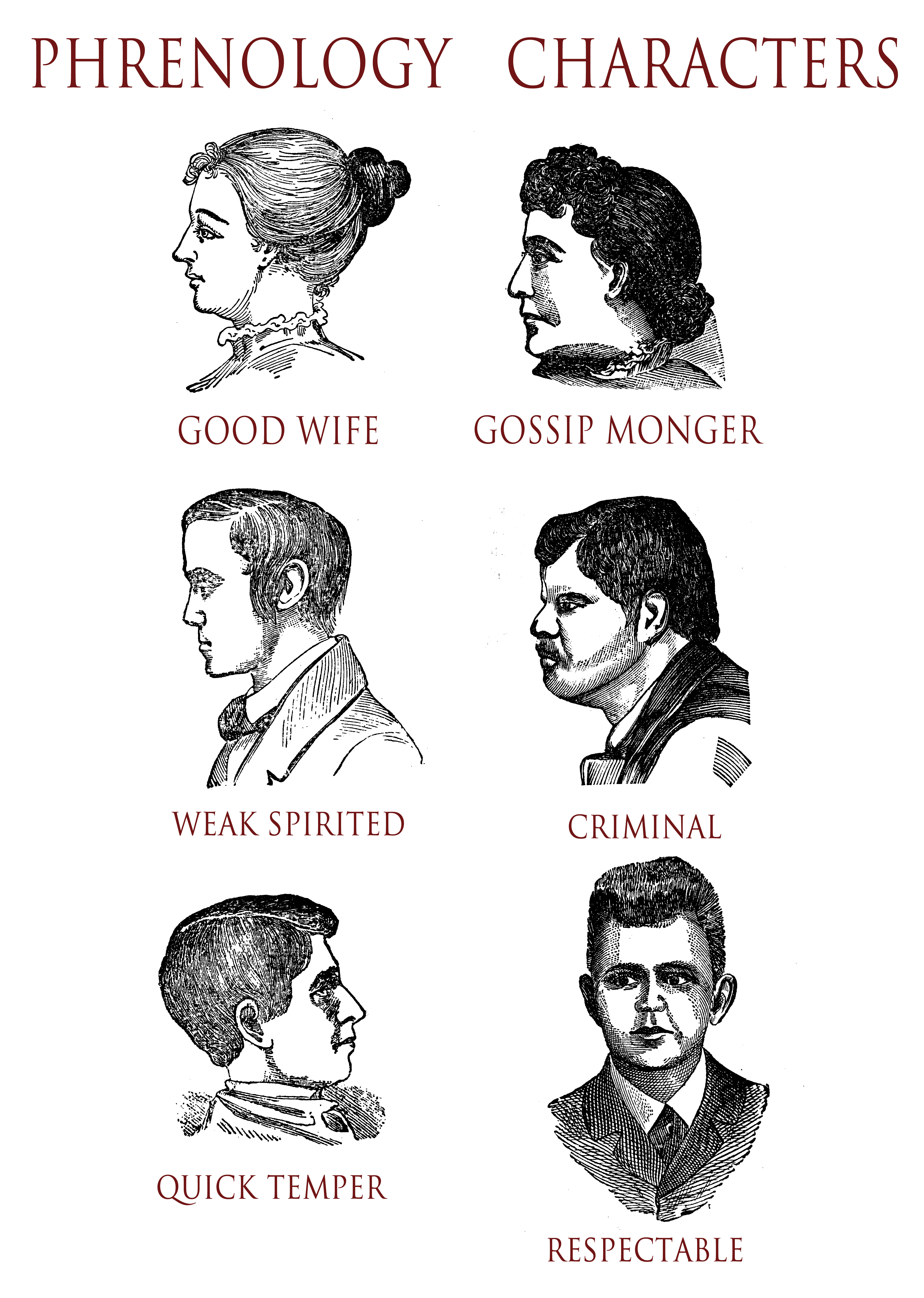
After Gall, phrenologists came to see the brain as malleable and capable of change. Criminals, on this view, were not fully responsible for their crimes.
This idea had real consequences.
People, in principle, could be cured of their criminality (Morin, 2014).
George Combe, the Edinburgh lawyer who took up phrenology after hearing Spurzheim lecture, worked this idea into a typology of criminal responsibility. He sorted offenders into three classes by the balance of their organs.
Three types emerged:
- Fully Responsible: large moral and intellectual organs with only moderate lower propensities; Combe argued these people had free will and should be punished for their crimes.
- Responsible but Tempted: all organs, higher and lower, strongly developed; they felt powerful criminal impulses but retained the capacity to resist, so stayed responsible.
- Pathologically Compelled: large lower-propensity organs alongside small moral and intellectual ones; Combe saw these offenders as needing restraint rather than punishment (Lucie, 2007; Morin, 2014).
Criminal phrenology ultimately fed the positivist biological school of criminology that followed it.
Darwin’s theory of evolution influenced this school further. It shaped the theory of atavism: the idea that criminals are physiological throwbacks to earlier stages of human evolution (Lombroso, 2005; Morin, 2014).
Phrenology and Scientific Racism
Phrenology’s darkest legacy lies in its entanglement with scientific racism. The theory located moral and intellectual worth in the size and shape of brain organs.
That made it easy to misuse. It was readily pressed into service to rank races, and to justify slavery, colonial rule, and social inequality as reflections of fixed cerebral endowment.
This was not a fringe misuse. Phrenology overlapped with the wider 19th-century project of craniometry: the measurement of skulls to compare the supposed mental capacities of different peoples.
The American physician Samuel George Morton amassed a large collection of human skulls. In Crania Americana (Morton, 1839), he tabulated cranial measurements that he read as evidence of a racial hierarchy of intelligence.
The numbers looked scientific.
George Combe, Britain’s leading phrenologist, contributed an appendix to that book, reading Morton’s skulls in phrenological terms.
This work gave racism the borrowed authority of measurement and anatomy. Its claims were cited to defend slavery in the United States, and to justify imperial rule elsewhere.
Yet the science itself was worthless. The categories were arbitrary, and the inferential chain from skull to worth was simply false.
Discrediting
Even at the height of its popularity in the early 1800s, phrenology was controversial. By the 1840s it was largely discredited within the scientific community, surviving mainly as popular entertainment.
In its own time, phrenology drew criticism for many reasons. Phrenologists could never agree how many organs existed, or where they sat.
One core problem stood out. Phrenology’s central premise was anatomically wrong: the skull does not mirror the surface of the brain.
Bone thickness varies from place to place, sinuses create hollows and prominences unrelated to the brain, and the folded cortex beneath does not push matching bumps onto the skull. So even if the mind really were divided into discrete cortical organs, cranioscopy could never have detected them.
Pierre Flourens delivered the decisive experimental blow. He tested phrenology’s central claim not by reading heads, but by removing parts of the brain.
Then he observed what happened.
Aim. To determine whether the brain is a mosaic of independent faculty-organs, as phrenology claimed, or a unified, cooperating whole. Flourens tested this directly (Flourens, 1824, 1846).
He destroyed defined portions of the nervous system, and recorded exactly which functions were lost.
Method. Flourens performed controlled surgical removals of specific brain structures in living animals, chiefly pigeons.
The animals survived. He then observed their behavior and recovery, varying which region he removed and how much tissue he took.
Results. Removing small portions of the cerebral hemispheres did not knock out one specific faculty while sparing the rest.
The damage was general: all the higher functions weakened together, roughly in proportion to how much tissue was removed, regardless of exactly where the cut was made.
Conclusion. Flourens concluded that the cerebral hemispheres act, for higher mental functions, as a unified whole rather than a patchwork of independent organs.
Gall’s map, he showed, was fiction. This was the first rigorous demonstration that the brain does not divide the mind into neat, skull-readable compartments.
Young (1968) provided an influential critique of Gall’s original data. Gall, he argued, could not directly examine brain organs in the living.
So he mostly worked from the outside of the head. Young believed Gall was “extremely predisposed” to see a large organ once he already knew something of a person’s behavior.
The result, in essence, was circular. Each new case simply strengthened Gall’s belief that he had found a valid correlation (Young, 1968; Greenblatt, 1995).
Phrenology was also criticized from its inception by those who believed it promoted materialism, the belief that all phenomena are caused by material processes. Critics also charged it with atheism, and with the destruction of morality that atheism implied (Greenblatt, 1995).
Phrenologists still exist today. But modern brain imaging has tested their central claim directly.
Aim. Parker Jones, Alfaro-Almagro, and Jbabdi (2018) asked a direct question.
Does local scalp and skull shape carry information about a person’s traits and lifestyle, tested empirically rather than dismissed out of hand?
Method. Drawing on one of the largest structural-MRI cohorts ever assembled, the researchers used high-quality scans to quantify the curvature of each person’s scalp.
They then compared it to real life. A battery of lifestyle and demographic measures, deliberately matched to 19th-century phrenological faculties, was tested against those curvature statistics.
Results. The sample was huge.
Across it, the analysis found no meaningful, statistically compelling relationship between scalp curvature and the matched lifestyle measures.
The bumps on people’s heads carried essentially no information about the traits phrenology said they should predict.
Conclusion. Scalp and skull shape do not encode character or ability.
The study used objective measures, a huge sample, and a direct mapping onto phrenology’s own claims. That combination makes it one of the cleanest empirical refutations of phrenology’s core hypothesis available.
Implications of Gall’s phrenology on modern neuroscience
Gall localized psychological and sensory functions to the cerebral cortex. This shaped his whole view of the nervous system. He saw the cortex as the “highest” part of the brain, absent in “low animals” like worms that have only a spinal cord.
Gall’s localization theory carried a second implication. He distinguished the brain’s gray matter, where he believed mental faculties resided, from its white matter.
White matter, on this view, connected those regions to each other. It linked them to the cortex and to lower brain centers.
Modern neuroscience agrees. Gall was right that white matter is a collection of connecting fibers.
The Legacy of Phrenology: Localization of Function
Phrenology’s refutation did not bury its founding idea. It refined it.
Within a generation, a rigorous, evidence-based theory of brain localization vindicated Gall’s core intuition, while discarding everything specific he had claimed.
Broca, Wernicke, and the Vindication of Localization
The turning point was the work of the French surgeon Paul Broca.
A live debate at the Paris Société d’Anthropologie asked whether the faculty of articulate speech was localized to the frontal lobes. That question was a disciplined descendant of Gall’s claim for an “organ of language” (Broca, 1861).
Method. Broca studied patients who had lost the ability to produce speech, then examined their brains at autopsy to locate the damage.
His most famous patient, Louis Victor Leborgne, was nicknamed “Tan,” because that syllable was almost the only word he could say. His comprehension and intelligence were largely preserved. A second patient, Lelong, showed a similar pattern.
Findings. In these patients, the damage centered on the posterior part of the left frontal lobe, the region now called Broca’s area.
The deficit was specific: a loss of fluent, articulate speech production, with comprehension relatively spared.
Conclusion. Broca showed, on hard anatomical evidence, that a particular higher mental function is served by a particular part of the cortex.
Crucially, he reached this conclusion by the method phrenology lacked: examining the brain itself, correlating damage with deficit, and producing a finding others could replicate.
A decade later, Carl Wernicke went further still.
He localized a distinct language-comprehension deficit to a region of the left temporal lobe, now called Wernicke’s area. Even a single faculty like language, this showed, is distributed across cooperating brain regions.
One more case belongs here.
The railway foreman Phineas Gage reportedly changed personality after an iron bar destroyed part of his frontal lobe. His case belongs to this same 19th-century movement: tying mind to specific brain territory using real injury, not imagined bumps.
The “New Phrenology” in Modern Neuroimaging
Phrenology’s shadow reaches into the present in an unexpected way.
Brain-imaging techniques like fMRI made it possible to “light up” the brain region for fear, love, or decision-making. Critics warned this risked repeating phrenology’s mistake in modern dress.
Psychologist William Uttal made this charge the theme of his book The New Phrenology (Uttal, 2001).
He argued that naive attempts to localize complex cognitive processes to single brain modules oversimplify a brain that actually works through distributed, interacting networks.
Poldrack (2006) sharpened the critique further.
His formal analysis of a large neuroimaging database showed that arguing backward, from “region X is active” to “process Y is engaged,” is not logically valid.
A brain region is rarely dedicated to just one process. So its activation is only weak evidence about the mind, unless that region is highly selective.
Later theorists pushed further still.
Anderson’s (2014) account of neural reuse, aptly titled After Phrenology, argues that individual brain regions are typically redeployed across many different tasks. The one-region-one-function assumption behind both old and “new” phrenology, on this view, is fundamentally mistaken.
None of this means localization is false. Broca settled that question.
What it means is that localization must be earned with the right evidence and the right caution. That temptation, to read a simple map of the mind off the brain’s surface, recurs with every new imaging technology.
Critical Evaluation of Phrenology
Beyond its specific empirical failures, phrenology also fails a more basic test of what counts as science. It also faced a genuine, unbeaten rival for explaining how the brain divides labour.
Falsifiability: Popper’s Verdict
The philosopher Karl Popper used phrenology, alongside astrology, to illustrate his falsifiability criterion for distinguishing science from pseudoscience (Popper, 1963).
A genuine scientific theory must make risky predictions that some observation could show to be false. Phrenology failed this test: it was flexible enough to explain any head shape after the fact, with nothing it could not accommodate.
The theory could not fail.
Rival Theories: Lashley’s Mass Action and Equipotentiality
A century after Gall, the psychologist Karl Lashley put a rival account of localisation to the test (Lashley, 1929). He trained rats to run mazes, then removed varying amounts of their cerebral cortex.
The location of the damage barely mattered. What mattered was how much cortex was gone. The bigger the lesion, the worse the maze performance, almost regardless of where it sat.
From this, Lashley proposed two principles: mass action, the cortex working as one whole, and equipotentiality, undamaged regions standing in for damaged ones.
Gall gave each faculty its own address. Lashley could find no fixed address for maze learning at all. His holism, like Flourens’s, later proved too sweeping: language does have a reproducible cortical home.
The accurate picture sits between phrenology’s rigid extreme and Lashley’s opposite one, reached by convergent, replicated evidence rather than either theorist’s single-handed conviction.
Contemporary Research
Two more recent strands of evidence bear on phrenology’s legacy.
One shows what rigorous brain-mapping looks like once it is done properly; the other warns that its discredited logic has resurfaced in automated form.
Modern Lesion-Symptom Mapping
A systematic review and meta-analysis pooled ten independent lesion-symptom mapping studies of stroke patients with naming difficulties (Piai & Eikelboom, 2023). It combined the studies statistically to find where damage reliably co-occurred with impaired picture naming.
The results were mixed.
The review found convergent clusters in the left anterior and posterior temporal lobe and adjoining inferior parietal cortex, broadly consistent with a language network.
One expected region was missing.
Older, less systematic accounts had emphasised a cluster in the left inferior frontal gyrus. This review found none there, and was explicit that so few studies limit how much weight the evidence can bear.
That combination, real localisation for some regions, an honest null for another, is the methodological opposite of cranioscopy’s confident, unreplicated bump-reading.
Physiognomic AI: Phrenology’s Logic, Automated
A legal and critical-technology-studies analysis examined what its authors call “physiognomic artificial intelligence” (Stark & Hutson, 2022). These are computer-vision and machine-learning systems marketed to infer personality, competence, or future behaviour from facial images or body posture.
The claims sound familiar.
These systems claim no more genuine evidential basis than 19th-century cranioscopy, but carry the borrowed authority of a modern statistical pipeline. The pattern echoes the circular reasoning historians attribute to Gall himself, and the caution already raised above against naive brain-mapping.
A Lasting Cautionary Tale
Phrenology’s collapse taught neuropsychology a standard its own method never met: test for convergence across many cases, not a single striking correlation.
Broca’s original method correlated one deficit with one lesion found at autopsy. Every serious lesion-based localisation study since has tried to do that correlation properly, at scale, and with statistical controls phrenology never had. That discipline is phrenology’s most durable positive legacy.
References
Anderson, M. L. (2014). After phrenology (Vol. 547). Cambridge, MA: MIT Press.
Broca, P. (1861). Remarques sur le siège de la faculté du langage articulé, suivies d’une observation d’aphémie (perte de la parole). Bulletin de la Société Anatomique de Paris, 6, 330–357.
Combe, G. (1828). The constitution of man considered in relation to external objects. John Anderson.
Flourens, P. (1846). Phrenology examined. Hogan & Thompson.
Gall, F. J. (1818). Anatomie et physiologie du système nerveux en général, et du cerveau en particulier (Vol. 3). Librairie Grecque-Latine-Allemande.
Greenblatt, S. H. (1995). Phrenology in the science and culture of the 19th century. Neurosurgery, 37(4), 790-805.
Lashley, K. S. (1929). Brain mechanisms and intelligence: A quantitative study of injuries to the brain. University of Chicago Press.
Lombroso, C. (2005). The criminal atlas of Lombroso. Editorial Maxtor.
Lucie, P. (2007). The sinner and the phrenologist: Davey Haggart meets George Combe. Journal of Scottish Historical Studies, 27(2), 125-149.
Morin, R. (2014). Phrenology and crime. The encyclopedia of theoretical criminology, 1-4.
Morton, S. G. (1839). Crania Americana. J. Dobson.
Parker Jones, O., Alfaro-Almagro, F., & Jbabdi, S. (2018). An empirical, 21st century evaluation of phrenology. Cortex, 106, 26–35. https://doi.org/10.1016/j.cortex.2018.04.011
Piai, V., & Eikelboom, D. (2023). Brain areas critical for picture naming: A systematic review and meta-analysis of lesion-symptom mapping studies. Neurobiology of Language, 4(2), 280–296. https://doi.org/10.1162/nol_a_00097
Poldrack, R. A. (2006). Can cognitive processes be inferred from neuroimaging data? Trends in Cognitive Sciences, 10(2), 59–63. https://doi.org/10.1016/j.tics.2005.12.004
Popper, K. (1963). Conjectures and refutations: The growth of scientific knowledge. Routledge & Kegan Paul.
Rawlings III, C. E., & Rossitch Jr, E. (1994). Franz Josef Gall and his contribution to neuroanatomy with emphasis on the brain stem. Surgical neurology, 42(3), 272-275.
Simpson, D. (2005). Phrenology and the neurosciences: contributions of FJ Gall and JG Spurzhei m. ANZ journal of surgery, 75(6), 475-482.
Spurzheim, J. G. (1826). The anatomy of the brain: with a general view of the nervous system. S. Highley.
Spurzheim G. Appendix to the Anatomy of the Brain Containing
a Paper Read Before the Royal Society on the 14th of May, 1829,
and Some Remarks on Mr. Charles Bell’s Animadvers.
Stark, L., & Hutson, J. (2022). Physiognomic artificial intelligence. Fordham Intellectual Property, Media & Entertainment Law Journal, 32(4), 922–978.
Temkin, O. (1947). Gall and the phrenological movement. Bulletin of the History of Medicine, 21(3), 275-321.
Uttal, W. R. (2001). The new phrenology: The limits of localizing cognitive processes in the brain. MIT Press.
Young, R. M. (1968). The functions of the brain: Gall to Ferrier (1808-1886). Isis, 59(3), 250-268.