When you write a literature review or psychology essay, you have to go beyond just summarizing the articles you’ve read. You need to synthesize the literature, which means combining several sources to show how they fit together (and how your own research fits in).
Don’t summarize each source in turn. Put together the ideas and findings of several sources to make an overall point.
At the most basic level, this involves looking for similarities and differences between your sources. Your synthesis should show the reader where the sources overlap and where they diverge.
Key Takeaways
- Synthesis: Combine several sources to make one overall point, instead of summarizing each source in turn.
- Organize: Put your notes in a summary table or synthesis matrix to see where sources agree and differ.
- Structure: Group sources by time, theme, method or theory, not by author.
- Paragraphs: Each paragraph discusses several sources under one topic sentence.
- Weigh evidence: Judge sources by quality and design, not by how many say the same thing.
- Check: Use your own words, revise, and verify every citation against the original paper.
Unsynthesized Example
Franz (2008) studied undergraduate online students. He looked at 17 females and 18 males and found that none of them liked APA. According to Franz, the evidence suggested that all students are reluctant to learn citations style.
Perez (2010) also studies undergraduate students. She looked at 42 females and 50 males and found that males were significantly more inclined to use citation software ( p < .05). Findings suggest that females might graduate sooner.
Goldstein (2012) looked at British undergraduates. Among a sample of 50, all females, all confident in their abilities to cite and were eager to write their dissertations.
Source Used with Permission: The Chicago School
Synthesized Example
Studies of undergraduate students reveal conflicting conclusions regarding relationships between advanced scholarly study and citation efficacy.
Although Franz (2008) found that no participants enjoyed learning citation style, Goldstein (2012) determined in a larger study that all participants watched felt comfortable citing sources, suggesting that variables among participant and control group populations must be examined more closely.
Although Perez (2010) expanded on Franz’s original study with a larger, more diverse sample…
Source Used with Permission: The Chicago School
Step 1: Organize your sources
After collecting the relevant literature, you’ve got a lot of information to work through, and no clear idea of how it all fits together.
Before you can start writing, you need to organize your notes in a way that allows you to see the relationships between sources.
Start by putting your notes into a table. Depending on your topic and the type of literature you’re dealing with, there are a couple of different ways to organize it.
Summary table
A summary table collates the key points of each source under consistent headings. This is a good approach if your sources tend to have a similar structure – for instance, if they’re all empirical papers.
Each row lists one source. Each column identifies a specific part of it. You can decide which headings to include based on what’s most relevant to the literature you’re dealing with.
For example, you might include columns for things like aims, methods, variables, population, sample size, and conclusion.
For each study, you briefly summarize each of these aspects.
You can also include columns for your own evaluation and analysis.
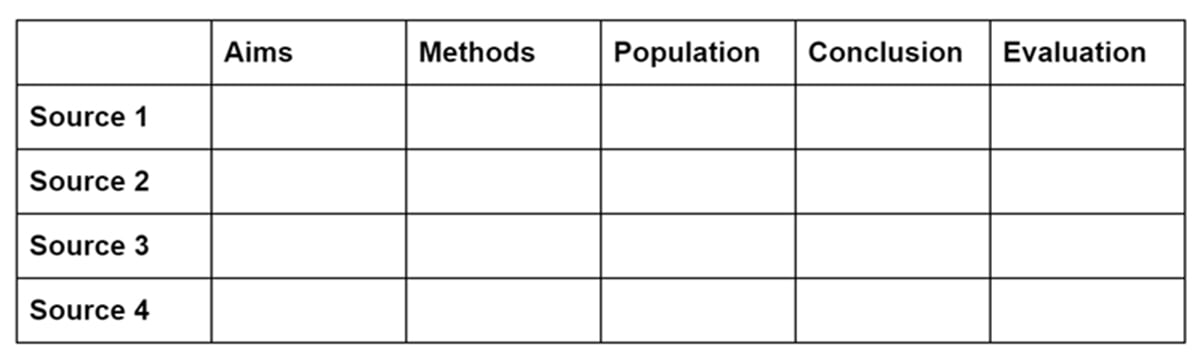
The summary table gives you a quick overview of the key points of each source. This allows you to group sources by relevant similarities, as well as noticing important differences or contradictions in their findings.
Formal reviews call this an evidence table. Readers can then consult the table instead of reading each study described at length in the text.
Synthesis matrix
A synthesis matrix is useful when your sources vary more in purpose and structure. For example, you might be dealing with books and essays that make different arguments about a topic.
Each column in the table lists one source. Each row is labeled with a specific concept, topic or theme that recurs across all or most of the sources.
Then, for each source, you summarize the main points or arguments related to the theme.
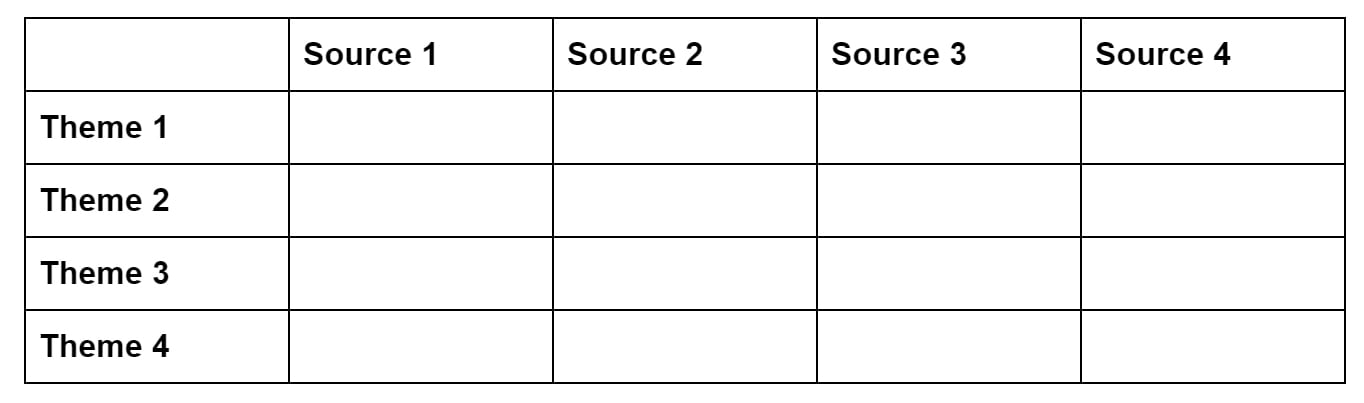
The purpose of the table is to identify the common points that connect the sources, and the points where they diverge or disagree. Here is a small example. The studies are invented and labelled by letter, so no real finding is misreported.
| Theme | Study A | Study B | Study C |
|---|---|---|---|
| Does the effect exist? | Yes, small | Yes, moderate | No difference detected |
| Who took part? | University students | Adults aged 30 to 60 | Children |
| Design | Randomized trial | Cohort study | Randomized trial |
| Main limitation | Self-report outcome | Confounding by lifestyle | Short follow-up |
Reading across the rows is the synthesis. Row one shows that the answer depends on something. Rows two and three suggest what, perhaps age. Row four shows which studies deserve the most trust on which point.
Weigh Source Quality, Not Source Count
Synthesis is not a head-count. Judge each source by its design before deciding what the sources add up to.
Evidence is commonly ranked from strongest to weakest.
- Meta-analyses and systematic reviews
- Randomized controlled trials
- Observational studies, including cohort, case-control and correlational designs
- Case series and case reports
- Expert opinion
If one position rests on ten case reports and its rival on two meta-analyses, the second is better supported, even with fewer sources.
The ranking is a rule of thumb, not a law. A poorly run trial can be worse than a careful cohort study.
Do not rely on vote counting, which tallies the studies that found an effect against those that did not. Hedges and Olkin (1980) analyzed this procedure formally.
The problem is that a study can miss statistical significance simply because it was too small to detect a real effect. With a true effect of d = 0.30 (a small effect), a study of 25 participants per group has only about an 18% chance of reaching p < .05.
Most such studies will appear to find nothing. So ask of each non-significant study whether it could have detected the effect, and say so.
Finally, state how confident you are. Confidence grows when several high-quality studies agree and independent groups have replicated the result.
Flag a finding from a single study as unreplicated. Where studies conflict, say the question cannot yet be answered and explain why.
Match your wording to the evidence: “the evidence suggests” for one correlational study, a plain statement for a result replicated in large trials.
Step 2: Outline your structure
You now have a clear overview of the main connections and differences between the sources you’ve read. Next, decide how to group them and in what order to discuss them.
For shorter papers, your outline can just identify the focus of each paragraph. Longer papers may need sections with headings.
There are four common ways to organize a synthesis:
- Chronological: Use this when approaches changed over time. Group articles into periods, note what they share, and flag turning points instead of summarizing each paper in date order.
- Thematic: Use this when the literature covers several topics. Each paragraph or section takes one theme and explains how the literature approaches it.
- Methodological: Use this when sources span several fields or research methods. Group studies by the type of research and discuss what emerged from each method.
- Theoretical: Use this when the topic is a debate between schools of thought. Compare the theories, group papers by their position, and evaluate which arguments are most convincing.
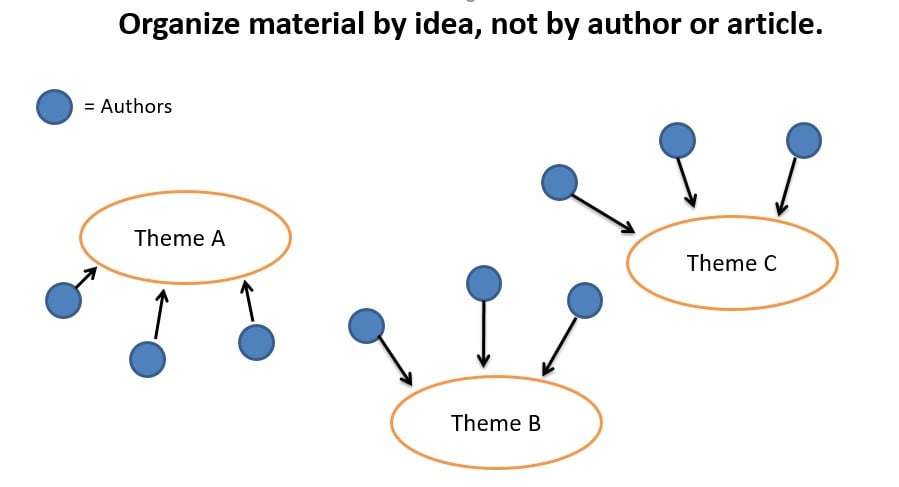
Source Used with Permission: The Chicago School
You can also organize by outcome. Hold one measured outcome constant and show where studies agree and disagree on it. That removes one source of variation, so the comparison is cleaner.
You also need not give every source equal space. If your appraisal found flaws in some studies, give them less room and say why.
Step 3: Write paragraphs with topic sentences
What sets a synthesis apart from a summary is that it combines various sources. Each paragraph should discuss a few different sources. Its overall point should fit into one sentence.
This is called a topic sentence, and it usually appears at the start of the paragraph. The topic sentence signals what the whole paragraph is about; every sentence in the paragraph should be clearly related to it.
A topic sentence can be a simple summary of the paragraph’s content:
- “Early research on [x] focused heavily on [y].”
For an effective synthesis, you can use topic sentences to link back to the previous paragraph, highlighting a point of debate or critique:
- “Several scholars have pointed out the flaws in this approach.”
- “While recent research has attempted to address the problem, many of these studies have methodological flaws that limit their validity.”
By using topic sentences, you can ensure that your paragraphs are coherent and clearly show the connections between the articles you are discussing.
Supporting sentences then move from the general idea to specifics. They can give a reason, refer to previous research, or offer an example, a statistic or a specific detail. Each should relate to the topic sentence and not merely repeat it. A new idea belongs in a new paragraph.
Bridge language does much of the synthesizing. These phrases state how one source relates to another:
- “Consistent with this…”
- “In contrast…”
- “A notable exception is…”
- “Both X and Y found…”
- “This disagreement may reflect…”
A list of summaries leaves those relationships unsaid.
As you write your paragraphs, avoid quoting directly from sources: use your own words to explain the commonalities and differences that you found in the literature.
Swapping a few words is not paraphrasing. This is called patchwriting, and it can still count as plagiarism (Pecorari, 2003). Restate the idea after you understand it, usually by rebuilding the sentence around your own point.
Don’t try to cover every point from every source. The key to synthesizing is to extract the most important and relevant information. Combine it to give your reader an overall picture of the state of knowledge on your topic.
Step 4: Revise, edit and proofread
Like any other piece of academic writing, synthesizing literature doesn’t happen all in one go – it involves redrafting, revising, editing and proofreading your work.
Start with flow. Check that paragraphs follow a logical order and that the last sentence of one connects to the first sentence of the next. Reading the draft aloud, or leaving it for a few days, helps you hear awkward passages.
Three problems damage flow: disorganized material, a lack of synthesis (one paragraph per source), and an unclear argument.
Keep the prose plain. In five experiments, Oppenheimer (2006) found that more complex writing led readers to judge its author as less intelligent. Needless long words backfire.
Ask for feedback too. If the synthesis feeds a psychology essay, ask a peer to read the draft, ideally swapping drafts.
Hattie and Timperley (2007) concluded that feedback is among the strongest influences on learning, but its effect can be positive or negative depending on how it is given. Ask for comments that tell you what to do next, not just a mark.
Verify Every Citation, Including AI-Generated Ones
Read the original paper before you cite it. Citations often misrepresent their sources, and chatbots make the problem worse.
Citation Errors Are Common
A systematic review and meta-analysis of quotation accuracy pooled 28 studies of medical journals. It estimated a total quotation error rate of 25.4% (95% CI 19.5 to 32.4).
A quotation error means the cited source does not support the claim attached to it (Jergas & Baethge, 2015). The data come from medicine, not psychology. The lesson still transfers.
Chatbots Invent References
Walters and Wilder (2023) had ChatGPT-3.5 and ChatGPT-4 write short literature reviews on 42 topics. They then checked all 636 citations in the 84 papers.
In their sample, 55% of the GPT-3.5 citations and 18% of the GPT-4 citations were fabricated. Among the real citations, 43% (GPT-3.5) and 24% (GPT-4) contained substantive errors. Those models have since been superseded, so treat the figures as a snapshot.
Chatbots and Shallow Reasoning
Stadler et al. (2024) randomly assigned 91 university students to research a science issue with ChatGPT-3.5 or Google. Chatbot users reported lower cognitive load. Their recommendations, though, showed lower-quality reasoning and argumentation.
It was one short task on one topic, so read it as a warning, not a verdict.
Taken together, the evidence suggests AI tools may help with mechanics. Delegating the synthesis, the judgment of source quality and the reference check is where harm and error appear. Verify every reference a chatbot gives you against the original.
Checklist for Synthesis
- Do I introduce the paragraph with a clear, focused topic sentence?
- Do I discuss more than one source in the paragraph?
- Do I mention only the most relevant findings, rather than describing every part of the studies?
- Do I discuss the similarities or differences between the sources, rather than summarizing each source in turn?
- Do I put the findings or arguments of the sources in my own words?
- Is the paragraph organized around a single idea?
- Is the paragraph directly relevant to my research question or topic?
- Is there a logical transition from this paragraph to the next one?
References
Hattie, J., & Timperley, H. (2007). The power of feedback. Review of Educational Research, 77(1), 81–112. https://doi.org/10.3102/003465430298487
Hedges, L. V., & Olkin, I. (1980). Vote-counting methods in research synthesis. Psychological Bulletin, 88(2), 359–369. https://doi.org/10.1037/0033-2909.88.2.359
Jergas, H., & Baethge, C. (2015). Quotation accuracy in medical journal articles: A systematic review and meta-analysis. PeerJ, 3, Article e1364. https://doi.org/10.7717/peerj.1364
Oppenheimer, D. M. (2006). Consequences of erudite vernacular utilized irrespective of necessity: Problems with using long words needlessly. Applied Cognitive Psychology, 20(2), 139–156. https://doi.org/10.1002/acp.1178
Pecorari, D. (2003). Good and original: Plagiarism and patchwriting in academic second-language writing. Journal of Second Language Writing, 12(4), 317–345. https://doi.org/10.1016/j.jslw.2003.08.004
Stadler, M., Bannert, M., & Sailer, M. (2024). Cognitive ease at a cost: LLMs reduce mental effort but compromise depth in student scientific inquiry. Computers in Human Behavior, 160, Article 108386. https://doi.org/10.1016/j.chb.2024.108386
Walters, W. H., & Wilder, E. I. (2023). Fabrication and errors in the bibliographic citations generated by ChatGPT. Scientific Reports, 13, Article 14045. https://doi.org/10.1038/s41598-023-41032-5

