Jean Piaget’s theory describes cognitive development as a progression through four distinct stages, where children’s thinking becomes progressively more advanced and nuanced.
Sensorimotor Stage (Birth to 2 Years)
Children learn about the world entirely through their senses and physical actions (like touching, grasping, and looking).
By coordinating these sensory and motor experiences, they begin to construct schemas (basic knowledge units).
During this time, they develop the key concept of object permanence – the understanding that objects continue to exist even when they can’t be seen.
Preoperational Stage (2 to 7 Years)
Children start using symbols and language but struggle with logical thinking.
They can’t yet understand conservation, meaning they think a tall, thin glass holds more water than a short, wide one.
They may also be egocentric, meaning they find it difficult to see things from others’ perspectives.
Concrete Operational Stage (7 to 11 Years)
Children become more logical in their thinking.
They can understand concepts like conservation, realizing that quantity doesn’t change even if the appearance of an object does.
This newfound logic allows them to sort things into groups and mentally reverse actions.
They also begin to think about others’ thoughts and feelings more realistically.
Formal Operational Stage (11+ Years)
Adolescents develop the ability to think abstractly and solve hypothetical problems.
This means they can now tackle “what-if” scenarios and understand concepts that aren’t tied to physical reality.
They can now reason about complex concepts like ethics, science, and mathematics, thinking systematically and forming hypotheses.
Summary of Piaget’s Four Stages
| Stage | Age | Thinking |
|---|---|---|
| Sensorimotor | Birth to 18-24 months | Object permanence |
| Preoperational | 2 to 7 years | Symbolic thought |
| Concrete operational | 7 to 11 years | Logical thought |
| Formal operational | Adolescence to adulthood | Scientific reasoning |
Core Principles
- Each child goes through the stages in the same order (but not all at the same rate).
- Some individuals may never attain the later stages.
- Child development is determined by biological maturation and interaction with the environment.
- At each stage of cognitive development, the child’s thinking is qualitatively different.
- Each stage is characterized by a unique type of intelligence.
- Piaget proposed that children’s intellectual development is not simply about accumulating more information, but involves qualitative changes in how children think.
How Children Learn
The 4 developmental stages are influenced by several key factors:
- Biological maturation: As children grow, their cognitive abilities naturally evolve.
- Interaction with the environment: Engaging with the world around them shapes their understanding and learning processes.
- Social experiences: Interactions with peers and adults provide crucial learning opportunities
- Equilibration: The internal drive to maintain a balance between what they know and what they experience.
Sensorimotor Stage
Ages: Birth to 2 Years
In the sensorimotor stage, infants actively refine motor skills and engage in sensory exploration.
This is how they form early concepts like object permanence.

Key Milestones:
-
Learning through senses and actions (0–2 years): Infants explore the world through movement, touch, and observation. Their learning is based on sensory experiences and physical interaction.
-
Object permanence (8 months): Infants begin to understand that objects still exist even when out of sight and will search for them when they disappear.
-
Self-recognition (18–24 months): Children start to realize they are separate individuals, recognizing themselves in mirrors and showing early self-awareness.
-
Deferred imitation (18–24 months): Infants can reproduce actions they observed earlier, showing memory development and the ability to form mental representations.
-
Representational play (18–24 months): Children begin to use one object to stand for another, such as pretending a block is a car, marking the start of symbolic play.
-
Symbolic function (emerges 18–24 months): The child gains the ability to mentally represent people, objects, and events, forming the foundation for thought and language.
-
Educational implications (0–2 years): Educators and caregivers should focus on interactive and sensory-rich experiences, such as tactile play (sand, water), games promoting object permanence (peek-a-boo), and imitation activities.
Understanding Object Permanence
At the beginning of the sensorimotor stage, infants live in the present without a mental representation of the world, lacking a sense of object permanence.
If an infant cannot see an object, it does not exist to them; thus, if a toy is hidden from view, the infant will not search for it once it is out of sight.
The primary achievement during the sensorimotor stage is the development of object permanence — the understanding that objects continue to exist even when hidden.
It requires the ability to form a mental representation (i.e., a schema) of the object.
Towards the end of this stage the general symbolic function begins to appear where children show in their play that they can use one object to stand for another.
Language starts to appear because they realise that words can be used to represent objects and feelings.
The child begins to be able to store information about the world, recall it, and label it.
Individual Differences
- Cultural Practices: In some cultures, babies are carried on their mothers’ backs throughout the day. This constant physical contact and varied stimuli can influence how a child perceives their environment and their sense of object permanence.
- Gender Norms: Toys assigned to babies can differ based on gender expectations. A boy might be given more cars or action figures, while a girl might receive dolls or kitchen sets. This can influence early interactions and sensory explorations.
Learn More: The Sensorimotor Stage of Cognitive Development
Ages: 2 – 7 Years
Piaget’s second stage of intellectual development is the preoperational stage, which occurs between 2 and 7 years.
At the beginning of this stage, the child does not use operations (a set of logical rules), so thinking is influenced by how things look or appear to them rather than logical reasoning.
A child might think the tall glass has more to drink than the short one, even though they’re equal. The child pays attention only to height and ignores the width.
Furthermore, the child is egocentric; he assumes that other people see the world as he does, as shown in the Three Mountains study.
As the preoperational stage develops, egocentrism declines, and children begin to enjoy the participation of another child in their games, and let’s pretend play becomes more important.
Learning Through Play and Storytelling
Teaching should incorporate role-playing, symbolic play, storytelling, and visual aids to support imaginative thinking.
Tasks that encourage perspective-taking can help children gradually overcome egocentrism.
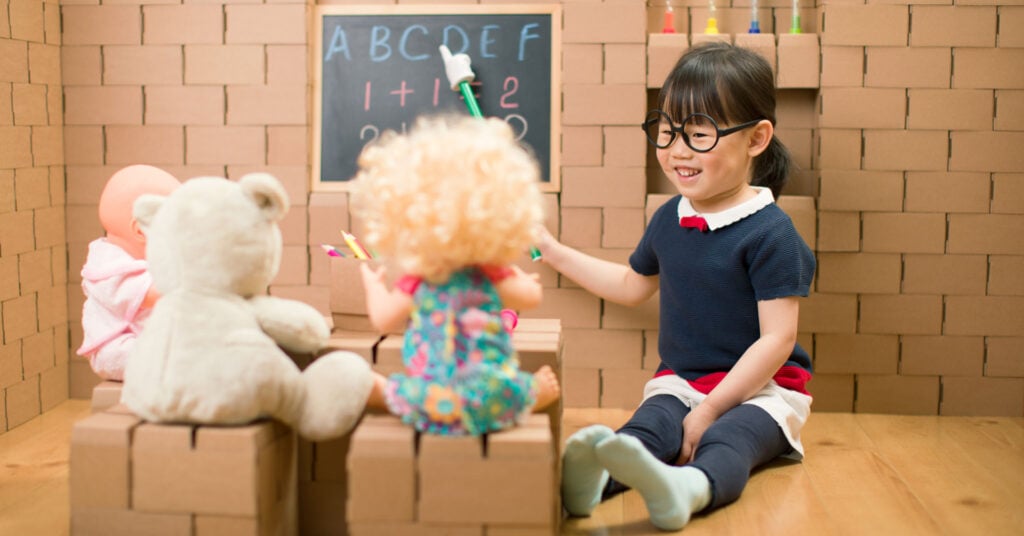
Toddlers often pretend to be people they are not (e.g. superheroes, policemen), and may play these roles with props that symbolize real-life objects.
Children may also invent an imaginary playmate.
By 2 years, children have made some progress toward detaching their thoughts from the physical world.
However, have not yet developed logical (or “operational”) thought characteristics of later stages.
Thinking is still intuitive (based on subjective judgments about situations) and egocentric (centered on the child’s own view of the world).
Key Milestones:
-
Mental representation (2–7 years): Toddlers and young children develop the ability to represent the world internally through language, symbols, and mental images.
-
Symbolic thought (2–4 years): Children begin to use words and objects to stand for other things, showing the emergence of symbolic play and imagination.
-
Centration (around 4–6 years): Thinking is focused on one aspect of a situation at a time, often ignoring other important features. In the conservation task, a child who focuses only on the height of the water in a tall, thin glass, ignoring the width, is exhibiting centration.
-
Appearance over reality (2–7 years): A child’s reasoning is dominated by how things look rather than by logic or evidence. They cannot yet think logically or solve problems systematically.
-
Class inclusion (around 5–7 years): Children can sort objects into categories but struggle to understand that one object can belong to multiple categories at once (e.g., a flower being both a rose and a type of flower).
-
Animism (2–7 years): Children often believe that non-living things, like toys or the sun, have feelings and intentions just like people.
-
Theory of mind (4–5 years): As children mature, they begin to understand that others can have different thoughts, feelings, and perspectives from their own.
Individual Differences
- Cultural Storytelling: Different cultures have unique stories, myths, and folklore. Children from diverse backgrounds might understand and interpret symbolic elements differently based on their cultural narratives.
- Race & Representation: A child’s racial identity can influence how they engage in pretend play. For instance, a lack of diverse representation in media and toys might lead children of color to recreate scenarios that don’t reflect their experiences or background.
Learn More: The Preoperational Stage of Cognitive Development
Ages: 7 – 11 Years
By the beginning of the concrete operational stage, children can apply logical rules, known as operations.
They begin to understand that quantity stays the same even when appearance changes (conservation).
They can also see things from another person’s perspective (decentring) and perform inclusion tasks more accurately.
Children still have difficulties with abstract thinking.
The stage is called concrete because children can think logically much more successfully if they can manipulate real (concrete) materials or pictures of them.

Key Milestones:
-
Logical thinking (7–11 years): Children begin to think logically about concrete events and physical objects but still struggle with abstract ideas.
-
Conservation (6–9 years): They understand that certain properties—like volume, mass, and number—stay the same even when appearance changes. Number is typically conserved around age 6, mass around age 7, and weight around age 9.
-
Reversibility (7–8 years): Children can mentally reverse actions, such as imagining a squashed ball of clay being reshaped back to its original form.
-
Reduced egocentrism (7–8 years): They become less centered on their own perspective and can begin to understand other people’s thoughts and feelings, supporting empathy and cooperation.
-
Limits to abstract reasoning (7–11 years): Children can reason about tangible, real-world situations but may struggle with hypothetical or abstract concepts.
-
Improved classification (7–11 years): They can group objects based on shared characteristics and understand hierarchical relationships among categories.
-
Seriation (7–9 years): Children can arrange items along a quantitative dimension, such as height or weight, in logical order.
-
Transitive inference (8–9 years): They can use logic to infer relationships, such as understanding that if A > B and B > C, then A > C.
Teaching Tips
Teachers can support cognitive growth at this stage through hands-on learning and activities using real objects, such as sorting tasks, math manipulatives, or simple science experiments.
These methods help reinforce emerging skills in logical operations, conservation, classification, and reversibility.
Individual Differences
- Cultural Context in Conservation Tasks: In a society where resources are scarce, children might demonstrate conservation skills earlier due to the cultural emphasis on preserving and reusing materials.
- Gender & Learning: Stereotypes about gender abilities, like “boys are better at math,” can influence how children approach logical problems or classify objects based on perceived gender norms.
Learn More: The Concrete Operational Stage of Development
Ages: 12 and Over
During the formal operational stage (beginning around age 12), adolescents develop the ability to think abstractly, reason hypothetically, and engage in deductive logic.
They are no longer limited to reasoning about physical, concrete objects and can instead manipulate ideas, principles, and theoretical constructs.

Abstract and Hypothetical Thinking
Adolescents can think systematically and reason about what might be as well as what is (not everyone achieves this stage).
This allows them to understand politics, ethics, and science fiction, as well as to engage in scientific reasoning.
Adolescents can deal with abstract ideas; for example, they can understand division and fractions without having to actually divide things up, and solve hypothetical (imaginary) problems.
From about 12 years, children can follow the form of a logical argument without reference to its content.
Key Milestones
-
Abstract thinking (11+ years): Thinking shifts from being tied to physical objects to operating on abstract ideas. Adolescents can reason about concepts that are not directly experienced.
-
Freedom from perceptual constraints (11+ years): Formal operational thought is no longer limited by what can be seen or touched, allowing reasoning beyond concrete experience.
-
Understanding abstract concepts (11–15 years): Adolescents can grasp ideas like justice, love, or freedom, and understand mathematical or logical relationships without needing physical examples.
-
Hypothetical reasoning (12+ years): They can think about hypothetical or “what if” situations, imagining multiple possible outcomes or solutions to a problem.
-
Logical argumentation (12–16 years): Adolescents can follow the form or structure of an argument without relying on concrete examples, showing a deeper level of reasoning.
-
Reflective abstraction (12–16 years): They become aware of and can reflect on their own thought processes — a skill known as metacognition — which helps them plan, evaluate, and regulate their thinking.
-
Hypothetico-deductive reasoning (12–16 years): This is the ability to generate hypotheses, systematically test them, and logically deduce conclusions. It marks the emergence of scientific, systematic thinking beyond trial and error.
Scientific and Logical Reasoning
During this time, people develop the ability to think about abstract concepts, and logically test hypotheses.
This stage sees the emergence of scientific thinking, formulating abstract theories and hypotheses when faced with a problem.
Educational strategies at this stage should involve open-ended questions, debates, scientific investigations, and exploration of abstract topics (e.g., ethics, politics, algebra) to foster logical reasoning, critical thinking, and self-reflection.
Individual Differences
- Culture & Abstract Thinking: Cultures emphasize different kinds of logical or abstract thinking. For example, in societies with a strong oral tradition, the ability to hold complex narratives might develop prominently.
- Gender & Ethics: Discussions about morality and ethics can be influenced by gender norms. For instance, in some cultures, girls might be encouraged to prioritize community harmony, while boys might be encouraged to prioritize individual rights.
Learn More: The Formal Operational Stage of Development
Piaget’s Theory
1. Biological Foundations of Cognitive Development
Piaget viewed cognitive development as both a biological and psychological process.
He believed that mental growth depends on the maturation of the nervous system and the child’s ability to adapt to the environment.
Just as physical structures become more complex with age, Piaget proposed that cognitive structures—the mental frameworks used to organise and interpret information—develop through similar stages of refinement.
According to Piaget (1964), knowledge emerges as part of biological adaptation.
The developing brain, sensory systems, and motor coordination form the foundation for thought.
How Biology Shapes Thinking
During the sensorimotor stage, for instance, infants use actions like grasping and looking to build early schemas for understanding the world.
As the nervous system matures, these simple actions evolve into higher-order reasoning and problem-solving.
Piaget argued that this link between biological maturation and cognition explains why children progress through developmental stages in a fixed sequence.
Each stage reflects the child’s increasing capacity to achieve equilibrium—a balance between internal cognitive structures and the external world.
2. Genetic Epistemology
Piaget’s theory is rooted in his philosophy of genetic epistemology, emphasizing how knowledge evolves from basic sensory experiences to abstract reasoning.
Genetic epistemology is a theory of knowledge developed by Swiss psychologist Jean Piaget, focusing on how human beings acquire, develop, and structure knowledge.
The term “genetic” here doesn’t refer to genes or heredity, but rather to “genesis”, meaning the origins and developmental processes through which knowledge emerges.
Core Ideas of Genetic Epistemology:
- Constructivist Approach to Learning: Children actively build understanding by exploring their environment as “little scientists,” rather than passively absorbing information.
-
Developmental Approach: Knowledge arises through developmental stages, not simply through the accumulation of facts.
-
Active Learning: Individuals actively construct knowledge by interacting with their environment, rather than passively absorbing it.
-
Cognitive Structures (Schemas): Knowledge consists of structures or mental schemas that evolve over time through a balance of assimilation (integrating new information into existing schemas) and accommodation (altering schemas to accommodate new experiences).
3. History of Piaget’s Theory of Cognitive Development
Piaget was employed at the Binet Institute in the 1920s, where his job was to develop French versions of questions on English intelligence tests.
He became intrigued with the reasons children gave for their wrong answers to the questions that required logical thinking.
He believed that these incorrect answers revealed important differences between the thinking of adults and children.
Piaget branched out on his own with a new set of assumptions about children’s intelligence:
- Children’s intelligence differs from an adult’s in quality rather than in quantity. This means that children reason (think) differently from adults and see the world in different ways.
- Children actively build up their knowledge about the world. They are not passive creatures waiting for someone to fill their heads with knowledge.
- The best way to understand children’s reasoning is to see things from their point of view.
Piaget’s New Approach to Measuring Intelligence
Piaget did not want to measure how well children could count, spell, or solve problems as a way of grading their I.Q.
He was more interested in how fundamental concepts emerged, such as the very ideas of number, time, quantity, causality, and justice.
Piaget studied children from infancy to adolescence using naturalistic observation of his own three babies and sometimes controlled observation too.
From these, he wrote diary descriptions charting their development.
He also used clinical interviews and observations of older children who were able to understand questions and hold conversations.
4. Piaget’s Clinical Method
Piaget’s clinical method is a research technique used to investigate children’s cognitive development.
It is a research approach for understanding children’s thinking that Piaget adapted from the diagnostic clinical interview used in psychopathology.
Unlike standardized tests, the clinical method uses flexible, open-ended questions to explore the child’s thinking in depth.
The interviewer adapts their questions based on the child’s initial responses, prompting further explanation and clarification.
Key characteristics of the clinical method:
-
Child’s Perspective: Piaget emphasized understanding the child’s viewpoint rather than imposing adult ways of thinking.
-
Open-Ended Questioning: The method relies on flexible, non-judgmental questions that let children express their thoughts freely.
-
Careful Observation: Interviewers closely observe children’s answers and ask follow-up questions to clarify their reasoning.
-
Distinguishing Responses: Interviewers must tell apart spontaneous answers from those shaped by suggestion or outside influence.
How Piaget Assessed Children’s Thinking
Piaget developed clear guidelines for assessing the quality of children’s responses,
He focused on how consistent their answers were, how deeply they thought about questions, and whether they resisted outside influence.
Piaget’s clinical method has been influential in the field of developmental psychology and has helped to shape the way researchers and educators understand children’s thinking.
What is the “critical method” and how does it differ from the clinical method?
It’s important to note that the clinical method evolved throughout Piaget’s career.
In his early work, Piaget primarily relied on what he called the “clinical method,” which focused on verbal interactions with children through open-ended questioning to understand their thinking processes.
The Original “Clinical Method”
The clinical method primarily relied on verbal dialogue between the researcher and child.
Through careful questioning, Piaget would explore children’s reasoning and underlying cognitive structures without imposing adult frameworks on their responses.
In developing his cognitive theory, Piaget engaged in significant intellectual debates, notably with contemporaries Susan and Nathan Isaacs.
Susan Isaacs (1951) provided empirical observations suggesting that children possessed cognitive abilities earlier than Piaget claimed.
These critiques prompted Piaget to critically evaluate and refine his methodological approach.
The Birth of the “Critical Method”
As a result of these challenges, Piaget began incorporating physical objects and manipulations into his interviews, leading to what he termed the “critical method.”
This approach combined observation and hands-on experimentation to capture children’s authentic cognitive processes more accurately.
While the clinical method focused on verbal dialogue, the critical method let children manipulate objects.
This allowed researchers to observe their actions and reasoning with physical materials.
Watching Children Think in Action
By incorporating physical objects into his research, Piaget could observe how children’s actions and manipulations influenced their thinking.
For example, a researcher might ask a child to predict whether a ball of clay will weigh more or less after being rolled into a snake (conservation of mass).
By observing the child’s actions and explanations, researchers could gain insight into their understanding of the concept.
Another example of this approach was Piaget’s exploration of how children transition from animistic to mechanistic thinking.
He investigated children’s conceptions of material force through a series of experiments involving physical demonstrations.
Why This Approach Worked So Well
Piaget believed hands-on tasks helped children feel comfortable, reduced the need for long explanations, and encouraged natural conversation.
This made the research process more accessible and revealing of children’s true cognitive abilities.
Even though Piaget refined his methods, the core features of the clinical approach stayed the same.
He still used open-ended questions, focused on children’s reasoning, and interviewed them sensitively.
5. Piaget’s Theory Differs From Others In Several Ways:
Piaget’s (1936, 1950) theory of cognitive development explains how a child constructs a mental model of the world.
He disagreed with the idea that intelligence was a fixed trait, and regarded cognitive development as a process that occurs due to biological maturation and interaction with the environment.
Children’s ability to understand, think about, and solve problems in the world develops in a stop-start, discontinuous manner (rather than gradual changes over time).
Piaget’s theory:
- Is concerned with children, rather than learners of all ages.
- Focuses on development, rather than learning per se, so it does not address the learning of information or specific behaviors.
- Proposes discrete stages of development, marked by qualitative differences, rather than a gradual increase in the number and complexity of behaviors, concepts, ideas, etc.
The Purpose of Piaget’s Theory
The goal of the theory is to explain the mechanisms and processes by which the infant, and then the child, develops into an individual who can reason and think using hypotheses.
To Piaget, cognitive development was a progressive reorganization of mental processes as a result of biological maturation and environmental experience.
Children construct an understanding of the world around them, then experience discrepancies between what they already know and what they discover in their environment.
6. Schemas
A schema is a mental framework or concept that helps us organize and interpret information. It’s like a mental file folder where we store knowledge about a particular object, event, or concept.
According to Piaget (1952), schemas are fundamental building blocks of cognitive development. They are constantly being created, modified, and reorganized as we interact with the world.
Wadsworth (2004) suggests that schemata (the plural of schema) be thought of as “index cards” filed in the brain, each one telling an individual how to react to incoming stimuli or information.
According to Piaget, we are born with a few primitive schemas, such as sucking, which give us the means to interact with the world.
These initial schemas are physical, but as the child develops, they become mental schemas.
Examples of Innate Schemas:
- • Sucking reflex: Triggered when something touches a baby’s lips — this corresponds to a “sucking schema.”
- Grasping reflex: When something touches the palm of a baby’s hand, the baby grips it — another innate schema.
- Rooting reflex: When a baby turns its head toward something that touches its cheek — also an innate schema.
How Schemas Become More Complex
When Piaget discussed the development of a person’s mental processes, he referred to increases in the number and complexity of the schemata that the person had learned.
Operations are more sophisticated mental structures that allow us to combine schemas in a logical (reasonable) way.
For example, picking up a rattle would combine three schemas, gazing, reaching and grasping.
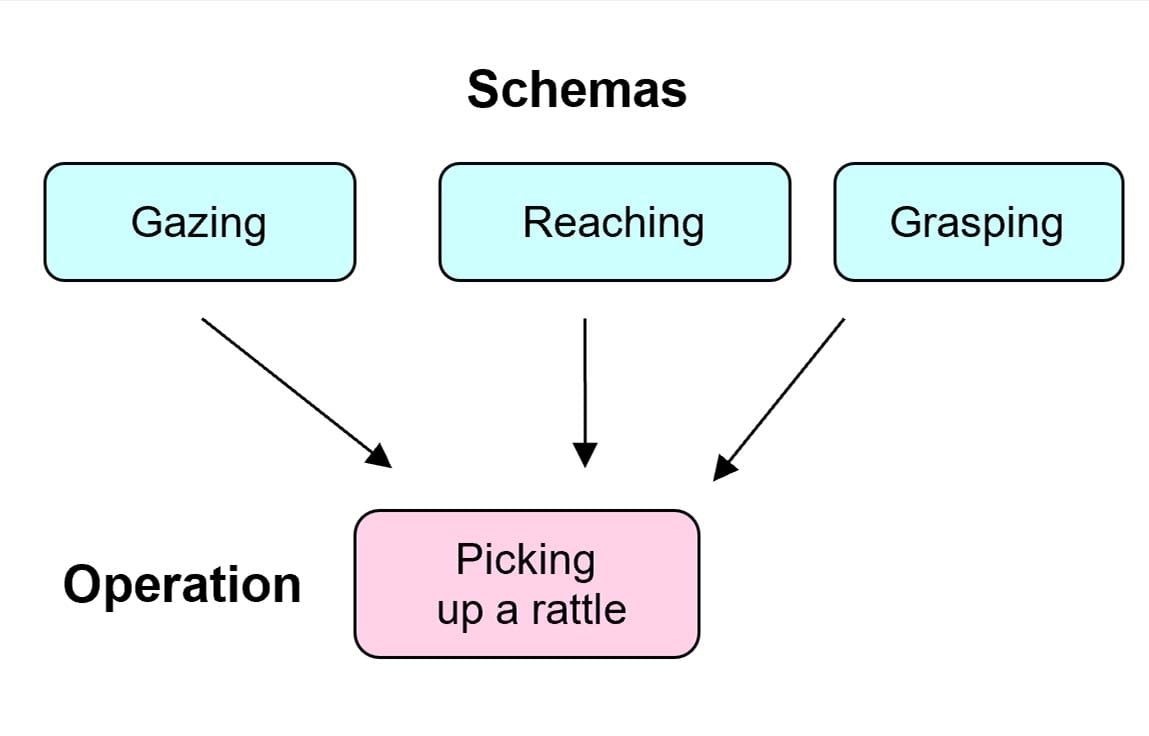
As children grow, they can carry out more complex operations and begin to imagine hypothetical (imaginary) situations.
Operations are learned through interaction with other people and the environment, and they represent a key advancement in cognitive development beyond simple schemas.
As children grow and interact with their environment, these basic schemas become more complex and numerous, and new schemas are developed through the processes of assimilation and accommodation.
7. The Process of Adaptation
Jean Piaget (1952) viewed intellectual growth as a process of adaptation (adjustment) to the world.
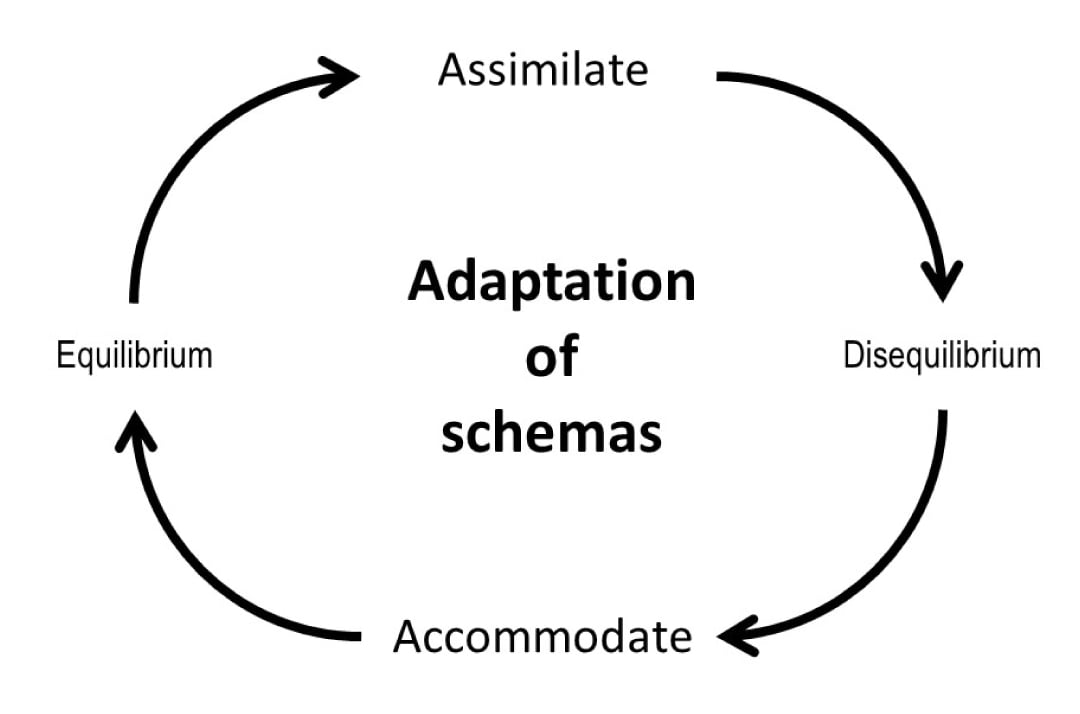
This happens through assimilation, accommodation, equilibration, and disequilibrium.
- Equilibration, the mechanism balancing assimilation and accommodation, drives cognitive growth and transition between developmental stages according to Piaget.
- Assimilation is fitting new information into existing schemas without changing one’s understanding. For example, a child who has only seen small dogs might call a cat a “dog” due to similar features like fur, four legs, and a tail.
- Accommodation occurs when existing schemas must be revised to incorporate new information. For instance, a child who believes all animals have four legs would need to accommodate their schema upon seeing a snake.
- A baby tries to use the same grasping schema to pick up a very small object. It doesn’t work. The baby then changes (accommodates) the schema using the forefinger and thumb to pick up the object.
When a child’s existing schemas are capable of explaining what it can perceive around it, it is said to be in a state of equilibrium, i.e., a state of cognitive (i.e., mental) balance.
Disequilibrium occurs when new information conflicts with existing schemas, creating cognitive discomfort. This cognitive conflict drives cognitive development and learning.
Example
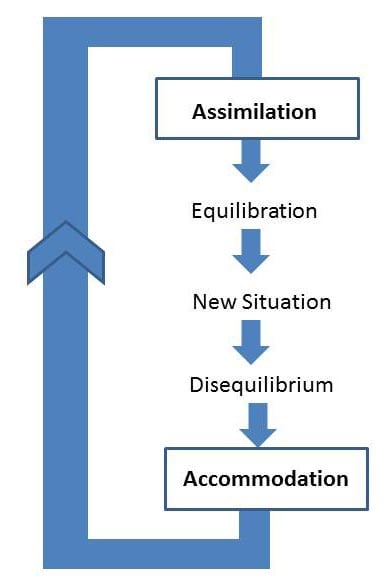
When encountering new information, a child first attempts to assimilate it into existing schemas.
If assimilation fails, disequilibrium occurs, prompting the need for accommodation.
Through accommodation, the child adjusts their schemas to restore equilibrium.
This cycle continues, driving cognitive development in a non-linear fashion – progressing through “leaps and bounds” rather than at a steady rate.
Importance of Equilibration:
Equilibration acts as a regulatory mechanism, balancing assimilation and accommodation. This balance is crucial because:
- Constant assimilation without accommodation would prevent the learning of new concepts.
- Constant accommodation without assimilation would make every experience seem novel, leading to cognitive exhaustion.
By maintaining this balance, equilibration facilitates cognitive growth, allowing children to build increasingly complex and accurate mental representations of the world.
Example
Jamie, age 5, believes that “big things sink and small things float.” When he drops a small coin into water and it sinks, he’s confused.
He tries to assimilate the event by thinking the coin is heavier than it looks. But then he sees a large plastic bowl float and feels stuck—his rule doesn’t explain what he’s seeing.
This disequilibrium prompts him to ask questions. With guidance, Jamie begins to realize that material, not size, affects floating.
He accommodates his schema, now understanding that both size and material matter.
This updated thinking reflects a move toward concrete operational logic, where reasoning becomes more systematic and evidence-based.
How does the development of conservation skills in the concrete operational stage demonstrate the interaction of assimilation, accommodation, and equilibration in Piaget’s theory?
Conservation refers to understanding that quantity stays the same despite changes in appearance.
For example, understanding that the amount of liquid stays the same when poured into a different-shaped glass.
Conservation is a classic example of how assimilation, accommodation, and equilibration work together in Piaget’s theory of cognitive development.
- Assimilation = incorporating new info into existing schemas.
- Accommodation = altering schemas in response to new info.
- Equilibration = balancing both to resolve cognitive conflict.
Why Children Fail Conservation Tasks
In the preoperational stage (ages 2–7), children often fail conservation tasks.
For instance, when shown two glasses with the same amount of water, and then the water from one is poured into a taller, thinner glass, they may say the taller glass now has “more.”
This happens because the child is assimilating the new situation into an existing schema: “Taller means more.”
They are focusing on height alone and ignoring width.
Cognitive Conflict and Disequilibrium
Eventually, this leads to cognitive conflict (disequilibrium).
The child might notice that the same amount of water was just poured from one glass to the other, yet they feel confused because their “taller = more” idea doesn’t quite explain what’s happening.
This mismatch causes disequilibrium – a sense that their current thinking doesn’t fit with what they observe.
How Children Reach Equilibration
To resolve this, the child must accommodate their schema.
They learn that height alone doesn’t determine quantity; both height and width matter.
This adjustment allows them to understand compensation—that changes in one dimension (like height) can be offset by changes in another (like width).
Equilibration is the process of noticing a problem, changing one’s thinking, and forming a new, balanced understanding.
It’s the driving force behind learning and cognitive growth.
By the concrete operational stage (ages 7–11), children can understand that quantity stays the same even when appearance changes.
8. Theory of Consciousness
Although Piaget is best known for his four stages of cognitive development and his theory of schemas, his later work explored deeper questions about consciousness.
In The Grasp of Consciousness (1976), Piaget examined how children become aware of their own thinking.
He found that young children can often perform tasks correctly but struggle to explain how they did so, suggesting a gap between knowing and understanding one’s own knowledge.
Egocentrism and Self-Awareness
Piaget interpreted this limited self-awareness as a consequence of egocentrism – the child’s natural tendency to view the world solely from their own perspective.
Because young children cannot yet decentre their thinking, they remain unaware of the mental operations they use to reason.
As children move into the concrete and formal operational stages, they begin to overcome egocentrism.
They learn to reflect on their own thinking, compare perspectives, and explain their reasoning.
The Role of Language in Conscious Thought
Language plays an important role in this shift. Early in development, children’s speech is largely egocentric—directed at themselves rather than others.
As social interaction and communication increase, this speech becomes socialised, supporting awareness of different viewpoints and allowing children to reflect on their thought processes.
For Piaget, this transformation from egocentric to socialised language mirrors the growth of conscious thought itself.
Applications to Education
Think of old black-and-white films you’ve seen where children sat in rows at desks with inkwells.
They learned by rote, all chanting in unison in response to questions set by an authoritarian figure like Miss Trunchbull in Matilda.
Children who were unable to keep up were seen as slacking and would be punished by variations on the theme of corporal punishment.
Yes, it really did happen and in some parts of the world still does today.
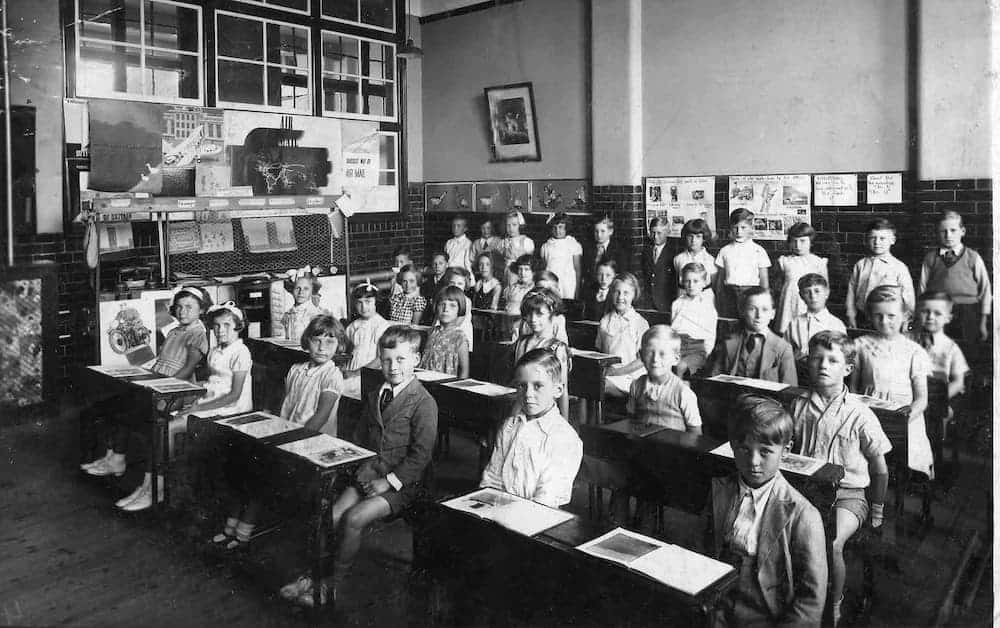
Piaget is partly responsible for the change that occurred during the 1960s to early children’s education.
“Children should be able to do their own experimenting and their own research. Teachers, of course, can guide them by providing appropriate materials, but the essential thing is that in order for a child to understand something, he must construct it himself, he must re-invent it. Every time we teach a child something, we keep him from inventing it himself. On the other hand that which we allow him to discover by himself will remain with him visibly”.
Piaget (1972, p. 27)
Plowden Report
In the 1960s, the Plowden Committee investigated deficiencies in United Kingdom education and incorporated many of Piaget’s ideas into its final report, published in 1967.
This was notable because Piaget’s (1952) work was not originally designed for educational applications.
The report made three key recommendations based on Piaget’s theories:
- Age-appropriate learning: The report recommended that educational activities and content should be tailored to match children’s cognitive developmental stages as outlined by Piaget. This meant ensuring that learning tasks were appropriate for the child’s current level of thinking and understanding.
- Concrete experiences: Following Piaget’s emphasis on the importance of concrete experiences in learning, especially for younger children, the report advocated for hands-on, experiential learning opportunities. This included recommendations for more practical activities and the use of manipulatives in the classroom.
- Active learning: The report emphasized the importance of children being active participants in their own learning, rather than passive recipients of information. This aligns with Piaget’s view that children construct their own understanding through interaction with their environment
The Plowden Report emphasized several recurring themes aligned with Piaget’s work:
- Individual learning
- Curriculum flexibility
- The central role of play in children’s learning
- Utilizing the environment for learning
- Discovery-based learning
- Assessment of children’s progress
Importantly, the report cautioned that teachers should “not assume that only what is measurable is valuable,” encouraging a holistic approach to assessing children’s development.
Educational Strategies Based on Piaget’s Theory
Piaget’s theory has had a major influence on modern education, shaping how teachers design curricula, assess readiness, and support active learning.
He argued that effective teaching must take account of the child’s stage of cognitive development and that learning activities should match the learner’s current level of thinking.
This led to the principle of age-appropriateness in education: young children in the preoperational stage.
For example, learn best through hands-on exploration and visual materials, while older children in the concrete operational stage can engage with logical reasoning and problem-solving tasks.
Abstract subjects, such as algebra or formal logic, are most suitable once students reach the formal operational stage.
Constructivism and the Shift Away from Instructionism
Piaget’s theory of constructivism revolutionised educational thinking by challenging the traditional, teacher-centred model known as instructionism.
Instructionist approaches assume that knowledge can be transmitted directly from teacher to student, viewing learners as passive recipients who simply absorb information.
Piaget rejected this view, arguing instead that children are active participants in their own learning.
Piaget also emphasised spontaneous learning – the idea that children construct understanding through discovery, rather than memorising facts supplied by the teacher.
Assimilation and accommodation require an active learner, not a passive one, because problem-solving skills cannot be taught, they must be discovered (Piaget, 1958).
Classrooms inspired by his theory encourage curiosity, experimentation, and peer discussion, allowing students to learn by doing.
Teachers act as facilitators, providing experiences that challenge students’ thinking and promote equilibration, the process of balancing new knowledge with existing ideas.
Overall, Piaget’s approach shifted education from teacher-centred instruction to learner-centred exploration, promoting developmental readiness and deeper conceptual understanding.
Therefore, teachers should encourage the following within the classroom:
- Consider the stages of cognitive development: Educational programs should be designed to correspond to Piaget’s stages of development. For example, a child in the concrete operational stage should not be taught abstract concepts and should be given concrete aid such as tokens to count with.
- Provide concrete experiences before abstract concepts: Especially for younger children, ensure they have hands-on experiences with concepts before introducing more abstract representations.
- Provide challenges that promote growth without causing frustration: Devising situations that present useful problems and create disequilibrium in the child.
- Focus on the process of learning rather than the end product: Instead of checking if children have the right answer, the teacher should focus on the students’ understanding and the processes they used to arrive at the answer.
- Encourage active learning: Learning must be active (discovery learning). Children should be encouraged to discover for themselves and to interact with the material instead of being given ready-made knowledge. Using active methods that require rediscovering or reconstructing “truths.”
- Foster social interaction: Using collaborative, as well as individual activities (so children can learn from each other). Implement cooperative learning activities, such as group problem-solving tasks or role-playing scenarios.
- Differentiated teaching: Adapt lessons to suit the needs of the individual child. For example, observe a child’s ability to classify objects by color, shape, and size. If they can easily sort by one attribute but struggle with multiple attributes, tailor future activities to gradually increase complexity, such as sorting buttons first by color, then by color and size together.
- Providing support for the “spontaneous research” of the child: Provide opportunities and resources for children to explore topics of their own interest, encouraging their natural curiosity and self-directed learning. Create a “Wonder Wall” in the classroom where children can post questions about topics that interest them.
Classroom Activities
-
Sensorimotor Stage (0-2 years):
Although most kids in this age range are not in a traditional classroom setting, they can still benefit from games that stimulate their senses and motor skills.
- Object Permanence Games: Play peek-a-boo or hide toys under a blanket to help babies understand that objects still exist even when they can’t see them.
- Sensory Play: Activities like water play, sand play, or playdough encourage exploration through touch.
- Imitation: Children at this age love to imitate adults. Use imitation as a way to teach new skills.
-
Preoperational Stage (2-7 years):
- Role Playing: Set up pretend play areas where children can act out different scenarios, such as a kitchen, hospital, or market.
- Use of Symbols: Encourage drawing, building, and using props to represent other things.
- Hands-on Activities: Children should interact physically with their environment, so provide plenty of opportunities for hands-on learning.
- Egocentrism Activities: Use exercises that highlight different perspectives. For instance, having two children sit across from each other with an object in between and asking them what the other sees.
-
Concrete Operational Stage (7-11 years):
- Classification Tasks: Provide objects or pictures to group, based on various characteristics.
- Hands-on Experiments: Introduce basic science experiments where they can observe cause and effect, like a simple volcano with baking soda and vinegar.
- Logical Games: Board games, puzzles, and logic problems help develop their thinking skills.
- Conservation Tasks: Use experiments to showcase that quantity doesn’t change with alterations in shape, such as the classic liquid conservation task using differently shaped glasses.
-
Formal Operational Stage (11 years and older):
- Hypothesis Testing: Encourage students to make predictions and test them out.
- Abstract Thinking: Introduce topics that require abstract reasoning, such as algebra or ethical dilemmas.
- Problem Solving: Provide complex problems and have students work on solutions, integrating various subjects and concepts.
- Debate and Discussion: Encourage group discussions and debates on abstract topics, highlighting the importance of logic and evidence.
- Feedback and Questioning: Use open-ended questions to challenge students and promote higher-order thinking. For instance, rather than asking, “Is this the right answer?”, ask, “How did you arrive at this conclusion?”
Individual Differences In Learning
While Piaget’s stages offer a foundational framework, they are not universally experienced in the same way by all children.
Social identities play a critical role in shaping cognitive development, necessitating a more nuanced and culturally responsive approach to understanding child development.
Piaget’s stages may manifest differently based on social identities like race, gender, and culture:
- Race & Teacher Interactions: A child’s race can influence teacher expectations and interactions. For example, racial biases can lead to children of color being perceived as less capable or more disruptive, influencing their cognitive challenges and support.
- Racial and Cultural Stereotypes: These can affect a child’s self-perception and self-efficacy. For instance, stereotypes about which racial or cultural groups are “better” at certain subjects can influence a child’s self-confidence and, subsequently, their engagement in that subject.
- Gender & Peer Interactions: Children learn gender roles from their peers. Boys might be mocked for playing “girl games,” and girls might be excluded from certain activities, influencing their cognitive engagements.
- Language: Multilingual children might navigate the stages differently, especially if their home language differs from their school language. The way concepts are framed in different languages can influence cognitive processing. Cultural idioms and metaphors can shape a child’s understanding of concepts and their ability to use symbolic representation, especially in the pre-operational stage.
Overcoming Challenges and Barriers in Implementing Piagetian Strategies
Balancing play and curriculum
- Purposeful Play: Ensuring that play is not just free time but a structured learning experience requires careful planning. Educators must identify clear learning objectives and create play environments that facilitate these goals.
- Alignment with Standards: Striking a balance between child-initiated play and curriculum expectations can be challenging. Educators need to find ways to integrate play-based learning with broader educational goals and standards.
- Pace of Learning: The curriculum’s focus on specific content by certain ages can create pressure to accelerate student learning, potentially contradicting Piaget’s notion of developmental stages. Teachers should regularly assess students’ understanding to identify areas where they need more support or challenge.
- Assessment Focus: The emphasis on standardized testing can shift the focus from process-oriented learning (as Piaget advocated) to outcome-based teaching. Educators should use assessments that reflect real-world tasks and allow students to demonstrate their understanding in multiple ways.
Parents
- Parental Expectations: Some parents may have misconceptions about play-based learning, believing it to be less rigorous than traditional instruction. Educators may need to address these concerns and communicate the value of play.
- Parental Involvement: Involving parents in understanding Piaget’s theory can foster consistency between home and school environments. Providing resources and information to parents about child development can empower them to support their child’s learning at home.
Other challenges
- Individual Differences: Piaget emphasized individual differences in cognitive development, but classrooms often have diverse learners. Meeting the needs of all students while maintaining a play-based approach can be demanding.
- Time Constraints: In some educational settings, there may be pressure to cover specific content or prepare students for standardized tests. Prioritizing play-based learning within these constraints can be difficult.
- Cultural Sensitivity: Recognizing and respecting cultural differences is essential. Piaget’s theory may need to be adapted to fit the specific cultural context of the children being taught.
Can Piaget’s Ideas Be Applied to Children with Special Educational Needs and Disabilities?
Yes, Piaget’s ideas can be adapted to support children with special educational needs and disabilities (SEND), though with important considerations:
- Individualized Approach: Tailor learning experiences to each child’s unique strengths, needs, and interests, recognizing that development may not follow typical patterns or timelines (Daniels & Diack, 1977).
- Concrete Learning Experiences: Provide hands-on, multisensory activities to support concept exploration, particularly beneficial for children with learning difficulties or sensory impairments (Lee & Zentall, 2012).
- Gradual Scaffolding: Break down tasks into manageable steps and provide appropriate support to help children progress through developmental stages at their own pace (Morra & Borella, 2015).
- Flexible Assessment: Modify Piagetian tasks to accommodate different abilities and communication methods, using multiple assessment approaches.
- Strengths-Based Focus: Emphasize children’s capabilities rather than deficits, using Piaget’s concepts to identify and build upon existing cognitive strengths.
- Interdisciplinary Approach: Combine Piagetian insights with specialized knowledge from fields like occupational therapy and speech-language pathology.
While Piaget’s theory offers valuable insights, it should be part of a broader, evidence-based approach that recognizes the diverse factors influencing development in children with SEND.
Social Media (Digital Learning)
Jean Piaget could not have anticipated the expansive digital age we now live in.
Today, knowledge dissemination and creation are democratized by the Internet, with platforms like blogs, wikis, social media, and generative AI allowing for vast collaboration and shared knowledge.
This development has prompted a reimagining of the future of education.
From Classrooms to Connected Learning
Traditional classrooms are no longer the only spaces for learning.
Mobile technologies and online platforms like MOOCs have expanded education beyond four walls (Passey, 2013).
The millennial generation, the first to grow up with cable TV, the internet, and cell phones, relies heavily on technology.
They view it as an integral part of their identity, with most using it extensively in their daily lives, from keeping in touch with loved ones to consuming news and entertainment (Nielsen, 2014).
Social Media as a Constructivist Tool
Social media provides the kind of interactive, collaborative space that Piaget’s theory supports.
It enables users to construct and share knowledge through processes similar to assimilation and accommodation.
Through discussion and shared activity, people test ideas, challenge perspectives, and build understanding together (Gehlbach, 2010).
Inclusive and Connected Learning
A major advantage of social media is inclusivity.
These platforms connect diverse groups of learners, reducing barriers linked to geography, race, or socio-economic status.
This aligns with Kegan’s (1982) concept of recruitability — the idea that learning opportunities should be open and accessible to all.
Balancing Opportunity and Challenge
Despite its potential, social media in education requires careful guidance.
Some educators remain hesitant due to distraction risks or technological complexity (Cuban et al., 2001).
Yet, when used purposefully, these tools can deepen learning, support collaboration, and link personal experience with academic understanding.
Everyday Cognition in the Digital World
In essence, the rise of social media aligns seamlessly with constructivist philosophies.
It blends everyday social interaction with knowledge-building, allowing learners to explore, question, and create meaning together.
Weaknesses of Piaget’s theory include:
Criticisms of Research Methods
-
Overreliance on Verbal Explanations: Many of Piaget’s tasks required children to give verbal responses or explanations. This reliance on language skills could underestimate the cognitive abilities of younger children or those with limited language proficiency.
-
Artificial or Abstract Tasks: Piaget’s experiments often used tasks that were unfamiliar to children in everyday life. Some critics suggest that these tasks lacked ecological validity, thus underestimating what children could do when engaged in more natural or socially relevant activities.
-
Potential Confusion: The instructions or structure of certain tasks (e.g., conservation tasks) could be confusing to younger children. When modified to be more intuitive or relatable, children’s performance on these tasks sometimes improved, challenging Piaget’s conclusions about the timing of cognitive milestones.
- Researcher Bias: Conducting much of the research solo—including observing his own children—may have led to subjective interpretation. The lack of multiple observers and limited inter-rater reliability potentially skewed the results (Donaldson, 1978).
- Small, Non-Representative Samples: Piaget frequently studied his own children or children from similar socio-economic and cultural backgrounds (primarily European and relatively affluent). Because these samples were small and non-diverse, the findings may not extend to broader populations.
Challenges to Key Concepts and Theories
-
Fixed developmental stages
Piaget’s concept of fixed developmental stages has been challenged by other theorists and researchers.
Vygotsky and Bruner would rather not talk about stages at all, preferring to see development as a continuous process.
Others have queried the age ranges of the stages. Some studies have shown that progress to the formal operational stage is not guaranteed.
For example, Keating (1979) reported that 40-60% of college students fail at formal operational tasks, and Dasen (1994) states that only one-third of adults ever reach the formal operational stage.
A More Flexible View of Development
Current developmental psychology has moved beyond seeing development as progressing through discrete, universal stages (as Piaget proposed.
Current perspectives acknowledge greater variability in the timing and sequence of developmental milestones.
There’s greater recognition of the brain’s plasticity and the potential for cognitive growth throughout the lifespan.
This perspective challenges the idea of predetermined endpoints in development and supports a more dynamic, lifelong view of learning and adaptation.
Domain Specificity: Why You Can Be Advanced in One Area and Struggling in Another
Kurt Fischer posits that cognitive development isn’t uniform across all areas.
A child might show formal operational thinking in their favorite subject (like video games or sports) while still thinking concretely in unfamiliar areas.
This concept, called domain specificity, helps explain why:
- A child who’s great at math might struggle with creative writing
- A teenager who can think abstractly about science might still think concretely about social relationships
- An adult might show advanced reasoning in their profession but simpler thinking in areas they’re less familiar with
This is a major refinement of Piaget’s original theory, which suggested that stages applied uniformly across all thinking.
Neo-Piagetian theorists show that development is more like a patchwork quilt than a uniform blanket, different areas develop at different rates.
-
Cultural and individual differences
While Piaget’s stages offer a helpful framework for understanding typical cognitive development, it’s crucial to recognize significant individual variability among children.
Factors such as cultural background, social environment, personal experiences, and specific educational opportunities can considerably influence when and how children reach developmental milestones.
Thus, educators and caregivers should use Piaget’s stages as flexible guidelines rather than strict benchmarks.
Cultural Bias in Piaget’s Research
Piaget’s research primarily involved Western, educated children from high socio-economic backgrounds.
Because cultural factors can significantly influence cognitive development, critics argue that Piaget’s stage theory might not accurately capture developmental patterns in non-Western or less affluent communities (Rogoff, 2003).
Cultural differences in cognitive development challenge the universality of Piaget’s stages.
The fact that the formal operational stage is not reached in all cultures and not all individuals within cultures suggests that it might not be biologically based.
Biology, Learning, and Cultural Influence
Piaget believed that development followed a biological timetable and that teaching could not accelerate progress.
However, evidence suggests that direct instruction can speed up development, meaning that learning is not entirely biological.
Cross-cultural research shows that the sequence of stages appears universal, but the ages at which children reach them vary widely.
This supports the idea that while maturation plays a role, social and cultural experiences also shape how thinking evolves.
Cross-Cultural Evidence: The Dasen Study
Dasen (1994) studied 8–14-year-old Indigenous Australian children living in remote desert regions.
He gave them conservation and spatial awareness tasks.
He found that conservation skills appeared later (around ages 10–13) than in Piaget’s Swiss sample (ages 5–7).
However, spatial awareness developed earlier among Aboriginal children, likely because it is vital for navigating large outdoor environments.
This study shows that cognitive development depends on cultural demands as well as biological maturation.
-
Underestimating children’s abilities
Critics argue that Piaget may have underestimated children’s cognitive abilities due to methodological issues.
One key problem is that Piaget failed to distinguish between competence (what a child can do) and performance (what a child can show when given a particular task).
For example, a child might have object permanence (competence) but still be unable to physically search for objects (performance). When Piaget hid objects from babies, he found that it wasn’t until after nine months that they looked for them.
However, Piaget relied on manual search methods – whether the child was physically looking for the object or not.
Later researchers such as Baillargeon and Devos (1991) used different methods and found that infants as young as four months looked longer at a moving carrot that didn’t do what they expected, suggesting they had some sense of permanence much earlier than Piaget thought.
This demonstrates how when tasks were altered, performance (and therefore our understanding of children’s competence) was affected.
Piaget’s tasks sometimes involved complex or abstract questions.
Younger children’s difficulties in comprehending these questions may have led Piaget to conclude that they were less cognitively advanced than they actually were (Hughes, 1975).
In more age-appropriate or contextually meaningful tasks, younger children often perform at higher levels than Piaget predicted. Therefore, Piaget might have underestimated children’s cognitive abilities due to these methodological limitations.
-
Neuroscience: Evidence for Biological Maturation
Just like a city needs roads and bridges to function, your brain needs neural networks (pathways that connect different brain regions) to support complex thinking.
Recent research using brain imaging (like fMRI scans) shows that as children progress through Piaget’s stages, specific brain networks are literally being built and strengthened.
1. The Concrete Brain: Connecting Logic and Space
When a child moves into the Concrete Operational Stage (around age 7), they aren’t just getting smarter; their brain is physically “wiring up” for logic.
Recent fMRI studies show that when a child successfully completes a conservation task, a specific parieto-frontal network lights up.
-
Parietal Lobe: Handles spatial reasoning (how much water is in that glass?).
-
Frontal Lobe: Handles the logical rule (nothing was added or taken away).
Before age 7, these two areas don’t always “talk” to each other efficiently. By the time a child reaches this stage, the neural “bridge” between them is strong enough to support complex, multi-step reasoning.
2. The Adolescent Remodel: Pruning and Speeding Up
As we move into the Formal Operational Stage, the brain undergoes a massive “renovation project.” It doesn’t just get bigger; it gets leaner and faster through two key processes:
-
Neural Pruning: Think of this as “digital decluttering.” The brain clears out unused neural connections to make room for more complex pathways.
-
Myelination: The brain coats its “wires” (axons) in a fatty layer called myelin. This works like upgrading from dial-up internet to high-speed fiber optics, allowing signals to travel faster across the brain.
This remodeling is most intense in the Prefrontal Cortex: the “CEO” of the brain.
This is why teenagers suddenly become capable of abstract thinking, long-term planning, and weighing hypothetical “what if” scenarios.
3. Executive Functions: The Brain’s Management Team
Think of Executive Functions as the “control panel” that runs Piaget’s stages. These are the skills that allow you to focus, remember instructions, and ignore distractions.
Modern research has found that the cortical thickness (the density of the brain’s outer layer) in children aged 6–13 changes in direct sync with their ability to perform Piagetian tasks.
As the cortex matures, working memory expands – acting like an upgrade to your brain’s RAM – allowing you to hold more complex ideas in your head at once.
-
Underemphasis on social and emotional factors
While Piaget’s emphasis on biological maturation provided a valuable framework for understanding developmental stages, later research has shown that cognitive growth is influenced by more than neural development alone.
Contemporary neuroscience suggests that although brain maturation sets broad limits on when certain skills can emerge, environmental stimulation and social experience are equally important in shaping neural pathways (Stiles & Jernigan, 2010).
Children’s brains show remarkable plasticity, meaning that learning and interaction can influence cognitive growth just as strongly as biological factors (Noble et al., 2015).
Modern developmental science therefore views cognitive development as a dynamic interplay between biology and environment.
Piaget was right that mental growth depends on the developing nervous system, but newer evidence shows that the brain itself develops through experience, blurring the line between maturation and learning (Johnson, 2011).
Critics argue that Piaget tended to underestimate the role of experience, language, and culture in shaping cognition
Lev Vygotsky, a contemporary of Piaget, emphasized the social nature of learning in his sociocultural theory.
Vygotsky argued that cognitive development occurs through social interactions, particularly with more knowledgeable others (MKOs) such as parents, teachers, or skilled peers.
He introduced the concept of the Zone of Proximal Development (ZPD), which represents the gap between what a child can do independently and what they can achieve with guidance.
Furthermore, Vygotsky viewed language as fundamental to thought development, asserting that social dialogue becomes internalized as inner speech, driving cognitive processes.
This perspective highlights how cultural tools, especially language, shape thinking.
Emotional factors, including motivation, self-esteem, and relationships, also play significant roles in learning and development – aspects not thoroughly addressed in Piaget’s cognitive-focused theory.
This social-emotional dimension of development has gained increasing recognition in modern educational and developmental psychology.
-
Neurodiversity
Jean Piaget’s landmark theory suggests that cognitive development is holistic: meaning a child’s logical, social, and abstract abilities mature at a synchronized rate.
However, for neurodivergent students (including those with Autism and ADHD), development is often asynchronous.
Instead of climbing a ladder one rung at a time, these students often have a jagged profile of high-level strengths and significant support needs.
Children with Autism may demonstrate advanced formal operational thinking in specific domains (e.g., mathematics, systems thinking) while showing delays in social-cognitive development that typically emerge in the preoperational stage.
For example, while Piaget expected social perspective-taking to emerge early, students with ASD may experience significant delays in understanding others’ viewpoints.
Similarly, children with ADHD may show age-appropriate cognitive abilities but struggle with the executive functions (attention, working memory) that support stage transitions.
A student with ADHD may have the cognitive capacity for Concrete Operations (like sorting and classifying) but fail to demonstrate it because their working memory or inhibitory control is overwhelmed.
Teacher Insight: Focus on reducing “cognitive load.” Use visual checklists and timers to support the executive functions, allowing the student’s true logical stage to shine through.
Jean Piaget’s Legacy and Ongoing Influence
Piaget’s ideas on developmental psychology have had an enormous influence. He changed how people viewed the child’s world and their methods of studying children.
He inspired many who followed and took up his ideas. Piaget’s theories inspired extensive research in the field of cognitive development.
Theoretical Contributions
-
Seminal Theory:
Ernst von Glasersfeld regarded Piaget as a pivotal figure in the development of constructivist theory.
He acknowledged Piaget as the visionary who laid the foundational groundwork for how we understand knowledge construction.
According to von Glasersfeld, Piaget’s insights and theories significantly contributed to shaping constructivist thought, positioning him as a trailblazer in this academic field.
Piaget (1936) was one of the first psychologists to study cognitive development systematically.
His contributions include a stage theory of child cognitive development, detailed observational studies of cognition in children, and a series of simple but ingenious tests to reveal different cognitive abilities.
-
Neo-Piagetian theories:
Neo-Piagetian theories build on the foundations laid by Jean Piaget, but they update and expand his ideas using insights from information processing, brain development, and cultural psychology.
These theories show that while children’s thinking does develop in predictable ways, the process is more nuanced, variable, and influenced by context than Piaget originally proposed.
They help explain not just when children develop certain abilities, but also why they may show strengths in one area and delays in another.
Key contributors include:
Juan Pascual-Leone (1970)
Juan Pascual-Leone (1970) believed that a child’s ability to think doesn’t just depend on the stage they’re in (as Piaget said), but also on how much mental space or working memory they have at any given age.
He called this M-space (mental space), and argued that as kids grow, they can hold and work with more information at once.
According to this view, as children mature, their ability to handle increasingly complex information expands, allowing them to master progressively advanced tasks within – or even across – Piagetian stages.
For example, a younger child might focus only on the height of a glass in a conservation task, while an older child with greater M-space can consider both height and width.
Pascual-Leone also proposed a set of constructive operators – mental tools that help children focus, learn, and manage conflicting ideas.
These operators help explain how children build new mental structures when faced with a problem that doesn’t fit their current way of thinking.
Robbie Case (1985)
Robbie Case (1985) agreed with Piaget that children’s thinking develops through qualitative changes, but he added a focus on how children become more efficient thinkers as they grow.
He proposed that children develop different central conceptual structures in areas like number, space, and social understanding.
For Case, cognitive development occurs as children become more efficient in how they use mental resources, such as working memory.
As their thinking becomes more streamlined, they free up mental space to tackle more advanced problems.
Case also said that brain development, like the myelination of neurons (which makes brain signals faster), plays a big role in these improvements.
Kurt W. Fischer (1980)
Kurt W. Fischer (1980) proposed a dynamic skill theory, shifting the focus from general stages to skills, which he defined as abilities that emerge in interaction with specific contexts.
He argued that development does not follow a fixed path but instead unfolds as a web of skills that vary across domains like math, language, or social interaction.
Fischer emphasized the importance of context. This reflects variations in the support available and the nature of the task.
Children perform differently depending on the level of support they receive, such as scaffolding from adults or learning environments that highlight key features of a task.
Fischer emphasized that children’s performance can vary depending on the situation:
-
In low support contexts (like working alone), they may perform at their everyday level.
-
In high support contexts (like in a guided classroom), they do better.
-
With scaffolding (support from a more skilled person), they may even perform above their usual level
He also explained that development happens through tiers – starting with reflexes in infancy, then moving to sensorimotor actions, mental representations, and finally abstract thinking in adolescence.
But rather than following a simple staircase, development looks more like a web, where different skills grow along different paths depending on the domain (e.g., reading, social skills, math).
Graeme Halford (1993)
Graeme Halford (1993) proposed that what limits a child’s thinking is not just how much information they can hold in mind, but the complexity of the relationships they can understand.
His relational complexity theory suggests that children progress by learning to understand increasingly complex relationships.
Cognitive development depends on how many relationships a child can understand at once—not just how much they can remember.
For instance:
-
A binary relationship might be: “The dog is bigger than the cat.”
-
A ternary relationship might be: “1 + 3 = 4” (three things are related).
-
A quaternary relationship might be: “If x = 3n + 1, and n = 4, what is x?”
Unlike traditional stage theories, Halford’s approach allows for a more continuous view of development.
Halford found that children are able to understand tasks of the same relational complexity at similar ages, no matter what the topic is—math, language, or science.
This shows that development follows predictable patterns based on mental complexity, even if it doesn’t always follow Piaget’s stages.
Andreas Demetriou (2010)
Andreas Demetriou (2010) created a very detailed model that breaks the mind into three layers:
-
Specific structural systems – different areas of thinking like number, space, language, and social understanding.
-
Hypercognitive systems – the parts of the mind that help us think about our own thinking, plan, and reflect (like metacognition).
-
Core processing capacities – basic mental abilities like processing speed, attention control, and working memory.
Demetriou’s model highlights how both the structure and efficiency of these systems improve with age, shaping how children learn and think across different domains.
He believed that all three systems develop over time and interact with each other.
For example, as your brain gets faster and your memory improves, you’re better able to reflect on your own thoughts and solve complex problems.
His theory also recognizes the important role of culture and learning environments, showing that thinking doesn’t develop in isolation – it’s shaped by the world around us.
-
Clinical Methods:
Piaget’s clinical and critical methods, revolutionized the study of child psychology.
They shifted the focus from simply measuring children’s performance to understanding the underlying processes of their thinking.
His emphasis on qualitative, exploratory research, as opposed to strictly quantitative measures, opened new avenues for studying children’s cognitive development and challenged prevailing assumptions about their capabilities.
Piaget’s legacy continues to influence contemporary research methods, highlighting the importance of considering children’s perspectives and the dynamic nature of their reasoning.
Impact on Educational Practices
-
Early Childhood Education: Piaget’s theories underpin many early childhood programs that emphasize play-based learning, sensory experiences, and exploration.
-
Constructivist Pedagogy: Piaget’s idea that children construct knowledge through interaction with their environment led to a shift from teacher-centered to child-centered approaches. Piaget’s constructivist theory is evident today in classrooms through methods like project-based learning and inquiry-driven instruction.
- Tailored Curriculum: Developmentally appropriate practice (DAP) ensures that educational experiences match children’s developmental stages, promoting optimal learning and growth.
By understanding Piaget’s stages, educators can create environments and activities that challenge children appropriately.
The National Association for the Education of Young Children (NAEYC) has incorporated Piagetian principles into its DAP framework, influencing early childhood education policies worldwide.
Parenting Practices
Piaget’s theory influenced parenting by emphasizing stimulating environments, play, and supporting children’s curiosity.
Parents can use Piaget’s stages to have realistic developmental expectations of their children’s behavior and cognitive capabilities.
For instance, understanding that a toddler is in the pre-operational stage can help parents be patient when the child is egocentric.
Play Activities
Recognizing the importance of play in cognitive development, many parents provide toys and games suited for their child’s developmental stage.
Parents can offer activities that are slightly beyond their child’s current abilities, leveraging Vygotsky’s concept of the “Zone of Proximal Development,” which complements Piaget’s ideas.
-
Sensorimotor Stage (0-2 years):
- Peek-a-boo: Helps with object permanence.
- Texture Touch: Provide different textured materials (soft, rough, bumpy, smooth) for babies to touch and feel.
- Sound Bottles: Fill small bottles with different items like rice, beans, bells, and have children shake and listen to the different sounds.
-
Preoperational Stage (2-7 years):
- Memory Games: Using cards with pictures, place them face down, and ask students to find matching pairs.
- Role Playing and Pretend Play: Let children act out roles or stories that enhance symbolic thinking. Encourage symbolic play with dress-up clothes, playsets, or toy cash registers. Provide prompts or scenarios to extend their imagination.
- Story Sequencing: Give children cards with parts of a story and have them arranged in the correct order.
-
Concrete Operational Stage (7-11 years):
- Number Line Jumps: Create a number line on the floor with tape. Ask students to jump to the correct answer for math problems.
- Classification Games: Provide a mix of objects and ask students to classify them based on different criteria (e.g., color, size, shape).
- Logical Puzzle Games: Games that involve problem-solving using logic, such as simple Sudoku puzzles or logic grid puzzles.
-
Formal Operational Stage (11 years and older):
- Debate and Discussion: Provide a topic and let students debate the pros and cons. This promotes abstract thinking and logical reasoning.
- Hypothesis Testing Games: Present a scenario and have students come up with hypotheses and ways to test them.
- Strategy Board Games: Games like chess, checkers, or Settlers of Catan can help in developing strategic and forward-thinking skills.
How Piaget’s Cognitive Development Theory Relates to Hands-On Technology Learning
Evidence connecting Piaget’s theory of cognitive development to students’ performance in practical technology and engineering tasks comes from a comparative study within the Australian Technologies curriculum.
Cerovac & Keane (2025) looked at how students of different ages approached hands-on engineering challenges. They compared:
-
Younger students (ages 8–10), who are typically in Piaget’s concrete operations stage, and
-
Older students (ages 15–18), who are in the formal operations stage.
The researchers focused on two key thinking skills:
-
Abstraction – the ability to think about ideas and solutions in general terms rather than concrete details.
-
Spatial inferential reasoning – the ability to mentally picture how different parts fit together in three-dimensional space.
1. Performance Across Task Complexity
-
Older students performed better overall: The secondary school students outperformed the younger ones on all three types of hands-on engineering tasks — simple, complicated, and complex.
-
The gap widened with harder tasks: As the challenges became more complex, the difference in students’ reasoning and abstraction abilities grew larger.
-
Consistent with Piaget’s model: These results matched what Piaget’s theory predicts — younger children, in the concrete stage, think more literally and practically, while older students in the formal stage can think abstractly and handle multiple variables at once.
Differences in Thinking Skills
Researchers gathered both quantitative data (scores and completion rates) and qualitative observations (video recordings and notes) to understand how students used abstraction and spatial reasoning.
1. Abstraction and Spatial Reasoning
| Task Type | Younger Students (Concrete Operations) | Older Students (Formal Operations) | |
|---|---|---|---|
| Simple Task (Low difficulty) | Struggled to finish on time and found it hard to match 2D pictures with 3D objects. | Performed better, showing smoother handling of parts and ideas. | |
| Complicated Task (Medium difficulty) | Couldn’t imagine the missing steps in the instructions. None completed a working model. One child expressed frustration that “every page is in a book” — showing dependence on explicit guidance. | Could mentally fill in missing steps and successfully complete the task. Some achieved near-perfect accuracy by visualizing how pieces fit together. | |
| Complex Task (High difficulty) | Failed to make the inferences needed to meet design goals (e.g., float, steer, use electricity). Did not consider extra materials like plastic bottles for buoyancy. | Made successful inferences, such as using bottles for floatation and a solar panel as an on/off switch. One student achieved a perfect score by combining prior knowledge with creative reasoning. |
2. Approaches to Problem-Solving
The students’ strategies also reflected their cognitive development stage:
-
Younger students: Jumped straight into building without planning or checking materials. Their trial-and-error approach is typical of the concrete operations stage, where thinking is focused on immediate actions rather than systematic planning.
-
Older students: Took a methodical and strategic approach. They first examined all the parts, planned their design on paper, and only then began building. This kind of organized, hypothesis-based thinking is a hallmark of the formal operations stage.
What the Findings Mean
Overall, the study showed that students’ success in hands-on engineering and technology tasks is closely tied to their stage of cognitive development.
-
Younger children, still developing abstract reasoning, struggle when a task requires them to imagine unseen steps or connections.
-
Older students, capable of formal operational thinking, can plan, infer, and apply prior knowledge to new situations.
These findings support Piaget’s idea that as children mature, their thinking becomes more abstract, flexible, and systematic — allowing them to tackle increasingly complex real-world problems.
Comparing Jean Piaget’s Ideas with Other Theorists
Integrating diverse theories enables early years professionals to develop a comprehensive view of child development.
This allows for creating holistic learning experiences that support cognitive, social, and emotional growth.
By recognizing various developmental factors, professionals can tailor their practices to each child’s unique needs and background.
Comparison with Lev Vygotsky
Differences:
1. Individual vs. Social Emphasis:
Piaget maintains that cognitive development stems largely from independent explorations in which children construct knowledge of their own.
Vygotsky argues that children learn through social interactions, building knowledge by learning from more knowledgeable others, such as peers and adults.
In other words, Vygotsky believed that culture affects cognitive development.
Unlike Vygotsky, who emphasized social interactions as the primary driver of cognitive development, Piaget viewed children as independently exploring their environments to build cognitive structures.
2. Stage-Based vs Continuous Development:
Piaget proposed a stage-based model of cognitive development, while Vygotsky viewed development as a continuous process influenced by social and cultural factors.
3. Role of Language:
Vygotsky viewed language as a primary tool for thought, while Piaget viewed it as an outcome of cognitive development – a theoretical disagreement.
For Piaget, language is considered secondary to action, i.e., thought precedes language.
Vygotsky argues that the development of language and thought go together and that the origin of reasoning has more to do with our ability to communicate with others than with our interaction with the material world.
5. Discovery Learning vs. Guided Scaffolding:
Piaget argued that the teacher should provide opportunities that challenge the children’s existing schemas and encourage them to discover for themselves.
Alternatively, Vygotsky would recommend that teachers assist the child to progress through the zone of proximal development by using scaffolding.
Similarities:
- Both theories view children as actively constructing their own knowledge of the world; they are not seen as just passively absorbing knowledge.
- They also agree that cognitive development involves qualitative changes in thinking, not only a matter of learning more things.
| Piaget | Vygotsky | |
|---|---|---|
| Sociocultural | Little emphasis | Strong emphasis |
| Constructivism | Cognitive constructivist | Social constructivist |
| Stages | Cognitive development follows universal stages | Cognitive development is dependent on social context (no stages) |
| Learning & Development | The child is a “lone scientist”, develops knowledge through own exploration | Learning through social interactions. Child builds knowledge by working with others |
| Role of Language | Thought drives language development | Language drives cognitive development |
| Role of the Teacher | Provide opportunities for children to learn about the world for themselves (discovery learning) | Assist the child to progress through the ZPD by using scaffolding |
Comparison with Erik Erikson
Erikson’s (1958) psychosocial theory outlines 8 stages of psychosocial development from infancy to late adulthood.
At each stage, individuals face a conflict between two opposing states that shapes personality. Successfully resolving conflicts leads to virtues like hope, will, purpose, and integrity.
Failure leads to outcomes like mistrust, guilt, role confusion, and despair.
Differences:
- Cognitive vs. Psychosocial Focus: Piaget focuses on cognitive development and how children construct knowledge. Erikson emphasizes psychosocial development, exploring how social interactions shape personality and identity.
- Universal Stages vs. Cultural Influence: Piaget proposed universal cognitive stages relatively independent of culture. Erikson’s psychosocial stages, while sequential, acknowledge significant cultural influence on their expression and timing.
- Role of Conflict: Piaget sees cognitive conflict (disequilibrium) as a driver for learning. Erikson views psychosocial crises as essential for personal growth and identity formation.
- Scope of Development: Piaget’s theory primarily covers childhood to adolescence. Erikson’s theory spans the entire lifespan, from infancy to late adulthood.
- Learning Process vs. Identity Formation: Piaget emphasizes how children learn and understand the world. Erikson focuses on how individuals develop their sense of self and place in society through resolving psychosocial conflicts.
Similarities:
- Stage-based theories: Both propose that development occurs in distinct stages (Gilleard & Higgs, 2016).
- Age-related progression: Stages are generally associated with specific age ranges.
- Cumulative development: Each stage builds upon the previous ones.
- Focus on childhood: Both emphasize the importance of early life experiences.
- Active role of the individual: Both see children as active participants in their development.
Comparison with Urie Bronfenbrenner
Bronfenbrenner’s (1979) ecological systems theory posits that an individual’s development is influenced by a series of interconnected environmental systems, ranging from the immediate surroundings (e.g., family) to broad societal structures (e.g., culture).
Bronfenbrenner’s theory offers a more comprehensive view of the multiple influences on a child’s development, complementing Piaget’s focus on cognitive processes with a broader ecological perspective.
Differences:
- Individual vs. Ecological Emphasis: Piaget focuses on individual cognitive development through independent exploration. Bronfenbrenner emphasizes the complex interplay between an individual and multiple environmental systems, from immediate family to broader societal influences.
- Stage-based vs. Systems Approach: Piaget proposed distinct stages of cognitive development. Bronfenbrenner’s Ecological Systems Theory views development as ongoing interactions between the individual and various environmental contexts throughout the lifespan.
- Role of Environment: For Piaget, the environment provides opportunities for cognitive conflict and schema development. Bronfenbrenner sees the environment as a nested set of systems (microsystem, mesosystem, exosystem, macrosystem, chronosystem) that directly and indirectly influence development.
- Cognitive Structures vs. Proximal Processes: Piaget focused on the development of cognitive structures (schemas). Bronfenbrenner emphasized proximal processes – regular, enduring interactions between the individual and their immediate environment – as key drivers of development.
- Discovery Learning vs. Contextual Learning: Piaget advocated for discovery learning to challenge existing schemas. Bronfenbrenner would emphasize the importance of understanding and leveraging the various ecological contexts in which learning occurs, from family to cultural systems.
Similarities:
- Both recognize the child as an active participant in development.
- Both acknowledge the importance of the child’s environment in shaping development.
Comparison with Jean Lave
Jean Lave builds on Piaget’s theory rather than completely rejecting him. She accepts his idea that learners construct knowledge, but extends it:
“Learning is neither entirely subjective nor entirely contained within social interaction… it is constituted in the experiential, lived world through participation in social practices.” (Lave, 1991)
In other words:
-
Piaget → how knowledge develops inside the mind
-
Lave → how knowledge develops through participation in the world
Lave argued Piaget’s theory “ignored the influence of culture and environment on learning and cognition” and limited learning to individual cognitive change.
Differences:
| Theme | Piaget | Lave |
|---|---|---|
| Focus of Development | Focuses on individual cognitive structures (schemas) and stages of intellectual development in children. | Focuses on social participation and identity formation in adults and groups (e.g., apprenticeships). |
| Role of Context | Context is secondary — learning mechanisms are universal across cultures. | Context is central — knowledge is inseparable from the cultural and social setting where it’s produced. |
| Mechanism of Learning | Learning occurs through assimilation and accommodation leading to equilibration. | Learning occurs through legitimate peripheral participation — gradually becoming a full member of a community of practice. |
| Nature of Knowledge | Knowledge is an internal cognitive structure that becomes more abstract with age. | Knowledge is socially distributed and expressed through practice, tools, and collaboration. |
| Role of Language and Others | Interaction with others provides feedback but is not central to the process. | Social interaction and communication are the process — learning happens through collaboration and dialogue. |
| Learner Type Studied | Primarily children (developmental psychology). | Often adults and apprentices (anthropology and sociology of learning). |
| Goal of Learning | Achieving logical reasoning and formal operations. | Becoming a competent member of a social practice. |
| View of Culture | Piaget underplayed culture; cognitive stages were seen as biologically driven. | Lave emphasised that cognition is situated in cultural practices — culture shapes thought and learning. |
Similarities:
| Theme | Explanation |
|---|---|
| Learning as Constructive Process | Both reject behaviorism and instructionism. Learning is not about absorbing information but about constructing meaning from experience. Piaget: “knowledge is actively constructed by the learner.” Lave: “learning is constituted through participation in practice.” |
| Emphasis on Experience and Action | Piaget believed children learn by manipulating objects and acting on their environment; Lave saw learning as embodied participation in real activities (e.g., apprenticeships). |
| Development through Interaction | For Piaget, interaction with environment (physical and social) is key to cognitive growth; for Lave, interaction within communities gives meaning and structure to learning. |
| Critique of Passive Learning |
Both oppose rote memorization and teacher-centred instruction (instructionism). Learners are active agents in creating understanding. |
How to reference this article:
McLeod, S. (2009, August 05). Piaget cognitive stages of development. Simply Psychology. https://www.simplypsychology.org/piaget.html
FAQs
What is cognitive development?
Cognitive development is how a person’s ability to think, learn, remember, problem-solve, and make decisions changes over time.
This includes the growth and maturation of the brain, as well as the acquisition and refinement of various mental skills and abilities.
Cognitive development is a major aspect of human development, and both genetic and environmental factors heavily influence it.
Key domains of cognitive development include attention, memory, language skills, logical reasoning, and problem-solving.
Various theories, such as those proposed by Jean Piaget and Lev Vygotsky, provide different perspectives on how this complex process unfolds from infancy through adulthood.
What are some of the weaknesses of Piaget’s theory?
Cross-cultural studies show that the stages of development (except the formal operational stage) occur in the same order in all cultures suggesting that cognitive development is a product of a biological maturation process.
However, the age at which the stages are reached varies between cultures and individuals, suggesting that social and cultural factors and individual differences influence cognitive development.
What are Piaget’s concepts of schemas?
Schemas are mental structures that contain all of the information relating to one aspect of the world around us.
According to Piaget, we are born with a few primitive schemas, such as sucking, which give us the means to interact with the world.
These are physical, but as the child develops, they become mental schemas. These schemas become more complex with experience.
According to Piaget, how does a child’s verbal thought relate to their active and concrete thought?
Piaget acknowledged the complex relationship between a child’s verbal expressions and their active engagement with the concrete world.
He recognized that children, like adults, possess a layer of purely verbal thought that can be superimposed over their“active and concrete thought.
This verbal layer can manifest in various ways, including:
Inventing Stories: Piaget observed that children frequently invent stories, both during questioning and in their everyday lives.
He argued that these stories offer insights into the child’s thought processes, as they often reflect the child’s understanding of causality, relationships, and the workings of the world.
Responding to Hypothetical Scenarios: In his studies on moral judgment, Piaget used hypothetical dilemmas to explore children’s reasoning.
He recognized that these verbal scenarios, while not directly mirroring the child’s lived experience, could still elicit valuable insights into their moral reasoning processes.
However, Piaget also expressed concerns about the limitations of relying solely on verbal expressions to understand children’s thinking.
Verbal Thought as a Potential Distraction: Piaget cautioned that focusing too heavily on a child’s verbalizations might lead researchers away from observing their active engagement with the world, which he considered a crucial aspect of their cognitive development.
He emphasized the need to balance verbal inquiry with observations of the child’s actions and manipulations of physical objects.
The Risk of Misinterpreting Verbal Responses: Piaget emphasized that children’s verbal expressions could be influenced by various factors, such as a desire to please the interviewer or a misunderstanding of the question.
He stressed the importance of careful interpretation and the need to distinguish between “liberated” or “spontaneous” responses and those that are influenced by suggestion or other external factors.
To address these challenges, Piaget advocated for integrating verbal inquiry with observations of the child’s active and concrete engagement with the world:
Combining Verbal and Concrete Tasks: As his clinical method evolved, Piaget increasingly incorporated concrete tasks and manipulations into his research protocols.
By engaging children in activities that involved interacting with physical objects, he believed he could gain a more comprehensive understanding of their reasoning processes.
This shift is exemplified in his research on physical causality, where he presented children with concrete demonstrations, such as dropping a pebble into a glass of water, and then questioned them about their observations and explanations.
Using Language Rooted in the Child’s Experience: Piaget emphasized the importance of using language and concepts that were familiar to the child and connected to their concrete experiences.
He believed that this approach helped to ensure that the child understood the question and that their responses reflected their genuine thinking.
Piaget’s theory posits that children take an active role in the learning process, acting much like little scientists as they perform experiments, make observations, and learn about the world.
This hands-on interaction is crucial, as it allows children to continually add new knowledge, build upon existing knowledge, and adapt previously held ideas to accommodate new information.
Ultimately, Piaget saw the relationship between verbal and concrete thought as a dynamic interplay that evolves as the child develops.
By carefully attending to both aspects of a child’s thinking, researchers can gain valuable insights into the complex processes of cognitive development, ensuring a well-rounded understanding of how children learn and grow.
How does Piaget’s concept of egocentrism in the preoperational stage relate to a child’s ability to take another person’s perspective, and how does this change by the concrete operational stage?
In Piaget’s theory, egocentrism is a key feature of the preoperational stage (ages 2–7).
It refers to a child’s difficulty in seeing the world from someone else’s point of view.
This doesn’t mean they’re selfish—it simply means their thinking is centered on their own perspective because their cognitive structures are still developing.
A famous example is the Three Mountains Task. In this experiment, a child is shown a model of three mountains and asked to describe what someone else, seated on the opposite side, would see.
Preoperational children usually describe the scene from their own viewpoint, unable to imagine how it looks from another angle.
This shows their inability to decenter—they can’t mentally step outside of their own position.
By the concrete operational stage (ages 7–11), this egocentrism begins to fade.
Children develop the ability to decenter, meaning they can consider multiple aspects of a situation at once.
This allows them to take into account someone else’s perspective more accurately.
In the Three Mountains Task, for example, older children can now correctly describe what the other person sees, because they can mentally rotate or shift their viewpoint.
This shift is part of broader cognitive changes. Concrete operational children can engage in logical thinking about real-world situations.
Their improved ability to classify, conserve, and sequence information supports more accurate social understanding.
In short, they’re no longer “trapped in their own head” – they can think relationally and understand that others may have different beliefs, feelings, or visual experiences.
So, Piaget saw the decline of egocentrism as an important sign of cognitive and social development, marking a child’s transition from self-focused thinking to more relational, flexible thought.
References
- Baillargeon, R., & DeVos, J. (1991). Object permanence in young infants: Further evidence. Child development, 1227-1246.
- Bronfenbrenner, U. (1979). The ecology of human development: Experiments by nature and design. Harvard University Press.
- Bruner, J. S. (1966). Toward a theory of instruction. Cambridge, Mass.: Belkapp Press.
- Case, R. (1985). Intellectual development: Birth to adulthood. Academic Press.
- Central Advisory Council for Education, England (1967). Children and their primary schools [Plowden Report]. London: HMSO. Available at https://education-uk.org/documents/plowden/
- Cerovac, M., & Keane, T. (2025). Early insights into Piaget’s cognitive development model through the lens of the Technologies curriculum. International Journal of Technology and Design Education, 35(1), 61-81.
- Cuban, L., Kirkpatrick, H., & Peck, C. (2001). High access and low use of technologies in high school classrooms: Explaining an apparent paradox. American Educational Research Journal, 38(4), 813-834.
- Daniels, H., & Diack, H. (1977). Piagetian tests for the primary school. Routledge and Kegan Paul.
- Dasen, P. (1994). Culture and cognitive development from a Piagetian perspective. In W .J. Lonner & R.S. Malpass (Eds.), Psychology and culture (pp. 145–149). Boston, MA: Allyn and Bacon.
- Demetriou, A., Spanoudis, G., & Mouyi, A. (2010). A three-level model of the developing mind: Functional and neuronal substantiation and educational implications. The Developmental Relations among Mind, Brain and Education: Essays in Honor of Robbie Case, 9-48.
- Donaldson, M. (1978). Children’s minds. Fontana Press.
- Fisher, K., Hirsh-Pasek, K., Golinkoff, R. M., Singer, D. G., & Berk, L. (2011). Playing around in school: Implications for learning and educational policy. In A. D. Pellegrini (Ed.), The Oxford handbook of the development of play (pp. 341-360). Oxford University Press.
- Erickson, E. H. (1958). Young man Luther: A study in psychoanalysis and history. New York: Norton.
- Gehlbach, H. (2010). The social side of school: Why teachers need social psychology. Educational Psychology Review, 22, 349-362.
- Guy-Evans, O. (2024, January 17). Bronfenbrenner’s Ecological Systems Theory. Simply Psychology. https://www.simplypsychology.org/bronfenbrenner.html
- Halford, G.S. (1993). Children’s Understanding: The Development of Mental Models. Erlbaum, New York.
- Halford, G.S., Andrews, G. (2006). Reasoning and problem solving. In: Kuhn, D., Siegler, R. (Eds.), Handbook of Child Psychology: Cognitive, Language and Perceptual Development, sixth ed., vol. 2. John Wiley & Sons, Hoboken, New Jersey, pp. 557-608.
- Halford, G.S., Andrews, G., Wilson, W.H., Phillips, S. (2012). Computational models of relational processes in cognitive development. Cognitive Development 27, 481-499.
- Hughes, M. (1975). Egocentrism in preschool children. Unpublished doctoral dissertation. Edinburgh University.
- Inhelder, B., & Piaget, J. (1958). The growth of logical thinking from childhood to adolescence. New York: Basic Books.
- Isaacs, N. (1949). A philosophical defense of common sense: A psychological preface to the problem of knowledge. Routledge.
- Isaacs, N. (1951). Critical Notice: Traité de Logique—Essai de Logistique Opératoire [A treatise onogic—An essay on operatory logistics]. By Jean Piaget. British Journal of Psychology, 42(1–2), 185–188.
- Isaacs, S. (1930). Intellectual growth in young children. Routledge.
- Isaacs, S. (1933). Social development in young children. Routledge.
- Johnson, M. H. (2011). Interactive specialization: A domain-general framework for human functional brain development? Developmental Cognitive Neuroscience, 1(1), 7–21.
- Keating, D. (1979). Adolescent thinking. In J. Adelson (Ed.), Handbook of adolescent psychology (pp. 211-246). New York: Wiley.
- Kegan, R. (1982). The evolving self: Problem and process in human development. Harvard University Press.
- Kitchener, R. F. (2025). When Jean Piaget met Susan and Nathan Isaacs.History of Psychology, 28(2), 92–119. https://doi.org/10.1037/hop0000273
- Lee, K., & Zentall, S. S. (2012). Psychostimulant and sensory stimulation interventions that target the reading and math deficits of students with ADHD. Journal of Attention Disorders, 16(4), 308-329.
- Nielsen. 2014. “Millennials: Technology = Social Connection.” http://www.nielsen.com/content/corporate/us/en/insights/news/2014/millennials-technology-social-connecti on.html.
- Noble, K. G., Houston, S. M., Brito, N. H., Bartsch, H., Kan, E., Kuperman, J. M., … & Sowell, E. R. (2015). Family income, parental education and brain structure in children and adolescents. Nature Neuroscience, 18(5), 773–778.
- Lave, J., & Wenger, E. (1991). Situated learning: Legitimate peripheral participation. Cambridge university press.
- Lourenço, O. (2012). Piaget and Vygotsky: Many resemblances, and a crucial difference. New Ideas in Psychology, 30(3), 281-295.
- Lourenço, O., & Machado, A. (1996). In defense of Piaget’s theory: A reply to 10 common criticisms. Psychological Review, 103(1), 143-164.
- Matusov, E., & Hayes, R. (2000). Sociocultural critique of Piaget and Vygotsky. New Ideas in Psychology, 18(2-3), 215-239.
- Morra, S., & Borella, E. (2015). Working memory training: From metaphors to models. Frontiers in Psychology, 6, 1097.
- McLeod, S. (2024, January 24). Vygotsky’s Theory Of Cognitive Development. Simply Psychology. https://www.simplypsychology.org/vygotsky.html
- McLeod, S. (2024, January 24). Piaget’s Sensorimotor Stage of Cognitive Development. Simply Psychology. https://www.simplypsychology.org/sensorimotor.html
- McLeod, S. (2024, January 24). Piaget’s Preoperational Stage (Ages 2-7). Simply Psychology. https://www.simplypsychology.org/preoperational.html
- McLeod, S. (2024, January 24). The Concrete Operational Stage of Cognitive Development. Simply Psychology. https://www.simplypsychology.org/concrete-operational.html
- McLeod, S. (2024, January 24). Piaget’s Formal Operational Stage: Definition & Examples. Simply Psychology. https://www.simplypsychology.org/formal-operational.html
- McLeod, S. (2024, January 25). Erik Erikson’s Stages Of Psychosocial Development. Simply Psychology. https://www.simplypsychology.org/erik-erikson.html
- Mayer, S. J. (2005). The early evolution of Jean Piaget’s clinical method. History of Psychology, 8(4), 362–382. https://doi.org/10.1037/1093-4510.8.4.362
- Ojose, B. (2008). Applying Piaget’s theory of cognitive development to mathematics instruction. The Mathematics Educator, 18(1), 26-30.
- Pascual-Leone, J. (1970). A mathematical model for the transition rule in Piaget’s developmental stages. Acta Psychologica, 32, 301-345.
- Passey, D. (2013). Inclusive technology enhanced learning: Overcoming cognitive, physical, emotional, and geographic challenges. Routledge.
- Piaget, J. (1932). The moral judgment of the child. London: Routledge & Kegan Paul.
- Piaget, J. (1936). Origins of intelligence in the child. London: Routledge & Kegan Paul.
- Piaget, J. (1945). Play, dreams and imitation in childhood. London: Heinemann.
- Piaget, J. (1952). The child’s conception of number. Routledge & Kegan Paul.
- Piaget, J. (1952). The origins of intelligence in children. (M. Cook, Trans.). W W Norton & Co. (Original work published 1936)
- Piaget, J. (1957). Construction of reality in the child. London: Routledge & Kegan Paul.
- Piaget, J., & Cook, M. T. (1952). The origins of intelligence in children. New York, NY: International University Press.
- Piaget, J. (1962). The language and thought of the child (3rd ed.). (M. Gabain, Trans.). Routledge & Kegan Paul. (Original work published 1923)
- Piaget, J. (1970). The Psychology of Intelligence. New York: Basic Books.
- Piaget, J. (1976). The grasp of consciousness: Action and concept in the young child.(Trans by S. Wedgwood).
- Piaget, J. (1981). Intelligence and affectivity: Their relationship during child development. (Trans & Ed TA Brown & CE Kaegi). Annual Reviews.
- Piaget, J. (1985). The equilibration of cognitive structures: The central problem of intellectual development. (T. Brown & K. J. Thampy, Trans.). University of Chicago Press. (Original work published 1975)
- Piaget, J., & Inhelder, B. (1956). The child’s conception of space. Routledge & Kegan Paul.
- Piaget, J., & Szeminska, A. (1952). The child’s conception of number. Routledge & Kegan Paul.
- Plowden, B. H. P. (1967). Children and their primary schools: A report (Research and Surveys). London, England: HM Stationery Office.
- Ratcliff, M. J. (2024). Jean Piaget and the autonomous disciples, Alina Szeminska and Bärbel Inhelder: From the “critical method” to the appropriation of research culture. History of Psychology, 27(4), 317–332.
- Rogoff, B. (2003). The cultural nature of human development. Oxford University Press.
- Shayer, M. (1997). The Long-Term Effects of Cognitive Acceleration on Pupils’ School Achievement, November 1996.
- Siegler, R. S., DeLoache, J. S., & Eisenberg, N. (2003). How children develop. New York: Worth.
- Smith, L. (Ed.). (1996). Critical readings on Piaget. London: Routledge.
- Stiles, J., & Jernigan, T. L. (2010). The basics of brain development. Neuropsychology Review, 20(4), 327–348.
- Von Glasersfeld, E. (2013). Radical constructivism. Routledge.
- Vygotsky, L. S. (1978). Mind in society: The development of higher psychological processes. Cambridge, MA: Harvard University Press.
- Wadsworth, B. J. (2004). Piaget’s theory of cognitive and affective development: Foundations of constructivism. New York: Longman.
Further Information
- BBC Radio Broadcast about the Three Mountains Study
- Piagetian stages: A critical review
- Bronfenbrenner’s Ecological Systems Theory
Sensorimotor Stage
Preoperational Stage
Concrete Operational Stage
Formal Operational Stage
Key Features
- Developmental Stages: Piaget proposed four sequential stages of cognitive development, each marked by distinct thinking patterns, progressing from infancy to adolescence.
- Constructivist Approach to Learning: Children actively build understanding by exploring their environment as “little scientists,” rather than passively absorbing information.
- Schemas: Mental frameworks that help children organize knowledge, expanding in complexity through assimilation and accommodation as they interact with their environment.
- Assimilation: Integration of new information into existing schemas.
- Accommodation: Modifying existing schemas or creating new ones to fit new information.
- Equilibration: Process of balancing assimilation and accommodation to progress through cognitive stages, resolving conflicts and shifting to new thought patterns.
How to cite this article:
McLeod, S. (2025, April 18). Piaget cognitive stages of development. Simply Psychology. https://www.simplypsychology.org/piaget.html