The nervous system is divided into two main parts based on location and role.
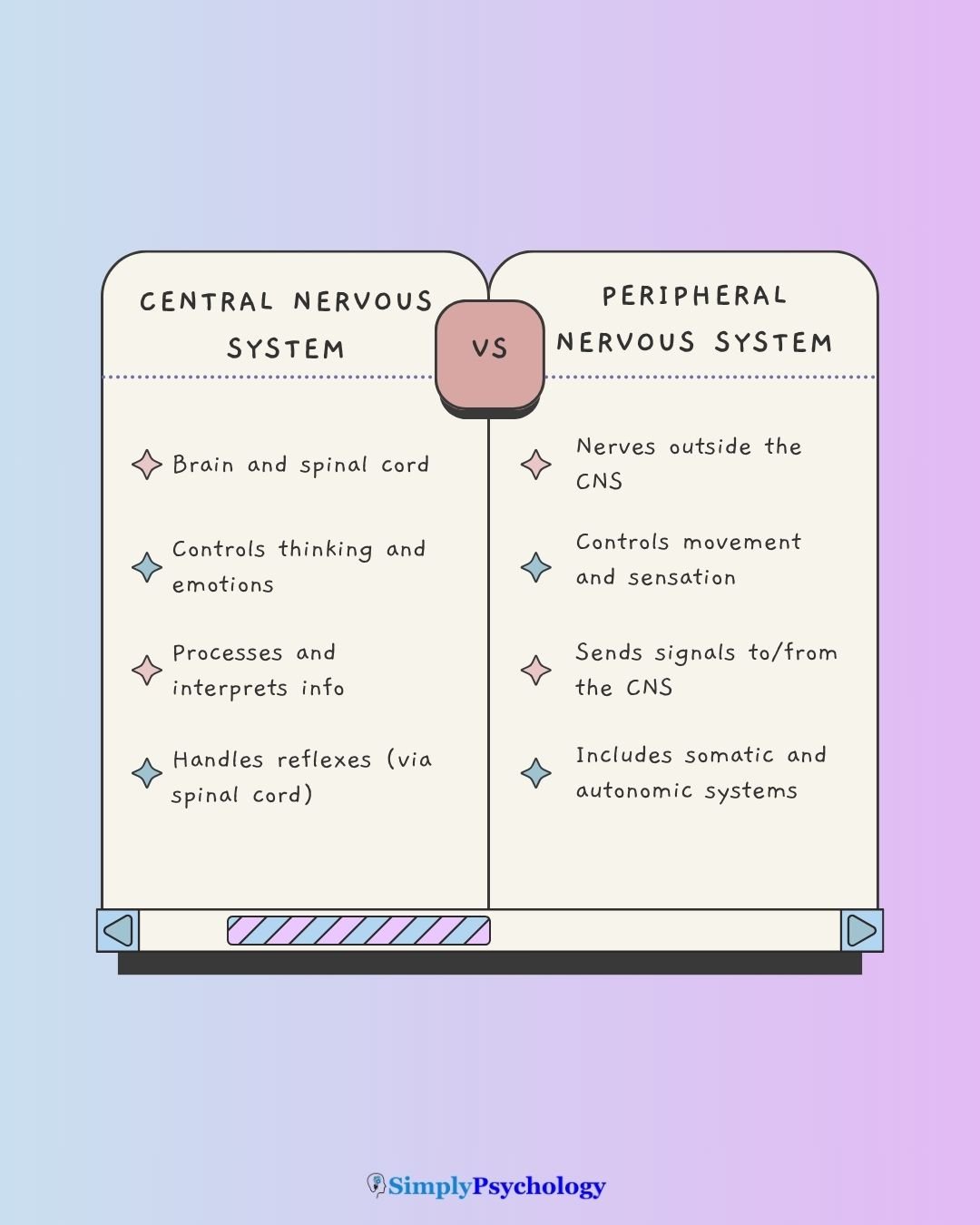
The Central Nervous System (CNS) is the command center, consisting of the brain and spinal cord. It is responsible for integrating sensory information and coordinating responses.
The Peripheral Nervous System (PNS) consists of all the cranial and spinal nerves that branch off from the CNS to the rest of the body.
Its primary function is to serve as a communication relay, sending sensory data toward the CNS and carrying motor commands away from it to the muscles and glands.

central nervous system
The Central Nervous System (CNS) is the body’s control center, consisting of the brain and spinal cord.
As the “headquarters” of the nervous system, the CNS primarily receives, processes, interprets, and stores incoming sensory information.
Once this information is interpreted by brain structures, commands are dispatched via the peripheral nervous system to direct bodily responses.
The CNS is responsible for sensing, perception, thinking, awareness, emotions, and planning.
Additionally, the spinal cord independently handles rapid automatic processes, such as reflexes, for quick reactions without direct brain involvement.

peripheral nervous system
The Peripheral Nervous System (PNS) comprises all nerves located outside the brain and spinal cord.
Its main role is to relay messages between the Central Nervous System (CNS) and the body’s muscles, organs, and senses.

The PNS has two key subdivisions:

1. The Somatic Nervous System (SNS)
The Somatic Nervous System (SNS) is the part of your peripheral nervous system controlling voluntary movements (skeletal muscles) and carrying sensory info (touch, pain, temp) from the body to the central nervous system, essentially managing conscious actions and external sensations.
It functions via two types of neurons:
- Sensory (Afferent) Neurons: These carry signals toward the CNS from sensory receptors (skin, eyes, ears).
- Motor (Efferent) Neurons: These carry signals away from the CNS to the skeletal muscles, allowing for voluntary actions like walking or typing.
- Reflex Arcs: The SNS also handles involuntary muscle “jerks” (like pulling your hand off a hot stove) where the signal bypasses the brain and loops through the spinal cord for a faster response.
2. The Autonomic Nervous System (ANS)
The Autonomic Nervous System (ANS) controls involuntary bodily functions like heart rate, digestion, breathing, and blood pressure, operating unconsciously to maintain internal balance (homeostasis).
It has two main divisions, the sympathetic system (fight-or-flight response) and the parasympathetic system (rest-and-digest), which generally act antagonistically to regulate organs, smooth muscles, and glands.
Sympathetic Division (“Fight or Flight“)
This system mobilizes the body’s resources during energy-expending activities or perceived threats.
- Physical Effects: Dilates pupils for better vision, increases heart rate and blood pressure, inhibits digestion, and triggers the release of adrenaline.
- Goal: Rapid survival response.
Parasympathetic Division (“Rest and Digest”)
This system dominates during quiet, relaxed periods to conserve energy and maintain long-term health.
- Physical Effects: Constricts pupils, slows the heart rate, stimulates digestion and salivation, and allows for waste elimination.
- Goal: Recovery and “housekeeping.”
Central nervous system Vs. peripheral nervous system
Below are some of the main differences between the CNS and the PNS:
Location
The Central Nervous System (CNS) consists solely of the brain and spinal cord.
These vital components are encased in bone for protection: the brain within the skull and the spinal cord within the spinal column.
In contrast, the Peripheral Nervous System (PNS) encompasses all nerves located outside of the brain and spinal cord.
It forms a vast network that extends throughout the entire body, connecting the CNS to muscles, organs, and sensory receptors.
Structure
The CNS is fundamentally composed of nerve cell bodies, forming what is known as gray matter in the brain, which is described as an “intricately patterned complex”.
The spinal cord is a crucial bundle of neurons that transmit messages.
The PNS is structured from thick bundles of axons, functioning as “long neural wires” or a two-way “superhighway” for signals.
Function
The CNS is responsible for receiving, processing, interpreting, and storing incoming sensory information.
It is primarily involved in complex cognitive functions like sensing, perception, thinking, and emotions, and then dispatches commands for appropriate bodily responses.
The spinal cord acts as the primary means for transmitting messages between the brain and the rest of the body.
The PNS serves as the body’s communication network, relaying sensory information from the body’s periphery to the CNS and carrying motor commands from the CNS to muscles and glands.
Its somatic subdivision handles voluntary movements and sensory input from the body’s surface, while its autonomic subdivision manages involuntary internal functions such as heart rate and digestion.
The autonomic system itself splits into the sympathetic division, which prepares the body for stress (“fight-or-flight” response), and the parasympathetic division, which calms the body and restores normal functions.
Response to Injury
Injuries to the CNS, particularly the spinal cord, often result in significant and sometimes permanent loss of function, such as paralysis, because lower segments are cut off from the brain.
While studies of brain damage contribute greatly to understanding its functions, neurons in the CNS have limited regenerative capacity.
The PNS, however, may exhibit a better capacity for regeneration or functional adaptation after injury, although the extent of recovery depends on the specific nerve and injury severity.
Comparison Table
| Feature | Central Nervous System (CNS) | Peripheral Nervous System (PNS) |
| Location | Brain and spinal cord; encased in bone. | All nerves outside brain and spinal cord; extends throughout body. |
| Structure | Composed of brain (nerve cell bodies, gray matter) and spinal cord (neuron bundles). | Made of thick bundles of axons called nerves; includes somatic and autonomic subdivisions. |
| Function | Processes, interprets, stores sensory info; sends commands; responsible for thought, emotion. | Relays sensory info to CNS; relays motor commands from CNS to body; controls voluntary and involuntary actions. |
| Injury Response | Damage often leads to permanent functional loss (e.g., paralysis). | May show better capacity for regeneration or functional adaptation. |
How do the CNS and PNS work together?
The Central Nervous System (CNS) and Peripheral Nervous System (PNS) continuously collaborate to enable all bodily functions and interactions with the world.
The Functional Flow
The relationship between the CNS and PNS is defined by a continuous feedback loop of information.
This flow follows three distinct phases:
- Sensory Input (PNS): Sensory information from our environment is detected by receptor cells and transmitted via afferent (sensory) neurons of the PNS to the CNS (brain and spinal cord).
- Integration (CNS): The brain and spinal cord act as the processing center. Interneurons within the CNS analyze the sensory input, compare it to stored memories or homeostatic set points, and formulate a specific response.
- Motor Output (PNS): Once the CNS processes and interprets this information, it dispatches commands via efferent (motor) neurons of the PNS to muscles and glands, dictating responses.
This constant electrochemical communication across nerves facilitates all our experiences and actions.
Example: Touching a Hot Surface
If you touch a hot stove, sensory receptors in your skin (PNS) immediately detect the heat. Afferent neurons swiftly transmit this “hot” signal up your arm to your spinal cord (CNS).
For a rapid reflex arc, the spinal cord can issue a motor command directly through efferent neurons to your arm muscles (PNS) to pull away, saving precious seconds without immediate brain processing.
Meanwhile, the “pain” signal continues to the brain for conscious perception and further response planning.

Everyday Tasks
Both systems are crucial for daily life.
Voluntary actions like typing (CNS planning, PNS motor commands) and involuntary functions such as digestion or maintaining posture (CNS oversight, PNS autonomic control) rely on this integrated communication.
It’s a continuous feedback loop that allows us to sense, think, feel, and act.
Common disorders and their impact
Common disorders affecting the nervous system can stem from issues within either the Central Nervous System (CNS) or the Peripheral Nervous System (PNS), leading to distinct symptoms and treatment approaches.
CNS-Related Conditions
Conditions impacting the CNS include stroke, multiple sclerosis (MS), and traumatic brain injury (TBI).
TBI, for example, often results in significant and sometimes permanent functional loss, as CNS neurons have limited regenerative capacity.
Schizophrenia, primarily affecting the brain, is characterized by major disturbances in thought, perception, emotion, and behavior, often leading to social and occupational impairment.
Mood disorders and anxiety disorders are also linked to brain chemistry imbalances, with psychotropic medications often used to restore neurotransmitter balance.
PNS-Related Conditions
Disorders of the PNS include neuropathy and nerve compression, which often manifest as symptoms like “numbness and tingling”.
This can feel very distressing, but also, the PNS may exhibit better capacity for regeneration compared to the CNS.
Summary
The central and peripheral nervous systems work together to control everything from basic reflexes to complex thoughts.
The CNS—made up of the brain and spinal cord—is the body’s processing hub, handling thinking, emotions, and coordination.
The PNS connects the CNS to the rest of the body, relaying sensory input and carrying out responses through nerves.
To remember the difference, think of the CNS as the “control center” and the PNS as the “communication network.” The CNS interprets information, while the PNS delivers messages to and from it.

