Key Takeaways
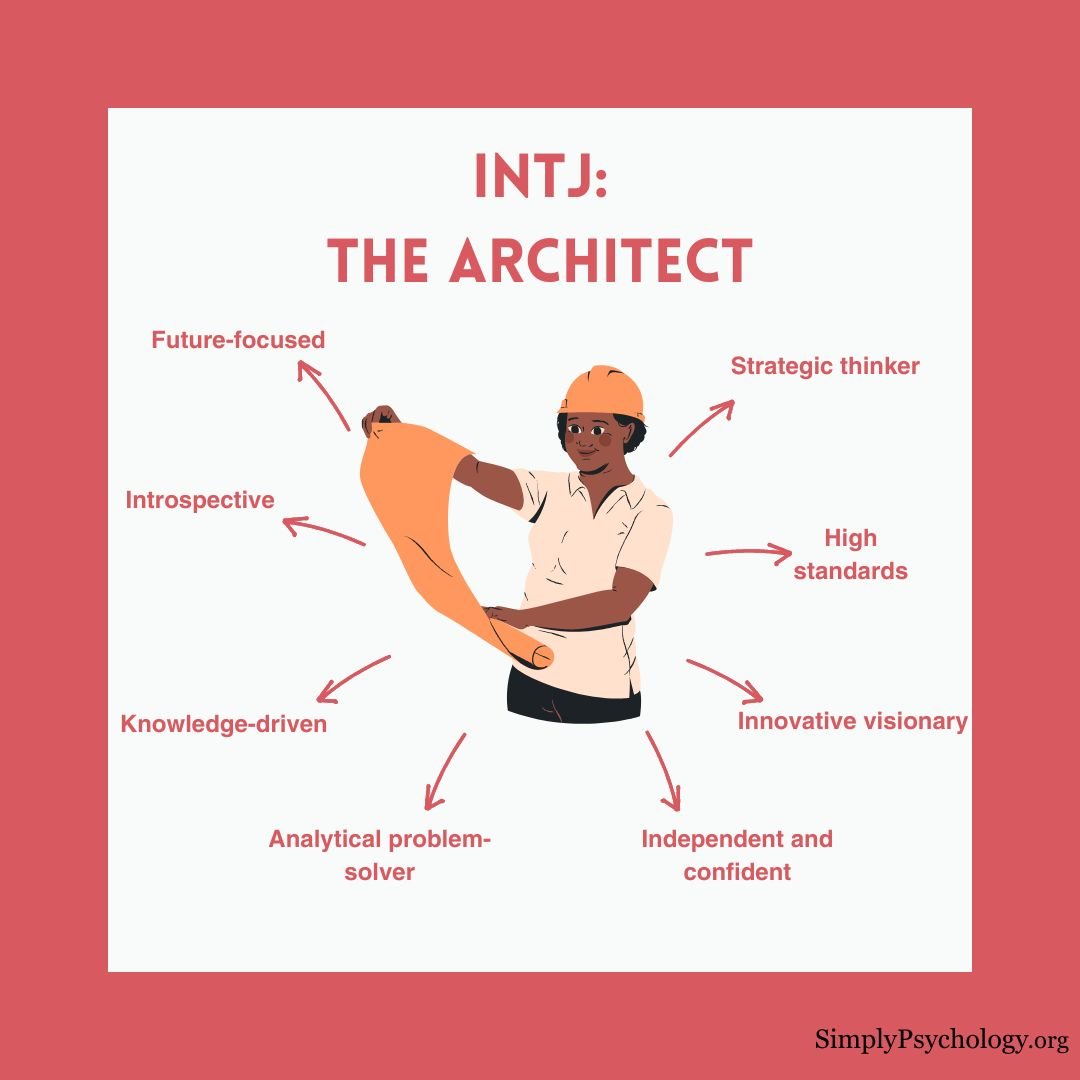
- Meaning: INTJ stands for Introversion, Intuition, Thinking, and Judging — one of 16 Myers-Briggs types, nicknamed “the Architect” for its strategic, analytical style.
- Rarity: INTJs are one of the least common types, making up roughly 2% of the general population.
- Strengths: Hard-working, intellectual, confident, and rational, with a drive to master complex problems.
- Challenges: Can come across as insensitive or single-minded, and often struggles to engage with emotions.
- Relationships: Values deep, intellectually compatible connections over small talk, and stays fiercely loyal once trust is built.
- Scientific Caveat: Like the MBTI overall, the INTJ label has weak test-retest reliability and predictive validity (how well it predicts job outcomes), so it’s best used for self-reflection, not diagnosis.
INTJ Meaning
INTJs derive energy from solitary thought and introspection (Introversion), and they lean towards abstract concepts and future scenarios over immediate facts (Intuition). They base their decisions on logical reasoning rather than emotional considerations (Thinking), and prefer planning and structure over spontaneous flexibility (Judging).
People with the INTJ personality type tend to be highly independent, confident, and self-sufficient individuals. They are analytical, creative, and driven.
INTJs are sometimes referred to as “the Architect” or “the Scientist,” “the Strategist,” or “the Mastermind.” ESFP is the opposite of the INTJ personality type.
They place an emphasis on logic and fact rather than emotion and can be viewed as perfectionists. They typically have high expectations of competence and performance for themselves and others.
INTJ-A vs INTJ-T
Some quizzes add an “-A” or “-T” suffix, like INTJ-A or INTJ-T. This label is not official MBTI. It comes from 16Personalities, a free test that adds a fifth axis called Assertive/Turbulent, borrowed from the Big Five trait of Neuroticism.
An “-A” (Assertive) INTJ tends to feel calm and self-assured, while a “-T” (Turbulent) INTJ leans toward stress and self-doubt. Free online versions like this lack the standardised validation of the certified MBTI assessment.
Famous INTJs include Hillary Clinton and Ruth Bader Ginsburg. Stephen Hawking, Thomas Jefferson, Lance Armstrong, and Bill Gates are also thought to fit the type.
INTJ is the third rarest type in the population, and the rarest type among women. INTJs make up:
- 2% of the general population
- 3% of men
- 1% of women
| Strengths | Weaknesses |
|---|---|
| Hard-working | Impatient |
| Intellectual | Insensitive |
| Confident | Single-minded |
| Rational | Emotionally disconnected |
| Determined | Perfectionistic |
Key INTJ Characteristics
INTJs are logical and analytical
- Objective Focus: They are intellectual problem-solvers who prioritize objective information over subjective emotion.
- Strategic Mindset: They are sometimes considered “the Strategist” or “the Mastermind” because of their strategic, rational way of thinking.
- Mastery Drive: They can master any topic that interests them and are not satisfied unless their work succeeds.
People with the INTJ personality type can be arrogant
- Need for Control: They want their environment to feel controlled and ordered, so they make decisions without asking for anyone else’s input.
- Intellectual Impatience: They overlook anyone they deem intellectually inferior and can be single-minded in their thinking.
- Superiority Complex: They won’t follow others’ ideas without understanding why, and can be impatient with people who don’t catch on quickly.
INTJs are bold dreamers
- Relentless Drive: They work relentlessly until they achieve their definition of success, believing they can master any subject that matters to them.
- Constant Improvement: They are determined in whatever they do and constantly seek new, creative ways to improve the world around them.
- Perfectionism Risk: This determination and steadfastness can quickly become perfectionism, taking a toll on their personal lives outside of work.
Cognitive Functions of an INTJ
The MBTI suggests that the four different cognitive functions (thinking, feeling, intuition, and sensing) form a hierarchy where each function is either directed outwardly (extroverted) or inwardly (introverted).
The order of these functions determines one’s personality.
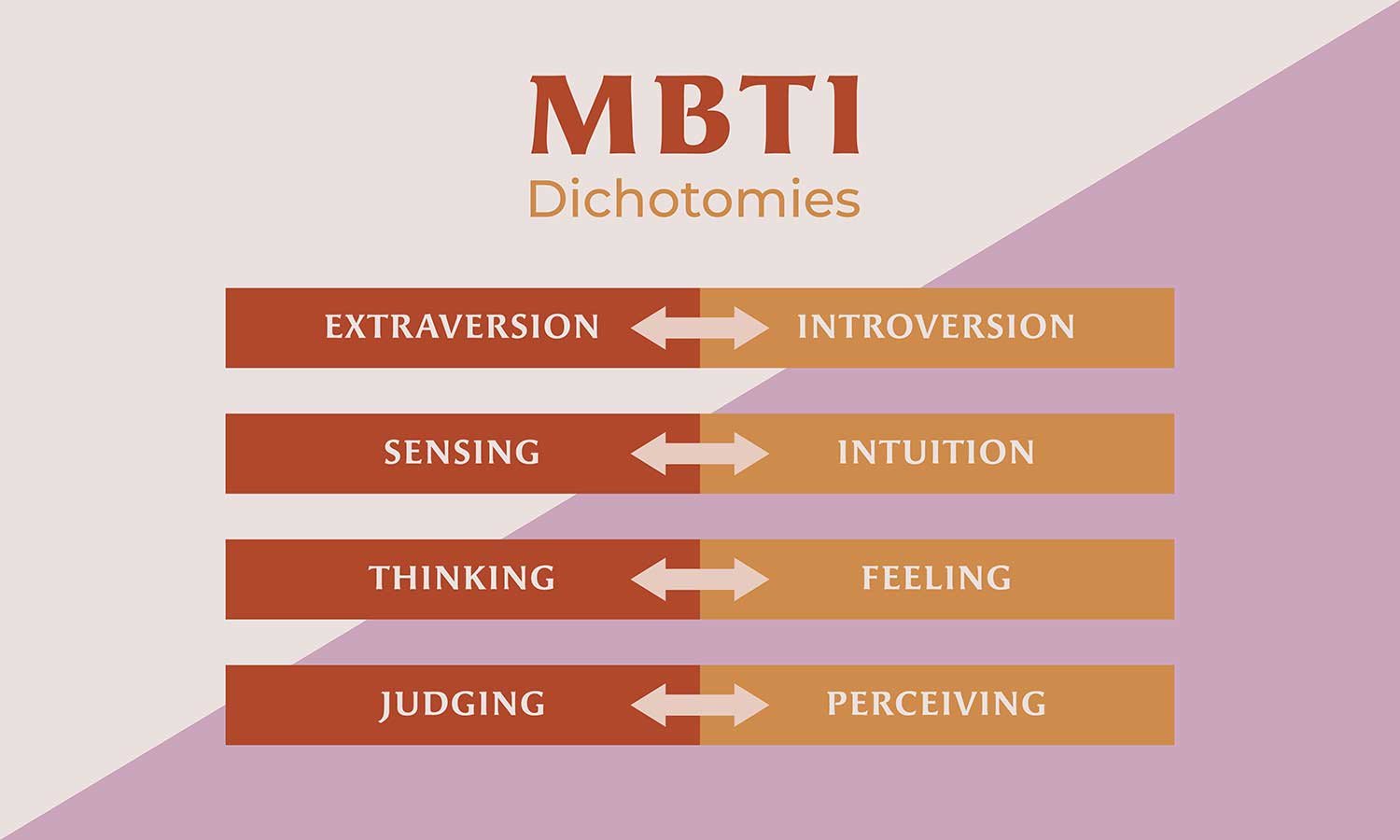
The dominant function is the primary aspect of personality, while the auxiliary and tertiary functions play supportive roles.
Dominant: Introverted Intuition
- INTJs depend greatly on their introverted intuition (Ni) and firmly trust their instincts.
- They like to look at the big picture and focus on abstract patterns and meanings rather than concrete details.
- A dominant function is the most conscious, trusted and habitually used function, and Jung treated it as the core of the whole personality, so Ni anchors everything else in the stack.
- Because INTJ is a Judging type, the function actually shown to the outside world is not Ni but the auxiliary, Extraverted Thinking; Ni itself operates almost entirely inside the mind.
- This is one reason INTJs can seem hard to read on first meeting: other people encounter the organised, decisive Te on the surface first, while the intuitive hunches driving it stay private until the INTJ chooses to share them.
Auxiliary: Extraverted Thinking
- Extraverted thinking (Te) is the INTJ’s auxiliary, or second, function. It leads them to seek order, control, and structure in the world around them.
- They make decisions based on logic and rationality, setting subjective emotion aside.
- An auxiliary function acts as a co-pilot to the dominant, supplying the outward-facing role that an introverted dominant function cannot provide by itself.
- Because INTJ carries a J in its four-letter code, Te is specifically the function extraverted toward the outside world; the J or P letter exists to signal exactly this pairing, which is how the type’s whole function order gets inferred from just four letters.
- This pairing is what pushes an INTJ’s private, pattern-based ideas out into workable plans, structures, and decisions that other people can see and act on.
Tertiary: Introverted Feeling
- Introverted feeling (Fi) is a part of the INTJ personality, but to a lesser degree than their dominant and auxiliary functions.
- This aspect of their personality leads some INTJs to pay more attention to their own values when making decisions.
- This is why INTJs connect best with those who are well-aligned with their thoughts and ideas.
- A tertiary function is less developed than the dominant and auxiliary, and it typically strengthens later in life.
- As Fi matures, many INTJs become more comfortable naming their own values, not just applying logic to everyone else’s.
Inferior: Extraverted Sensing
- This is the least developed part of the INTJ personality.
- This function allows some INTJs to process information through their senses and live in the moment, rather than focusing on future possibilities.
- An inferior function is the least conscious and least controlled part of a personality, and it is often where stress shows up first.
- Under pressure, an INTJ may become unusually focused on physical detail, comfort, or indulgence, the opposite of their usual big-picture style.
INTJ Hobbies, Interests, and Careers
Because INTJs are highly analytical and driven to master complex problems, they often thrive in intellectually demanding fields such as STEM.
They also appreciate order and structure, so they are suited for jobs that involve careful attention to detail and adherence to clear-cut procedures.
They are hardworking, with an unshakable work ethic. This drive helps INTJs succeed in management or administrative roles.
INTJ personality types value collaborative, team-oriented workplaces. In a management role, they aim to build a cohesive and productive environment.
Popular INTJ careers include social work, office management, teaching, childcare, and counselling. Outside work, INTJs often enjoy cooking, gardening, painting, walking, and watching movies.
INTJ Work Environments
Work Style and Standards
INTJs are deeply devoted to their work. They hold themselves to extremely high standards, and they excel in careers that demand productivity and the ability to evaluate complex information.
They enjoy creating innovative solutions and use their analytical skills to solve difficult problems, understand complex ideas, and build efficient systems. Above all, they want careers that challenge them intellectually.
Growth matters too. INTJs know how much they can offer the world, so they seek out roles that make full use of their unique gifts.
Best-Suited Careers and Interests
INTJs are typically drawn to STEM fields. They can also thrive in business or the arts, working as scientists, engineers, mathematicians, teachers, judges, or lawyers.
They also do well as project managers and systems engineers. Marketing, systems analysis, and management consulting suit them too.
Outside of work, INTJs enjoy reading, cultural events, and taking classes. Many also appreciate art, computers, video games, and independent sports such as swimming, backpacking, or running.
INTJ Personal Relationships
INTJs value compatibility in both friendships and romantic partnerships. Compatible others can be hard to find. They look for people who share their values and intellectual curiosity, and will not pursue a relationship without that match.
They are known for their low emotional intelligence, often struggling to engage with feelings or read others’ emotional cues. As introverted individuals, they spend much of their time alone and prefer working independently.
Work and success often take priority over relationships. Finding people who can keep pace can be difficult. This work ethic can cost them time with family, friends, or partners.
Forming new friendships is a slow process, since INTJs often dislike small talk. Yet they are fiercely loyal to their closest friends and family, and readily dive into deep, meaningful conversations with them.
Tips for Interacting With INTJs
Friendships
Establishing a friendship with an INTJ can be challenging. They are independent and self-sufficient.
They tend to only get close to those with whom they know they will be able to maintain a long-term relationship.
Because of this, they are highly devoted to their small circle friends. They avoid drama and bond best with those who share their same values, interests, and general approach to life.
Relationships
INTJs tend to struggle with romantic relationships. Because they are so independent and closed off, their partners often struggle to connect with them emotionally. Finding a compatible partner can be challenging as a result.
However, once they find the right person who matches their vigor and intellectual pursuits, INTJs become devoted and loyal partners.
INTJs value a partner who respects their independence and does not pressure them to discuss their emotions. Loyalty and understanding matter more to them than grand romantic gestures.
Parenting
As parents, INTJs are devoted and thoughtful, setting firm boundaries and high expectations.
They are typically not highly affectionate, but support their children by encouraging them to explore their own interests and potential.
They want to raise self-directed, independent children who are capable of solving their own problems and thinking for themselves.
Is INTJ Your Personality Type? Quick Self-Check
Answer these questions to find out if INTJ might be your personality type:
- Do you prefer spending time alone to recharge rather than in large social gatherings?
- Are you drawn to abstract concepts and future possibilities more than concrete facts?
- When making decisions, do you rely more on logic and objective analysis than on emotions?
- Do you enjoy planning and structuring your life rather than being spontaneous?
- Are you often described as independent, confident, and self-sufficient?
- Do you have high standards for yourself and others, sometimes bordering on perfectionism?
- Are you passionate about pursuing knowledge and mastering topics that interest you?
- Do you prefer looking at the big picture rather than focusing on small details?
- Are you comfortable challenging established ideas if you believe there’s a better way?
- Do you sometimes struggle with expressing emotions or understanding others’ emotional needs?
If you answer “yes” to most of these questions, you may have INTJ personality traits.
However, remember that personality is complex, and a professional assessment would be needed for a definitive personality type determination.
Take the MBTI (Paper Version)
Is the MBTI Scientifically Valid?
Before taking an INTJ label too literally, it helps to know how the MBTI itself holds up under research scrutiny. Psychologists raise five main concerns:
- Low Reliability: People often get a different type when they retake the test, sometimes within weeks.
- Weak Predictive Validity: Type does not reliably predict job performance or other real-world outcomes.
- Forced Categories: The test squeezes continuously distributed traits into either/or boxes that don’t match how personality actually varies.
- Weak Theoretical Foundation: The Jungian theory behind the test was never tested with controlled studies.
- The Barnum Effect: Vague, flattering type descriptions feel accurate to almost everyone, which inflates how convincing the results seem.
Low Reliability
Test-retest studies find that many people receive a different four-letter type when they retake the MBTI, sometimes within only a few weeks of the first attempt (Pittenger, 1993). A reliable psychometric test should return the same result for the same person twice.
The instability is not random. It follows directly from how the test scores work.
Someone who scores 51% Thinking and 49% Feeling is reported simply as “T”, indistinguishable from someone who scores 99% Thinking. A small shift in answers on a retest can flip that person to “F”, changing their whole four-letter code even though nothing real has changed.
This means a label can shift for reasons that have nothing to do with any real change in the person.
Weak Predictive Validity
Research reviews describe the MBTI’s predictive validity — its ability to predict job performance or other outcomes — as limited (Pittenger, 2005). This matters because the test is often marketed for exactly these high-stakes uses.
The stakes are high.
Critics argue this evidence gap should rule out using MBTI results to screen job candidates or shape personnel decisions. Type is not a substitute for a proper skills or performance assessment.
Coaching is different. As a conversation-starter for reflection, accuracy matters far less than it does in hiring.
Independent, peer-reviewed support for the test’s predictive claims remains thin relative to how widely organisations still lean on it in hiring conversations.
It stays one of the most consistently repeated criticisms of the test.
Forced Categories
The MBTI’s central design flaw, according to critics, is dichotomisation: it sorts people into either/or categories on traits that are more likely to be continuously distributed. Most people’s scores on a dimension like extraversion cluster near the middle of the scale, not at either extreme.
Carving that continuum at the midpoint creates two artificial boxes.
A near-twin who scores just one point differently on Thinking-Feeling can be reported as a different type, even though their profile looks almost the same. Dimensional models such as the Big Five avoid this problem by scoring people on a spectrum instead.
This is the same dichotomisation mechanism behind the reliability problem described above, just applied to a different pair of letters in the four-letter code.
Weak Theoretical Foundation
The MBTI rests on Carl Jung’s theory of psychological types. Jung never tested it with controlled studies. He built it instead from clinical observation and self-analysis.
Much of the research offered in support of the MBTI is methodologically weak. Reviews of the underlying theory conclude that its central claims are not well supported. This includes the discreteness of types and the reality of the function stack, both hard to test (Stein & Swan, 2019).
The instrument therefore rests on a pre-empirical theory. Modern factor-analytic research has not confirmed it.
The Barnum Effect
Much of the MBTI’s persuasive power comes from a cognitive bias rather than accuracy. Bertram Forer’s (1949) classic study gave students an identical, generic personality sketch, assembled from a newspaper astrology column, and asked them to rate how well it described them personally.
The rating was high. Students scored the vague, flattering description around 4.3 out of 5 for accuracy, despite everyone in the room receiving exactly the same text.
MBTI type portraits work the same way: they are broad and flattering enough that almost anyone can recognise themselves in the description. Once someone is given a label, confirmation bias takes over.
They start noticing the moments that fit the type, and quietly discount the ones that don’t, so the label seems to confirm itself over time.
Contemporary Research
Recent studies keep testing the same questions from new angles. Furnham (2022) mapped all four MBTI scores onto the 30 facets of the NEO-PI-R, a detailed Big Five measure. This confirmed the correlations McCrae and Costa (1989) first reported.
MBTI Extraversion-Introversion lines up with Big Five Extraversion. Sensing-Intuition lines up with Openness, Thinking-Feeling with Agreeableness, and Judging-Perceiving with Conscientiousness.
The MBTI has no Neuroticism dimension, one of the Big Five’s most useful predictors.
Francis and Village (2022) built and validated the Francis Psychological Type Scales (FPTS) against the MBTI, reporting on its factor structure, reliability, and concurrent validity. Neither study has restored the MBTI to research favour.
Sources
Forer, B. R. (1949). The fallacy of personal validation: A classroom demonstration of gullibility. The Journal of Abnormal and Social Psychology, 44(1), 118–123. https://doi.org/10.1037/h0059240
Francis, L. J., & Village, A. (2022). The Francis Psychological Type Scales (FPTS): Factor structure, internal consistency reliability, and concurrent validity with the MBTI. Mental Health, Religion & Culture, 25(9), 931–951. https://doi.org/10.1080/13674676.2022.2041584
Furnham, A. (2022). The Big Five facets and the MBTI: The relationship between the 30 NEO-PI-R facets and the four Myers-Briggs Type Indicator (MBTI) scores. Psychology, 13(10), 1504–1516.
King, S. P., & Mason, B. A. (2020). Myers‐Briggs Type Indicator. The Wiley Encyclopedia of Personality and Individual Differences: Measurement and Assessment, 315-319.
McCrae, R. R., & Costa, P. T. (1989). Reinterpreting the Myers-Briggs Type Indicator from the perspective of the five-factor model of personality. Journal of Personality, 57(1), 17–40. https://doi.org/10.1111/j.1467-6494.1989.tb00759.x
Myers, I. B. (1962). The Myers-Briggs Type Indicator: Manual (1962).
Myers, K. D., & Kirby, L. D. (2015). Introduction to type: A guide to understanding your results on the MBTI assessment. Sunnyvale, CA: CPP.
Myers-Briggs Type Indicator. (2019, May 28). New World Encyclopedia, . Retrieved from https://www.newworldencyclopedia.org/p/index.php?title=Myers-Briggs_Type_Indicator&oldid=1020015.
Myers, Isabel B.; Myers, Peter B. (1995) [1980]. Gifts Differing: Understanding Personality Type. Mountain View, CA: Davies-Black Publishing. ISBN 978-0-89106-074-1.
Pittenger, D. J. (1993). The utility of the Myers-Briggs Type Indicator. Review of Educational Research, 63(4), 467–488. https://doi.org/10.3102/00346543063004467
Pittenger, D. J. (2005). Cautionary Comments Regarding the Myers-Briggs Type Indicator. Consulting Psychology Journal: Practice and Research, 57(3), 210-221.
Stein, R., & Swan, A. B. (2019). Evaluating the validity of Myers-Briggs Type Indicator theory: A teaching tool and window into intuitive psychology. Social and Personality Psychology Compass, 13(2), e12434. https://doi.org/10.1111/spc3.12434
The purpose of the Myers-Briggs Type Indicator®. The Myers & Briggs Foundation: MBTI Basics. (n.d.). Retrieved from https://www.myersbriggs.org/my-mbti-personality-type/mbti-basics/
FAQS
What is an INTJ personality like?
An INTJ personality, based on the Myers-Briggs Type Indicator, is characterized by preferences for Introverted (I), Intuitive (N), Thinking (T), and Judging (J).
INTJs are analytical, strategic, and independent thinkers who thrive on exploring complex ideas and solving problems. They have a strong drive for competence, often setting high standards for themselves and others.
INTJs are reserved and may appear detached in social situations, as they prioritize logic and efficiency over emotions. They excel in areas that require critical thinking, planning, and a long-term perspective.
However, they may struggle with expressing feelings and empathizing with others, leading to misunderstandings or difficulties in personal relationships.
Is an INTJ rare?
The INTJ personality type is rare, making up approximately 2-4% of the general population. This introverted, intuitive, thinking, and judging type is known for its analytical and strategic thinking, as well as its high standards and independence.
Although a minority, INTJs can significantly impact the world around them, often excelling in roles that require critical thinking, planning, and a long-term perspective.
What does INTJ mean in dating?
In the context of dating, an INTJ person tends to approach relationships with a rational, strategic mindset. They value intellectual compatibility and shared interests, often seeking partners who can engage in stimulating conversations and appreciate their analytical nature. INTJs may take time to open up emotionally, as they prioritize logic and efficiency over emotions.
When dating, INTJs typically prefer meaningful, deep connections rather than casual encounters. They may be selective about potential partners and take relationships seriously, often investing time and effort into making them work.
However, they might struggle with expressing emotions and understanding their partners’ emotional needs, which can be a challenge in maintaining intimacy and harmony in the relationship. Open communication and mutual understanding are crucial for a successful INTJ relationship.