Mirror neurons are brain cells that activate both when we perform an action and when we observe someone else performing it.
Giacomo Rizzolatti and colleagues first discovered mirror neurons in the early 1990s. They were recording from the premotor cortex of macaque monkeys. The cells fired not only when a monkey grasped food, but also when it watched a researcher do the same.
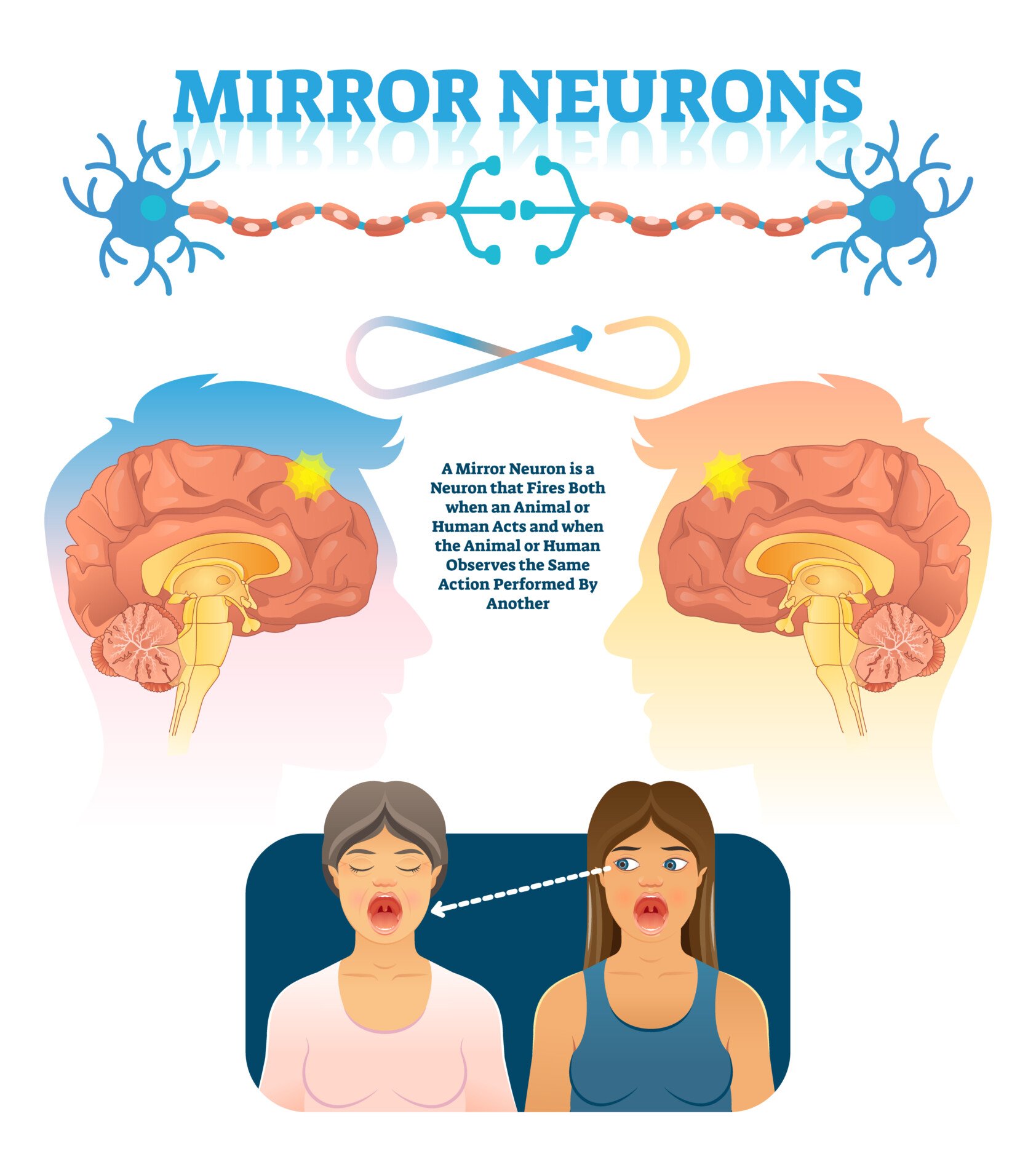
Further research showed that monkeys have mirror neurons in both the premotor cortex and the inferior parietal lobule, forming a fronto-parietal mirror system.
By the late 1990s, neuroimaging studies began suggesting that humans have a similar network.
Mirror Neurons in Humans
Routine electrode recording is not possible in healthy humans. Still, tools like fMRI, PET, EEG, and TMS show something consistent. Watching someone else act activates brain areas similar to those we use when acting ourselves. The evidence is indirect, but it is consistent.
This fronto-parietal network includes the inferior frontal gyrus and inferior parietal lobule, regions involved in planning and executing movements.
EEG studies reveal that the mu rhythm, an 8–13 Hz brainwave pattern recorded over the motor cortex, is suppressed during both action and observation. This suggests our brains simulate others’ actions internally, often outside conscious awareness.
How Mirror Neurons Work
Mirror neurons function by mapping observed actions onto our own motor systems.
If you grasp a cup, a neuron fires. That same neuron may also fire when you watch someone else grasp a cup. This internal simulation allows for intuitive understanding without deliberate reasoning.
In monkeys, mirror neurons were found in areas integrating sensory input with motor planning (e.g., ventral premotor cortex and inferior parietal lobule).
Aim: Gallese and colleagues (1996) wanted to characterise this new class of neuron, and see how closely an observed action must match the executed one.
Method: The team recorded activity from 532 neurons in macaque area F5 as the monkeys performed hand and mouth movements, then watched an experimenter perform similar actions.
Results: Ninety-two cells fired during both execution and observation. They needed an agent interacting with an object to respond; a hand or object alone was not enough.
Conclusion: The team named these cells mirror neurons. They proposed the cells match an observed action to the same action being performed, offering a possible neural basis for recognising what someone else is doing.
Humans show mirror-like activity in analogous regions: Broca’s area, the ventral premotor cortex (in the frontal lobes), and the inferior parietal cortex. This suggests a shared simulation system.
Even somatosensory areas show this effect, implying we might subtly “feel” the actions we observe.
Studying Mirror Neurons
Researchers study mirror neuron activity using various neuroimaging techniques:
- Functional Magnetic Resonance Imaging (fMRI) study showed that watching someone grasp an object led to increased signal in the observer’s inferior frontal cortex (a mirror neuron area) – especially when the grasp was shown in a context that revealed the person’s intention (grasping to drink vs. grasping to clean).
- Electroencephalography (EEG) shows suppression of the mu rhythm (an oscillation around 8–13 Hz seen over motor cortex) during both action execution and action observation. This suppression indicates that the motor cortex is active when watching others move, much as it is during one’s own movement.
- Transcranial Magnetic Stimulation (TMS) studies have found that the motor system’s excitability increases when a person watches someone else perform an action, like a finger movement, compared to when they watch static images, implying that the observer’s motor neurons are primed during action observation, consistent with mirror neuron activity.
Together, these methods support the existence of a mirror system in humans, though most evidence is indirect.
Key Functions of Mirror Neurons
Action Understanding
Mirror neurons are thought to help us make sense of other people’s actions.
Rather than simply observing movement, we tend to intuitively understand its purpose—like recognizing that someone reaching for a cup is likely trying to drink.
This system allows us to go beyond surface-level observation. By internally mapping observed actions onto our own motor systems, we can infer intentions behind those actions.
This contributes to our ability to quickly and effortlessly grasp what others are doing and why, without needing to analyze each movement in detail.
Imitation and Learning
Mirror neurons also play a role in connecting what we see with what we do.
This connection is especially important in imitation and observational learning.
From a young age, humans are natural imitators, learning gestures, skills, and behaviors simply by watching others.
This form of learning is not only practical—such as copying how to use a tool or follow a dance—but also social.
Imitation can build connection and trust, even when it’s unconscious. For instance, people often mirror each other’s posture, gestures, or tone during conversation.
This subtle mimicry fosters rapport and helps us navigate social interactions smoothly.
By linking perception and action, the mirror system makes it easier to replicate what we see and to understand how others move and behave.
Empathy and Emotions
Beyond actions, the mirror system may help us resonate with the emotional states of others.
When we see someone expressing pain, joy, or disgust, we might internally experience a faint echo of those feelings ourselves.
This neural resonance supports the idea that part of empathy is automatic and embodied. The effect is subtle.
Emotional mirroring may explain why we wince when watching someone get hurt, or feel uplifted by another person’s laughter.
It reflects a broader principle. The brain areas involved in our own emotional experiences can also activate when we witness those emotions in others.
This mechanism likely plays a key role in emotional contagion, the tendency to “catch” others’ moods, and helps form the basis for intuitive, affective empathy.
Social Cognition
Mirror neurons may also contribute to our understanding of others’ minds, a foundational aspect of social cognition.
This includes the ability to infer others’ thoughts, feelings, and intentions, often referred to as theory of mind.
By simulating others’ experiences internally, the brain may provide us with a kind of embodied understanding that supports more complex social reasoning.
This mirroring also shows up in everyday conversations. People naturally sync their gestures, facial expressions, or tone of voice, an interactional rhythm that strengthens connection.
These abilities matter most for developing social bonds and navigating the nuances of human interaction.
Mirror Neurons and Autism
The “broken mirror” theory of autism posits that reduced mirror neuron activity may underlie some social and communicative challenges.
An EEG study by Oberman and colleagues (2005) looked at mu rhythm suppression in autistic children. Autistic children often show reduced mu rhythm suppression when watching others move. Yet their own movements suppressed the rhythm normally.
Aim: Dapretto and colleagues (2006) tested whether autistic children show reduced mirror-region activity when processing emotional facial expressions. They also asked whether this relates to social impairment.
Method: Autistic children and typically developing children imitated and simply observed emotional facial expressions during fMRI. The scans compared a key mirror region against measures of social functioning.
Results: The autism group showed no mirror-region activity during imitation. Typically developing children showed strong activity. Lower activity predicted greater social impairment.
Conclusion: The authors argued that a dysfunctional mirror system may contribute to social difficulties in autism. This was the strongest evidence at the time.
This may help explain differences with imitation, empathy, and interpreting social cues. For example, if a child doesn’t instinctively mirror a smile, they may not learn to smile back, hindering social development.
However, the theory remains debated. Some studies show typical mirror responses in autistic individuals under certain conditions.
A systematic review by Hamilton (2013) put this to a stronger test. It looked at the whole evidence base. It appraised every published neuroscience study of the mirror system in autism, 25 in total, across EEG, fMRI, TMS, and other methods.
The evidence was mixed and largely unsupportive of a broad mirror deficit. The picture was not clean. Studies using non-emotional hand actions generally found no group differences at all.
Hamilton concluded that the broken-mirror hypothesis, in its strong form, is not supported. The data fit better with atypical top-down modulation of social responses. A broken mirror mechanism alone does not explain it.
Autism is highly heterogeneous, and mirror neuron function may vary across individuals. Moreover, it’s unclear whether reduced mirror activity is a cause or consequence of social differences.
Alternative explanations suggest that primary motor planning difficulties may underlie both movement and social impairments.
The Scientific Debate
While mirror neurons have generated excitement, some early claims—linking them to everything from empathy to civilization—were overstated.
Critics, like Gregory Hickok, argue that many of these claims lack strong evidence. For instance, monkeys with damaged mirror areas can still understand actions, and humans can comprehend movements or speech they can’t physically perform.
Mirror neurons are also more diverse than often assumed. Some respond to specific actions; others to sounds or pantomimes. No two mirror neurons are quite alike. Context and perspective matter, and not all neurons behave the same way.
This complexity suggests mirror neurons are part of a broader, dynamic system influenced by attention, motivation, and context.
Human studies often rely on indirect measures like fMRI, which can’t confirm that the same neuron fires during both action and observation.
While the mirror mechanism is well-supported, its exact role in human cognition remains an active area of research.
Contemporary Research
The most rigorous modern test of mirror neurons’ link to empathy came in 2021.
Bekkali and colleagues (2021) pooled 52 studies testing whether mirror-system activity relates to empathy, covering TMS, EEG, and fMRI measures from 1,044 participants in total.
Emotional and cognitive empathy were only moderately linked to mirror activity, and the results were inconsistent across methods. Motor empathy showed no significant relationship at all.
The authors concluded that mirror neurons offer, at most, preliminary support for empathy, far weaker than the popular claim that they are its basis. Methodological differences between studies, not a clean underlying effect, seemed to drive much of what association there was.
Rival Theories of Mirror Neurons
Direct-matching is not the only explanation on offer. Two rival theories challenge where mirror neurons come from, and what they contribute to reading other minds.
Associative Sequence Learning
The direct-matching account treats mirror neurons as an evolved adaptation for reading other minds. Associative Sequence Learning, or ASL, tells a different story.
Developed mainly by Cecilia Heyes, it holds that mirror neurons are simply ordinary learning at work. Every time an infant watches its own hand grasp something, the sight and the motor command occur together.
Enough of these pairings, ASL argues, wire a match between seeing and doing. No innate circuit is required.
The strongest evidence for ASL comes from counter-mirror training. Participants practise one action while repeatedly watching a different one, such as opening a hand while watching a hand close.
This measurably shifts mirror-system responses toward the trained pairing, producing “counter-mirror” responses (Catmur, Walsh, & Heyes, 2007). A genuinely innate module should not be so easily reprogrammed by one training session.
ASL does not deny that mirror neurons exist or matter.
It relocates their origin from evolutionary design to ordinary learning, challenging the idea that mirror neurons are a special-purpose adaptation for understanding others (Heyes, 2010).
Simulation Theory vs. Theory-Theory
A second dispute concerns how mirror neurons might help us read other minds. Simulation theory holds that we understand someone else by using our own mind as a model of theirs.
We covertly generate the mental state we would have in their position. Then we attribute it to them.
Gallese and Goldman (1998) proposed mirror neurons as a plausible neural basis for exactly this kind of simulation. The rival view, theory-theory, sees mentalising differently.
On this account, we apply folk-psychological generalisations about how beliefs and desires produce behaviour, rather than running an internal simulation. Saxe (2005) mounted an influential challenge, the “argument from error,” against the simulation account.
If mentalising worked by simulation, our mistakes about others’ minds should mirror the mistakes we make reasoning about ourselves. The evidence does not show this pattern.
Most contemporary accounts now treat simulation and theorising as complementary, not strict alternatives (Saxe, 2005). Even researchers sympathetic to mirror neurons treat their role in reading minds as a live question, not a settled fact.
Why Mirror Neurons Matter
Despite the controversy, mirror neurons have reshaped our understanding of how we connect with others.
They provide a neural link between perception and action. This shows how we might “feel into” others’ experiences through internal simulation.
Applications in Therapy and Learning
Mirror neuron principles inform rehabilitation strategies like action observation therapy for stroke patients.
Watching movements can help activate motor pathways and aid recovery.
A 2022 Cochrane systematic review tested this directly. It pooled 16 randomised trials of action observation in stroke survivors, 574 participants in total, looking at upper-limb motor function as the main outcome.
Action observation training was linked to improved arm and hand function compared with control conditions, though the certainty of this evidence was rated low. There was no clear benefit for daily living activities or quality of life (Borges et al., 2022).
In education, modeling and demonstration are now backed by neuroscience. Watching others perform tasks activates brain areas involved in doing them, priming the learner’s system for action.
This supports the use of visual learning, mentorship, and guided practice.
Mirror neurons highlight how infants learn through social interaction. Simple games, facial imitation, and shared attention shape the mirror system, laying the groundwork for empathy, language, and social skills.
From flinching when someone stubs their toe to smiling when a friend laughs, mirror neurons help us navigate the social world. They let us understand others’ actions, resonate with their feelings, and respond in kind. This forms much of the neural basis for human connection.
Key Takeaways
- Definition: Mirror neurons are brain cells that fire both when we perform an action and when we watch someone else perform it.
- Discovery: Rizzolatti’s team first found them in the 1990s in the premotor cortex of macaque monkeys.
- Human Evidence: In humans, the evidence is indirect, from fMRI, EEG, and TMS, not from single-cell recordings.
- Proposed Roles: They have been linked to action understanding, imitation, empathy, and social cognition.
- Autism Debate: The “broken mirror” theory of autism is contested; a major review found little support for a global deficit.
- Modern Verdict: A 2021 meta-analysis found only a modest link between mirror neurons and empathy, far weaker than popular claims.
- Real Use: Action-observation therapy, informed by mirror-neuron research, shows low-certainty but promising benefits for stroke recovery.
References
Acharya, S., & Shukla, S. (2012). Mirror neurons: Enigma of the metaphysical modular brain. Journal of Natural Science, Biology, and Medicine, 3(2), 118. https://doi.org/10.4103/0976-9668.101878
Bekkali, S., Youssef, G. J., Donaldson, P. H., Albein-Urios, N., Hyde, C., & Enticott, P. G. (2021). Is the putative mirror neuron system associated with empathy? A systematic review and meta-analysis. Neuropsychology Review, 31(1), 14–57. https://doi.org/10.1007/s11065-020-09452-6
Borges, L. R., Fernandes, A. B., Melo, L. P., Guerra, R. O., & Campos, T. F. (2022). Action observation for upper limb rehabilitation after stroke. Cochrane Database of Systematic Reviews, 2022(8), CD011887. https://doi.org/10.1002/14651858.CD011887.pub3
Catmur, C., Walsh, V., & Heyes, C. (2007). Sensorimotor learning configures the human mirror system. Current Biology, 17(17), 1527–1531. https://doi.org/10.1016/j.cub.2007.08.006
Dapretto, M., Davies, M. S., Pfeifer, J. H., Scott, A. A., Sigman, M., Bookheimer, S. Y., & Iacoboni, M. (2006). Understanding emotions in others: Mirror neuron dysfunction in children with autism spectrum disorders. Nature Neuroscience, 9(1), 28-30. https://doi.org/10.1038/nn1611
Gallese, V., Fadiga, L., Fogassi, L., & Rizzolatti, G. (1996). Action recognition in the premotor cortex. Brain, 119(2), 593–609. https://doi.org/10.1093/brain/119.2.593
Gallese, V., & Goldman, A. (1998). Mirror neurons and the simulation theory of mind-reading. Trends in Cognitive Sciences, 2(12), 493–501. https://doi.org/10.1016/S1364-6613(98)01262-5
Hamilton, A. F. de C. (2013). Reflecting on the mirror neuron system in autism: A systematic review of current theories. Developmental Cognitive Neuroscience, 3, 91–105. https://doi.org/10.1016/j.dcn.2012.09.008
Heyes, C. (2010). Where do mirror neurons come from? Neuroscience & Biobehavioral Reviews, 34(4), 575–583. https://doi.org/10.1016/j.neubiorev.2009.11.007
Kilner, J. M., & Lemon, R. N. (2013). What we know currently about mirror neurons. Current biology, 23(23), R1057-R1062.
Iacoboni, M., Molnar-Szakacs, I., Gallese, V., Buccino, G., Mazziotta, J. C., & Rizzolatti, G. (2005). Grasping the intentions of others with one’s own mirror neuron system. PLoS biology, 3(3), e79. https://doi.org/10.1371/journal.pbio.0030079
Oberman, L. M., Hubbard, E. M., McCleery, J. P., Altschuler, E. L., Ramachandran, V. S., & Pineda, J. A. (2005). EEG evidence for mirror neuron dysfunction in autism spectrum disorders. Cognitive Brain Research, 24(2), 190-198. https://doi.org/10.1016/j.cogbrainres.2005.01.014
Rizzolatti, G., & Craighero, L. (2004). The mirror-neuron system. Annu. Rev. Neurosci., 27(1), 169-192. https://doi.org/10.1146/annurev.neuro.27.070203.144230
Rizzolatti, G., Fadiga, L., Gallese, V., & Fogassi, L. (1996). Premotor cortex and the recognition of motor actions. Cognitive brain research, 3(2), 131-141.
Saxe, R. (2005). Against simulation: The argument from error. Trends in Cognitive Sciences, 9(4), 174–179. https://doi.org/10.1016/j.tics.2005.01.012