An amygdala hijack describes a very fast, intense emotional reaction that is disproportionate to the situation — one in which the brain’s emotional machinery (the amygdala) essentially “takes over” before our thinking brain can intervene.
The result often involves impulsive or reflexive behaviour — for instance snapping in anger, freezing in fear, or shutting down emotionally — that we may regret later.

Key Takeaways
- Definition: Amygdala hijack is an emotional overreaction to stress that activates the fight-or-flight response and disables rational thinking.
- Triggers: It can happen to anyone, usually set off by something that causes the amygdala to override the frontal lobes and take control of the response.
- Suppressed Emotions: Past memories can suddenly bring suppressed emotions to the surface, triggering the fight or flight response.
- Behaviour: The resulting reaction can be inappropriate or irrational, such as shouting at someone you care about.
- Aftermath: Afterwards, people often feel shame, embarrassment, or guilt about how they reacted.
Where the term came from
Psychologist Daniel Goleman coined the phrase in his 1995 book Emotional Intelligence: Why It Can Matter More Than IQ.
Goleman used the term to illustrate how, under strong emotional arousal, the emotional brain can overwhelm the rational brain, bypassing the slower, more considered processing in the neocortex.
“Amygdala hijack” is a metaphor, not a clinical diagnosis. Goleman used the vivid image of a hijacking to popularise a real neuroscientific idea. Intense emotional arousal can let the brain’s fast threat system take charge of behaviour before slower, deliberate thinking catches up.
The amygdala’s role in emotions
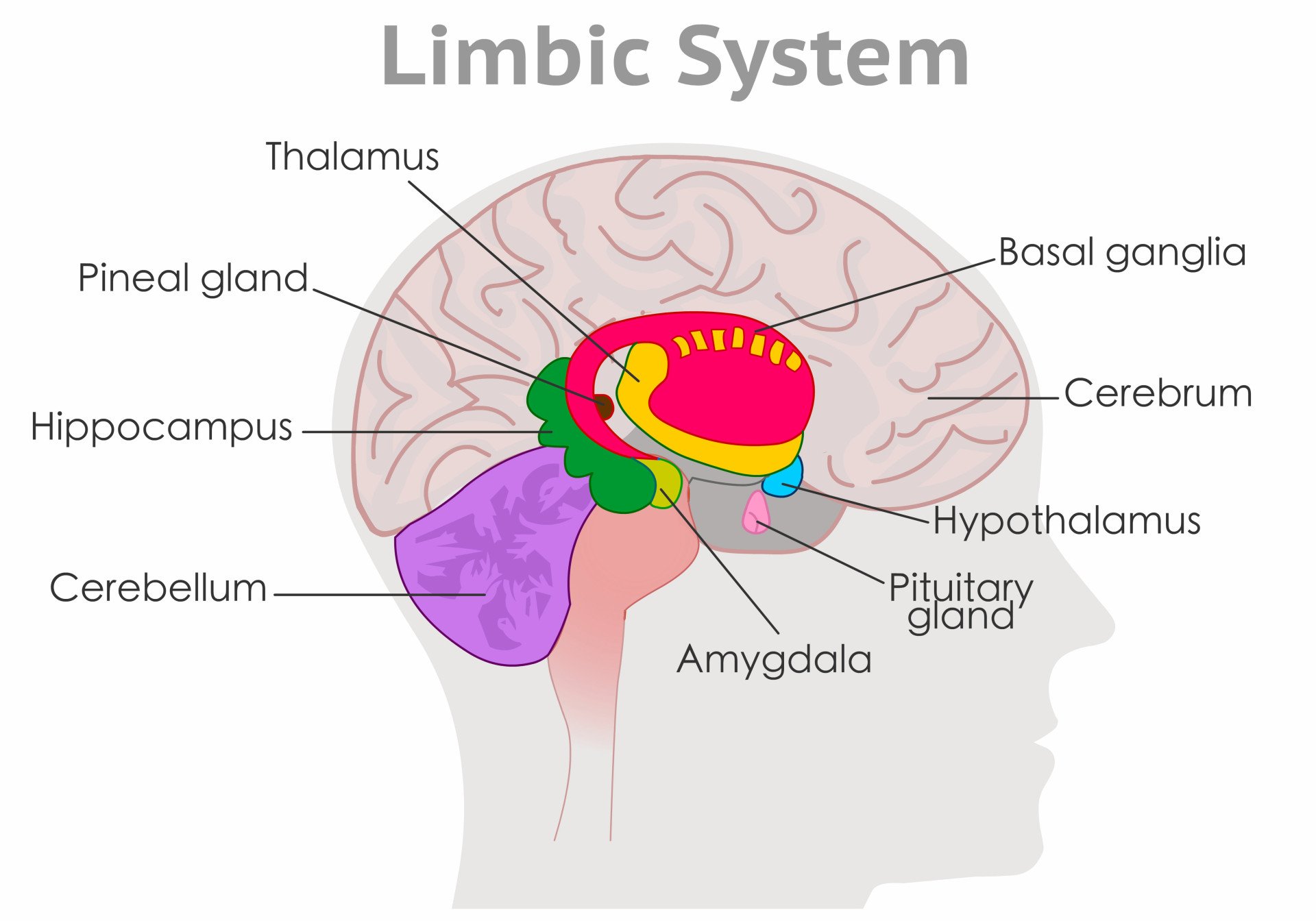
The amygdala is an almond-shaped structure deep in each hemisphere of the brain, part of the limbic system, which helps evaluate sensory input for emotional significance (especially threats).
When it detects a match to a threatening or emotionally charged pattern based on memory, the amygdala can trigger the fight-flight (or freeze) response quickly. The reaction is often immediate. It can happen before the frontal lobes have had time to assess whether the threat is real.
In such cases, the amygdala “hijacks” control of behaviour by activating stress pathways (via the HPA axis), rerouting processing away from the thinking parts of the brain.
Amygdala Hijack Signs
Emotional signs
When an amygdala hijack occurs, the emotional response tends to be sudden, intense, and disproportionate to the trigger.
Typical emotional signs include:
After the fact, individuals often report regret, embarrassment, or guilt for how they responded.
Because the hijack bypasses slower, rational processing, the reaction can feel almost automatic, leaving the person surprised at their own behavior when they “come to.”
Physical signs
The body’s fight-or-flight system is activated during an amygdala hijack, producing a cascade of physical symptoms.
Common signs include:
- A racing heart
- Sweaty or clammy skin
- Dilated pupils
- Goosebumps
- Trembling or shaking
- Fast shallow breathing
- Tense muscles
Sometimes people also feel a sense of being unable to think clearly (a narrowing of attention or tunnel vision), as working memory and rational thought temporarily shut down.
Everyday examples
In everyday life, amygdala hijacks often show up in situations of interpersonal stress or perceived threat (even if not life-threatening).
For example:
- Someone might snap at a loved one over a small misunderstanding or criticism, reacting more harshly than the situation warrants.
- In traffic or driving, a minor frustration (e.g., someone cutting in) might trigger road rage, with swearing, honking, or aggressive gestures.
- In contexts like public speaking or performance, sudden anxiety or panic may arise, causing freezing, stammering, or an emotional shut-down before calm thinking returns.
Amygdala Hijack Causes
The Brain’s Fast Track: Thalamus to Amygdala
Amygdala hijacks occur because the brain has a rapid “low road” pathway. Sensory inputs travel from the thalamus straight to the amygdala, its emotional hub, before reaching the cortex. This happens before conscious awareness catches up.
When the amygdala detects a threat, it quickly activates the stress response through the hypothalamic-pituitary-adrenal (HPA) axis. This fast reaction bypasses the cortex, which usually handles slower, rational thinking.
The result is a fight-flight (or freeze) response in milliseconds, often before conscious awareness. Behaviour is reflexive, not reasoned.
The classic evidence for this fast pathway comes from Joseph LeDoux’s work on classical fear conditioning in rats.
- Aim: To test whether the amygdala can learn and express a fear response through a fast subcortical pathway that bypasses the cortex entirely.
- Method: LeDoux paired a neutral tone with a mild foot-shock until the tone alone triggered freezing and a raised heart rate. He then selectively damaged the auditory thalamus, auditory cortex, and amygdala in turn to see which lesions blocked the learned fear response.
- Results: Damage to the auditory cortex did not stop the conditioned fear response, since the direct thalamus-to-amygdala route was enough on its own. Damage to the amygdala itself, however, abolished the fear response completely.
- Conclusion: The amygdala can trigger a full threat response using a pathway that never involves the cortex — direct evidence for the brain’s “low road” (LeDoux, 1996, 2000).
This is animal behaviour, not conscious human feeling. But it establishes the mechanism the “hijack” story depends on.
Common Triggers
Amygdala hijacks aren’t only sparked by life-threatening events. In everyday life, several modern stressors can set them off:
- Work pressure and deadlines – feeling overwhelmed by tasks or performance expectations can activate the stress response.
- Criticism and rejection – harsh feedback from a boss, teacher, or partner may be perceived as a threat, prompting an outsized reaction.
- Conflict and arguments – disagreements at home, school, or work can trigger strong emotional responses, especially if they feel personal.
- Social anxiety and judgment – fear of embarrassment, public speaking, or being evaluated by others often hijacks the amygdala.
- Everyday frustrations – small irritations like traffic jams or being interrupted may accumulate into sudden emotional outbursts.
These triggers highlight that the amygdala doesn’t differentiate between physical danger and social or emotional stress.
Even minor stressors can feel like threats to the brain, causing reflexive emotional reactions before rational thought can intervene.
Mental Health and Trauma Links
The amygdala is strongly implicated in several mental health conditions, particularly anxiety disorders.
Social anxiety disorder and specific phobias show hyperactivation, with individuals reacting to feared situations more intensely than the situation warrants (Etkin & Wager, 2007).
Similar patterns occur in panic disorder, PTSD, and OCD, all of which involve stronger emotional responses and difficulties with regulation.
Past trauma also sensitizes the amygdala. Research shows that early life adversity or childhood maltreatment lowers the threshold for emotional reactivity, making hijacks more likely (Yan, 2012; Adamec & Shallow, 2000).
Chronic stress further alters brain circuits, impairing regions like the hippocampus (which forms memories) and prefrontal cortex that normally help keep the amygdala in check (Roozendaal et al., 2009).
As a result, people with trauma histories or ongoing stress may overreact to everyday triggers, struggle with emotional regulation, and experience more frequent hijacks.
Why Amygdala Hijacks Matter
Short-term consequences
During a hijack, the amygdala overrides the frontal lobes, narrowing attention and shutting down clear thinking.
Attention tunnels onto the perceived threat. The capacity to weigh consequences or consider alternatives drops away. This is why people often act in ways they would never choose on reflection: the reasoning brain is temporarily offline.
This can lead to impulsive choices such as snapping at someone, walking out of a meeting, or escalating conflict.
Once the reaction passes, many people feel guilt, embarrassment, or regret for overreacting.
Long-term effects
Repeated hijacks can damage relationships by creating cycles of mistrust or ongoing conflict.
Over time, chronic emotional overreactions place strain on mental health. Heightened amygdala activity is also seen in anxiety disorders, PTSD, OCD, and phobias, so people with these conditions may be especially vulnerable to frequent hijacks.
This can create a feedback loop where reactivity worsens stress and reduces the brain’s capacity to regulate emotions.
When hijacks can be useful
Although often disruptive, hijacks evolved for survival. In emergencies—such as stepping out of the way of a speeding car—the amygdala’s rapid response can act before conscious thought, keeping us safe.
The trade-off makes evolutionary sense. Freezing at a shadow costs almost nothing. Missing a genuine predator can be fatal, so a fast, error-prone alarm beats a slow, accurate one that sometimes reacts too late.
In modern life, however, the same reflex can misfire, turning everyday stress into disproportionate reactions.
Preventing Amygdala Hijack
In-the-moment techniques
When you feel a hijack coming on, the key is to slow things down long enough for your rational brain to re-engage:
- Name the emotion — Simply acknowledging “I’m feeling angry/upset/anxious” out loud (or in your head) helps activate the neocortex and reduce the emotional intensity.
- 6-second (or pause) rule — Pause before responding. Even counting silently to six or three while taking a breath gives your thinking brain time to catch up and breaks the automatic reaction.
- Controlled breathing — Deep, slow, diaphragmatic breathing helps calm the nervous system, slow the heart rate, and interrupt the amygdala’s momentum. Techniques like box-breathing (inhale / hold / exhale / hold) are effective.
- Change the setting / physical distance — If possible, physically stepping away or shifting perspective (e.g. move to another room, take a short walk, or simply focus on something calming in the environment) can give emotional intensity room to dissipate.
Together, these techniques help momentarily disengage from the automatic emotional response, giving your frontal cortex a chance to reassert control.
Long-term prevention
To reduce the frequency and intensity of hijacks over time, building resilience through regular habits is key:
- Mindfulness — Regular mindfulness or meditation practice helps cultivate present-moment awareness and improves emotional regulation. Over time, mindfulness can strengthen connectivity between the amygdala and prefrontal cortex, making hijacks less likely.
- Stress management — Identifying personal triggers and managing ongoing stress is vital. Daily practices such as gentle exercise (walking, yoga), regular breaks, adequate sleep, and relaxation routines reduce baseline arousal, lowering the chance of being overwhelmed.
- Journaling / trigger tracking — Keeping a brief record of when hijacks occur and possible antecedent triggers helps increase self-awareness. Over time, this can help anticipate triggers, spot patterns, and plan ahead to avoid or mitigate them.
Building Emotional Intelligence
Daniel Goleman’s five emotional intelligence (EI) competencies provide a scaffold for longer-term emotional resilience and regulation: self-awareness, self-regulation, motivation, empathy, and social skills.
- Self-awareness: Recognising emotional cues early (e.g. physiological signs, internal tension) so you can intervene before escalation.
- Self-regulation: Practising responding thoughtfully rather than reacting impulsively. Over time, repeated use of in-the-moment techniques reinforces the ability to pause and choose.
- Motivation: Using intrinsic motivation to remain calm, intentional, and aligned with long-term goals (rather than short-term emotional reactivity).
- Empathy: Considering others’ perspectives and emotional states can help diffuse conflict and reduce emotional escalation.
- Social skills: Practising effective communication, conflict resolution, and maintaining supportive relationships can create a buffer during stressful moments. Strong interpersonal skills also mean you can repair and reflect after a hijack more constructively.

Critical Evaluation
The “amygdala hijack” label is a useful teaching device, but it compresses and sometimes distorts the neuroscience it borrows from.
- Not a Fear Centre: Joseph LeDoux, the researcher who first mapped the amygdala’s threat circuitry, argues it should not be treated as the brain’s dedicated “fear centre.”
- Constructed Emotion: Lisa Feldman Barrett’s (2017) theory holds that the amygdala tracks general salience and arousal, not one specific emotion like fear.
- An Oversimplified Metaphor: The image of a passive cortex being “hijacked” revives an outdated view; emotion and cognition are now understood as deeply intertwined.
Not a Fear Centre
Joseph LeDoux did more than anyone to map the amygdala’s role in fear, yet he has explicitly rejected calling it the brain’s “fear centre” (LeDoux, 2012, 2020). The distinction is not cosmetic.
As LeDoux argues, the amygdala runs a non-conscious defensive circuit that detects and responds to threat. The conscious feeling of fear, by contrast, is assembled separately, in cortical networks (LeDoux & Pine, 2016).
Treating amygdala activity as identical to felt fear, which the “hijack” image implicitly does, is a category error. It blurs both theory and practice.
The amygdala also activates to novelty, salience, and even positive events, not only to threat. Observing amygdala activity alone is therefore not proof that someone felt afraid, or was “hijacked” at all.
This is why a gold-standard account traces the hijack idea back to the primary neuroscience, rather than taking the metaphor at face value.
The Constructed-Emotion Critique
Psychologist Lisa Feldman Barrett (2017) goes further, arguing there is no dedicated brain region for any single emotion.
It’s a genuinely radical claim. On her theory of constructed emotion, the amygdala responds to salience, novelty, uncertainty, and general arousal rather than to “fear” specifically.
Brain-imaging meta-analyses back this up: the amygdala lights up across many emotional states, and even during some positive ones.
If that is right, then a phrase like “the amygdala hijacked me into anger” misdescribes what the structure is actually doing.
It is not a fear switch flipping on.
It is a general relevance detector, and the specific emotion a person ends up feeling is constructed elsewhere, from context, bodily sensation, and past experience.
This is a genuinely contested area of neuroscience, and Barrett’s account is itself debated.
But it is a serious enough challenge that any confident claim about what the amygdala “is for” deserves real caution.
An Oversimplified, Passive-Cortex Metaphor
The word “hijack” implies a passive, reasonable cortex overpowered by an emotional intruder.
That image echoes an old and largely abandoned idea in neuroscience: the “triune brain,” in which a primitive limbic system supposedly does battle with a civilised, rational cortex.
Modern affective neuroscience rejects this picture.
Emotion and cognition are deeply intertwined, and the prefrontal cortex stays an active participant throughout a hijack, rather than a passive bystander waiting to be overrun.
What looks like a “takeover” is better described as a shift in the balance of one integrated control system under stress. There is a related problem of over-localisation.
The amygdala never acts alone: it sits within densely interconnected limbic, cortical, hypothalamic, and brainstem circuits, and its behaviour depends on that whole network (Sah et al., 2003).
Because the amygdala also responds to novelty and to positive events, observing it activate does not by itself license concluding that a person felt fear, or was “hijacked” at all.
That is the reverse-inference fallacy, and it undercuts a lot of casual neuro-explanation built on brain-imaging alone.
Contemporary Research
The most direct test of the “hijack” idea comes from a 2021 meta-analysis.
It examined exactly the circuit a hijack is supposed to override: the coupling between the amygdala and the prefrontal regions that regulate it.
- Aim: To identify which prefrontal regions become functionally coupled to the amygdala when people deliberately regulate their emotions — mapping the top-down control circuitry whose failure a hijack represents.
- Method: A coordinate-based meta-analysis pooled fifteen brain-imaging studies that had examined how emotion regulation changes the amygdala’s functional coupling with other regions, both across regulation strategies generally and specifically during cognitive reappraisal.
- Results: Emotion regulation was reliably linked to stronger amygdala coupling with the ventrolateral prefrontal cortex across strategies, and with the dorsolateral, ventrolateral, and dorsomedial prefrontal cortices specifically during reappraisal. The pattern held up consistently across the pooled studies.
- Conclusion: Regulating emotion depends on dynamic prefrontal control over the amygdala, reliable enough to serve as a neurally grounded model of emotion regulation. A hijack, here, is a moment when that coupling fails to engage in time or with enough strength.
Read against the hijack idea, this reframes the phenomenon: not a rogue amygdala acting alone, but a moment when prefrontal-amygdala communication fails to engage quickly or strongly enough.
It fits a wider pattern. Studies of clinical anxiety link weaker prefrontal regulation of the amygdala to more severe symptoms.
Research on mindfulness similarly finds that sustained practice is associated with reduced amygdala reactivity over time (Hölzel et al., 2010).
The pattern repeats. Together, the modern evidence points to the same practical conclusion as this article’s own advice on pausing, breathing, and reappraisal.
The coupling can be overwhelmed by speed and stress, but it can also be strengthened by practice.
References
Adamec, R., & Shallow, T. (2000). Rodent anxiety and kindling of the central amygdala and nucleus basalis. Physiology & behavior, 70(1-2), 177-187.
Barrett, L. F. (2017). The theory of constructed emotion: An active inference account of interoception and categorization. Social Cognitive and Affective Neuroscience, 12(1), 1–23.
Berboth, S., & Morawetz, C. (2021). Amygdala-prefrontal connectivity during emotion regulation: A meta-analysis of psychophysiological interactions. Neuropsychologia, 153, 107767. https://doi.org/10.1016/j.neuropsychologia.2021.107767
Etkin, A., & Wager, T. D. (2007). Functional neuroimaging of anxiety: a meta-analysis of emotional processing in PTSD, social anxiety disorder, and specific phobia. American journal of Psychiatry, 164(10), 1476-1488.
Goleman, D. (1995). Emotional intelligence: Why it can matter more than IQ. Bantam Books.
Hölzel, B. K., Carmody, J., Evans, K. C., Hoge, E. A., Dusek, J. A., Morgan, L., Pitman, R. K., & Lazar, S. W. (2010). Stress reduction correlates with structural changes in the amygdala. Social Cognitive and Affective Neuroscience, 5(1), 11–17.
Hughes, K. C., & Shin, L. M. (2011). Functional neuroimaging studies of post-traumatic stress disorder. Expert review of neurotherapeutics, 11(2), 275-285.
LeDoux, J. E. (1996). The emotional brain: The mysterious underpinnings of emotional life. Simon & Schuster.
LeDoux, J. E. (2000). Emotion circuits in the brain. Annual Review of Neuroscience, 23, 155–184.
LeDoux, J. (2012). Rethinking the emotional brain. Neuron, 73(4), 653–676.
LeDoux, J. E. (2020). Thoughtful feelings. Current Biology, 30(11), R619–R623.
LeDoux, J. E., & Pine, D. S. (2016). Using neuroscience to help understand fear and anxiety: A two-system framework. American Journal of Psychiatry, 173(11), 1083–1093.
Roozendaal, B., McEwen, B. S., & Chattarji, S. (2009). Stress, memory and the amygdala. Nature Reviews Neuroscience, 10(6), 423-433.
Yan, X. (2012). Amygdala, childhood adversity and psychiatric disorders. The Amygdala: A Discrete Multitasking Manager, 303.
Further Information
Davis, M. (1992). The role of the amygdala in fear and anxiety. Annual review of neuroscience, 15(1), 353-375.
Sah, P., Faber, E. L., Lopez de Armentia, M., & Power, J. M. J. P. R. (2003). The amygdaloid complex: anatomy and physiology. Physiological reviews, 83(3), 803-834.


