Insecurities in a relationship are feelings of uncertainty, self-doubt, or fear. They can show up as fearing the loss of a partner or questioning one’s self-worth or attractiveness. Often they are rooted in a person’s self-esteem and past experiences, and they can reshape how a couple relates.
Insecurity can drive behaviors that harm a relationship, such as jealousy, clinginess, or an excessive need for reassurance.
Attachment is one common root. In the book Attached, Amir Levine and Rachel Heller explain that insecure attachment styles develop in childhood when a child’s needs for safety and security go unmet.
As adults, individuals with insecure attachment styles often have trust issues, a fear of abandonment, and/or high levels of anxiety.
Individuals with insecure attachment styles can exhibit a variety of behaviors in their relationships and these behaviors can manifest in different ways.
Here are examples of behaviors that insecurely attached people may display in relationships:
Anxious attachment:
- Seeking constant reassurance from their partners
- Having intense fears of being abandoned
- Being overly clingy
- Overanalyzing their partner’s actions and words, looking for signs of rejection or disinterest
- Feeling threatened by their partner’s interactions with others
Avoidant attachment:
- Withdrawing from their partner, both emotionally and physically
- Avoiding emotional intimacy
- Struggling to share their true feelings and thoughts with their partner
- Minimizing the importance of relationships
- Avoiding long-term commitments
Disorganized attachment:
- Hot-and-Cold behavior (alternating between seeking closeness and pushing their partner away)
- Desiring emotional intimacy but also fearing it
- Having difficulty trusting their partner’s intentions
- Being quick to anger or defensiveness
- Having unpredictable and intense emotional responses
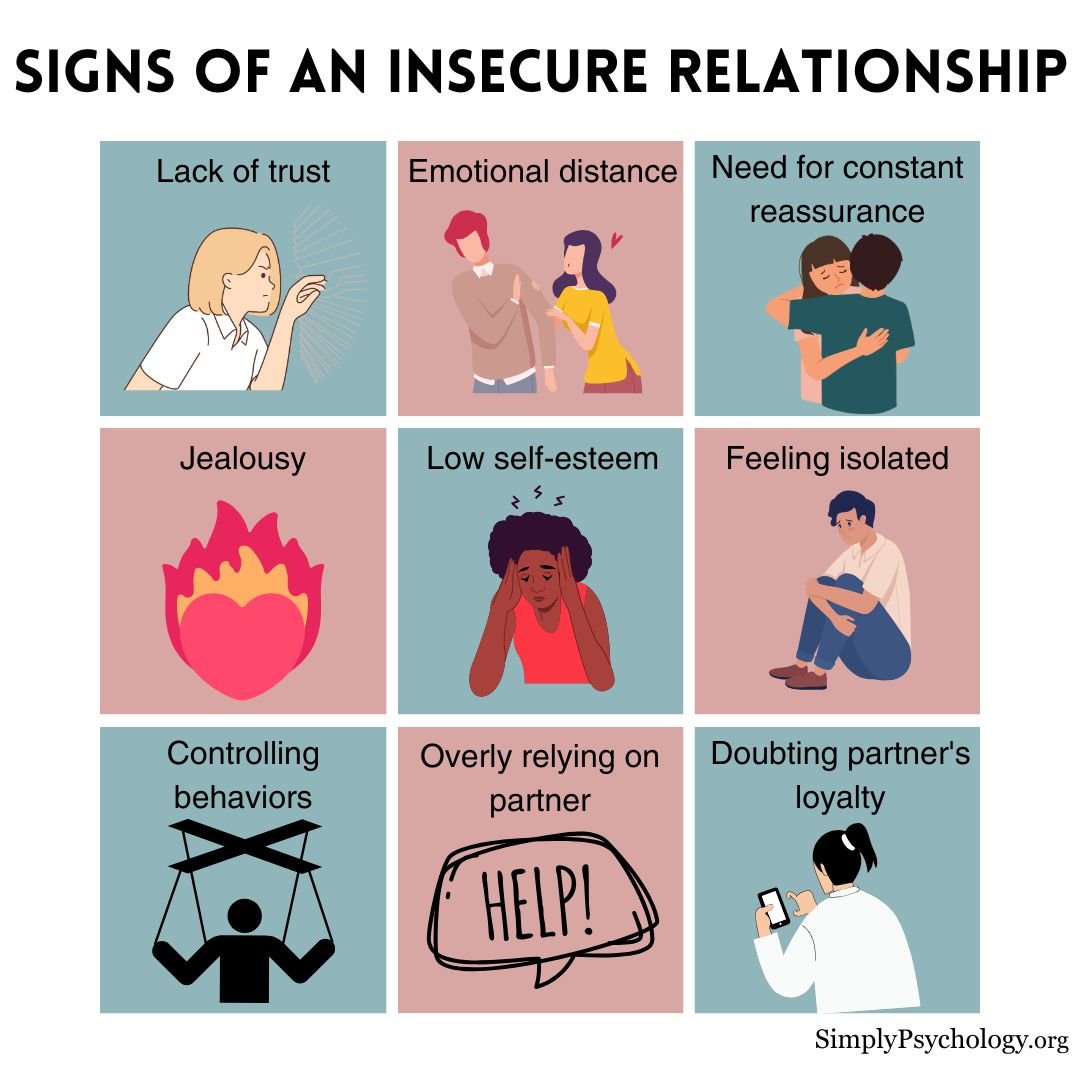
Signs of an Insecure Relationship, With Examples
Below are some common signs of an insecure relationship:

Lack of Trust
Trust is the foundation of a healthy relationship. If trust is lacking, this can result in anxiety, hyper-vigilance, and resentment.
Doubts about a partner’s honesty, intentions, or fidelity can undermine the foundation of the relationship.
Lack of trust in a relationship can manifest in a number of ways, including:
- Constantly monitoring the other’s activities, such as checking their phone, emails, or social media accounts without permission
- Regularly accusing your partner of deceit or infidelity without substantial evidence
- Subjecting your partner to repeated questioning and scrutiny about their actions, whereabouts, or interactions with others
- Having unfounded suspicions about a partner’s fidelity and honesty
Avoidance of Vulnerability
Partners may avoid vulnerability and emotional intimacy because they fear getting hurt.
If you struggle to connect emotionally with your partner, you may experience feelings of detachment and isolation.
This lack of emotional connection can make it difficult to communicate effectively, understand each other’s needs, and give each other adequate support and intimacy.
Fear is often the root. People worry that revealing a weakness will bring rejection or criticism. Self-doubt makes it worse. It becomes hard to believe a partner genuinely cares.
Constant Need for Reassurance
Partners in insecure relationships may frequently seek validation and verbal affirmation of love, often needing to hear “I love you” or “I’m committed to you” to feel secure.
Some reassurance-seeking is healthy in any relationship. It becomes a sign of insecurity when it is excessive and driven by a fear of abandonment, not by a specific, addressable concern.
Examples of Reassurance-Seeking
- Constantly fishing for compliments or validations
- Checking in with your partner excessively throughout the day
- Wanting to spend all of your time with your partner
- Repeatedly asking questions such as “Do you still love me?” or “Are you sure you want to be with me?”
This constant need for reassurance and approval can make you overly dependent on your partner for reassurance, which can be emotionally draining for both individuals.
Jealousy and Possessiveness
People who feel insecure are more likely to experience jealousy and exhibit possessiveness, often resulting in conflict and tension in a relationship.
Signs of jealousy and possessiveness include:
- Monitoring your partner’s social media activity
- Tracking their movements
- Limiting their contact with other people
Insecure individuals can feel threatened by their partner’s interactions with friends, family members, or acquaintances.
They may become jealous or anxious when their partner interacts with others at social gatherings, parties, or events, interpreting these interactions as a threat to the relationship.
Low Self-Esteem
Insecure relationships often involve one or both partners who experience feelings of inadequacy and low self-esteem.
Individuals with low self-esteem feel unworthy of love and acceptance, which affects their ability to trust and feel secure in a relationship.
This can also manifest as a lack of self-worth and contribute to a negative self-image.
Doubting your worth makes love hard to trust. Affection may never feel like enough, however a partner shows it. Reassurance becomes the fix. They may seek it frequently, which strains the partner providing it.
Withdrawal or Isolation
One or both partners may withdraw emotionally or physically from the relationship, creating distance as a defense mechanism against perceived threats.
When feeling insecure, it is common for individuals to withdraw from their partner emotionally, as they fear judgment or rejection.
They may also feel unable to talk to anyone else about their relationship and feel like they have to keep their relationship problems a secret.
Control or Manipulation
In an attempt to gain a sense of security, insecure individuals often try to exert control over their partner’s actions, choices, and interactions.
This control can take several forms:
- Monitoring their partner’s activities
- Controlling their finances
- Using guilt to gain compliance
Controlling behavior can stem from a desire to maintain power and dominance as individuals try to manage their fears.
Insecurity can also show up as criticism. A partner may put the other person down or make hurtful remarks about their appearance, abilities, or actions. This can arise from feeling threatened by their success, wanting more control, or projecting unresolved trauma.
Gaslighting is the most serious form of control. It means distorting facts, lying, or denying events so a partner doubts their own memory or sanity. Over time, it can erode self-esteem and leave a person anxious and confused.
Over-Reliance on the Relationship
Insecure individuals may overly depend on the relationship for validation, companionship, emotional well-being, or financial support.
Insecure individuals tend to rely excessively on their partner, feeling incomplete without their partner’s constant presence or validation.
This over-reliance can create an unhealthy relationship dynamic. It can hinder your personal growth and autonomy, and result in codependency.
Codependency means one partner’s identity, self-worth, or emotional stability depends excessively on the other person. Their own needs often come second.
Ineffective Communication
Insecure relationships often feature poor communication characterized by misinterpretations, defensiveness, and avoidance.
Instead of addressing and resolving conflicts, partners in insecure relationships may repeatedly revisit the same issues without making progress.
This can hinder the resolution of conflicts, prevent emotional connection, and lead to exhaustion and frustration.
Unspoken grievances can also fester into resentment. Over time, that resentment erodes trust.
Why do I feel insecure?
Feeling insecure is a common human experience, and the reasons for insecurity can vary widely from person to person.
Relationship expert Susan Winter suggests asking three questions: is it me, is it my partner, or is it the situation we’re in?
Insecurity often arises from a combination of internal and external factors. Here are some common reasons why individuals may feel insecure:
Past Relationships
Negative experiences in the past, such as rejection, betrayal, or childhood adversity, can leave emotional scars that affect one’s sense of security.
Some betrayals leave an attachment injury: a specific betrayal or abandonment within a relationship, such as infidelity. A 2026 systematic review pooled twelve qualitative studies (207 participants) of betrayal in romantic relationships (Davidar et al., 2026). Its findings clustered into four patterns:
- Emotional upheaval: Intense emotional responses and grief.
- Negative self-beliefs: Diminished self-worth and pervasive self-doubt.
- Relationship difficulty: Trouble sustaining relationships long after the original injury.
- Trauma symptoms: Intrusive memories, avoidance, and hyperarousal.
These patterns closely mirror complex post-traumatic stress disorder. Infidelity was the most common trigger.
Most participants were women (73.8%). Most samples were North American (83%). So the pattern may not hold for everyone.
Unresolved traumas or emotional baggage from past relationships can be projected onto new partners without valid justification.
“Baggage” can include negative experiences (e.g., betrayal, abandonment, neglect) or positive experiences (e.g., high expectations, unrealistic beliefs about relationships).
Abby Medcalf, host of the Relationships Made Easy podcast, makes a useful distinction. Past experiences help explain where an insecurity came from. But your present thoughts and habits are what cause and maintain it day to day.
Attachment Styles
Attachment insecurity can have significant effects on how people think, feel, and behave in relationships, shaping their expectations, attitudes, and beliefs about romantic partners.
People with insecure attachment styles have maladaptive responses to stress in relationships, with avoidant individuals using distancing coping strategies and anxious individuals using hyper-activating coping strategies.
Anxiously attached individuals fear abandonment, excessively seek reassurance, and worry that their partner will find someone better.
Avoidant individuals struggle with intimacy. They push their partners away, especially when feeling overwhelmed.
Why do these patterns arise? Underneath sits the attachment behavioral system: an innate system, active across life, that checks whether an attachment figure is nearby and responsive. Under threat or uncertainty, it works to restore a felt sense of security (Mikulincer & Shaver, 2016).
Childhood shapes which route a person takes:
- Hyperactivating strategies: protest, vigilance, and escalating bids for attention. They tend to develop where persistence sometimes won attention.
- Deactivating strategies: suppressing needs and relying on yourself. They tend to develop where bids for comfort were reliably unmet.
In adulthood, a romantic partner stands in for the caregiver. Both strategies tend to intensify, not resolve, when they fail.
Studies by Joshua Coleman, Ph.D. and Philip A. Cowan, Ph.D. found that “insecure attachment results in children—and later, adults—having difficulty controlling or modulating their emotions, knowing how to soothe themselves when distressed, or feeling relaxed and trusting with others.”
Low Self-Esteem
A lack of confidence in one’s abilities, appearance, or self-worth can contribute to insecurity, doubts, and fears.
Self-critical and negative self-talk only serves to reinforce these feelings, as individuals internalize harmful beliefs about themselves.
Constantly comparing yourself to others makes it worse. Achievements, appearances, and social status are common yardsticks, and each can create feelings of inadequacy and insecurity.
Moreover, societal and cultural expectations, such as beauty standards and success benchmarks, can create even more pressure to conform and trigger feelings of insecurity.
Poor Communication Skills
When couples struggle to communicate effectively or openly, it can lead to misunderstandings, assumptions, and a lack of trust.
Difficulty communicating your needs and feelings to your partner can make you feel misunderstood and resentful.
Insecurity often arises when partners feel that their needs, emotions, or concerns are not being heard or validated, leading to doubts about the stability of the relationship.
Relationship Issues
Conflicts or issues within current or past relationships, including trust issues, can lead to insecurity about one’s desirability or worthiness of love.
Furthermore, familial relationships can also impact one’s feelings of insecurity.
For example, witnessing parental infidelity can increase the likelihood of insecurity in your adult relationships. The experience creates deep-rooted fears of betrayal and a lack of trust in romantic partners.
Carrying these fears into your own relationships makes it difficult for you to fully trust your partner’s faithfulness.
Fear of Rejection
A strong fear of rejection makes a person hypersensitive to any hint of being left. They closely scan a partner’s words and actions for signs of disinterest. Sometimes they misread neutral or even positive signals as negative.
Past rejection can shape beliefs about your own desirability. Feeling undeserving of love then fuels the fear that a current partner will also leave, whatever the evidence shows. The fear becomes self-perpetuating.
Anxiety and Depression
Mental health conditions like anxiety and depression can exacerbate feelings of insecurity, as they often involve negative thought patterns and self-doubt.
For example, social anxiety can make it difficult to feel secure in social settings, as individuals may fear judgment or negative evaluation by others.
Furthermore, concerns about one’s physical appearance, fueled by societal pressures and unrealistic beauty standards, can lead to body image insecurity.
Why Modern Couples Struggle With Insecurity
According to psychotherapist Esther Perel, people do not carry more insecurity now than throughout history. What has changed is where it goes. Modern couples bring all of their insecurity needs to a single person.
Perel suggests we now ask one partner to be reassuring and predictable, while also providing novelty and surprise. Historically, those needs were spread across family and community.
Concentrating them on one relationship, she argues, makes consistent reassurance hard, even when both partners care.
Other Explanations for Insecurity
Attachment theory is not the only explanation. Three other traditions answer the question differently:
- Sociometer theory: Self-esteem acts as a gauge of how valued others make you feel, so low self-esteem tracks perceived relational threat (Leary et al., 1995).
- Investment model: Commitment reflects satisfaction, past investment, and alternatives, so some insecurity may accurately read a genuinely precarious relationship (Rusbult, 1980).
- Mate-retention accounts: Evolutionary psychologists see jealousy and monitoring as ways of keeping a partner, which varied with a partner’s attractiveness in married couples (Buss & Shackelford, 1997).
These lenses are complementary, not rival. A chronically insecure partner may carry an insecure working model (an early-formed expectation of how others will treat you), a sensitive sociometer, and a genuinely under-invested relationship at once. That is one reason no single fix works on its own.
How do insecurities affect relationships?
Insecurities can strain relationships with partners, friends, children, and co-workers. Chronic insecurity does the most damage.
It tends to show up in several ways:
- Emotional distance: The insecure partner withdraws, which makes it harder to feel good about the relationship.
- Projection: Doubts get projected onto a partner, who is then unfairly accused of wrongdoing.
- Conflict: Jealousy, possessiveness, and suspicion create ongoing tension.
- Exhaustion: Constant reassurance-seeking can wear out the partner providing it.
- Stalled conflict resolution: Fear of rejection or criticism makes it hard to voice feelings or concerns.
- Emotional blackmail: In severe cases, guilt is used to control a partner’s behavior.

One case study in Attached describes Sarah and Michael.
Sarah had a history of being cheated on in previous relationships, and she was constantly worried that Michael would cheat on her, too.

She would often check his phone, ask him where he was going, and accuse him of being unfaithful. This behavior eventually led Michael to break up with Sarah because he felt like he couldn't trust her.
Another case study in Attached describes John and Jane.
John was insecure about his appearance, and he was always worried that Jane would find someone else who was more attractive.

This insecurity led him to be controlling and jealous in his relationship. He would often criticize Jane's appearance. He also accused her of flirting with other men. This behavior eventually led Jane to end the relationship because she felt like she couldn't be herself around him.
Insecurity can create a negative cycle. Fears and behaviors reinforce each other, making it hard to break free without deliberate change.
People describe the experience in their own words. One person explains what insecurity does to their thinking:
“When I’m insecure, I notice myself becoming more self-involved. Telling myself negative stories. Looking for things that prove my feelings. To balance these things, I do the opposite as well. I tell myself stories that show the same behavior in a positive light.”
A partner describes the daily toll of constant reassurance-seeking:
“Nearly every day, throughout the day, he needs constant reassurance I won’t leave him, that I love him. He is always asking me what I am doing, who I am typing or texting, if I am ok even on days that I am 100% fine.”
Additionally, insecurity can limit personal growth and independence, as individuals may avoid pursuing their interests or goals to focus solely on the relationship.
Research on couples suggests insecurity is not a private problem. A meta-analysis of 132 studies found that both attachment anxiety and attachment avoidance were linked to lower relationship satisfaction (Candel & Turliuc, 2019).
A person’s own insecurity predicted their own dissatisfaction most strongly. It also lowered their partner’s satisfaction. Most of this evidence is correlational, and the link probably runs both ways, since a poorly functioning relationship can heighten insecurity too (Simpson & Rholes, 2017).
It’s important to recognize that everyone has moments of insecurity from time to time, but chronic and pervasive insecurities can be damaging to a relationship.
How to overcome relationship insecurities
Overcoming relationship insecurities is a process that involves self-reflection, communication, and personal growth.
Both partners in the relationship can play a role in addressing and working through these insecurities.
Here are some steps to help you overcome relationship insecurities:
Open Communication
Create a safe, non-judgmental space. Share your feelings and insecurities honestly, and encourage your partner to do the same.
Talking to your partner about your insecurities can help build trust and understanding. Be honest and open, and be willing to listen to their perspective. Both partners should listen actively and empathize.
Expressing your fears and concerns lets your partner offer reassurance and support. It also opens a chance to find solutions together.
Wording matters as much as honesty. Use “I” statements rather than accusations, so “you make me feel insecure” becomes “I feel insecure when you…”. Choose a calm moment rather than the heat of an argument, and be specific about what triggers the feeling.
Clinical psychologist Dr. Alexandra H. Solomon suggests being clear up front about the kind of support you want: a sounding board, sympathy, or advice. Your partner cannot be expected to guess which you need.
Challenge Negative Self-Talk
Insecurities often stem from distorted thinking patterns and irrational beliefs.
By questioning the validity of these thoughts and challenging their accuracy, you can gain a more balanced and realistic perspective.
Challenging your insecure thoughts and beliefs means asking yourself if there is any evidence to support or disprove them.
Try to replace self-criticism with self-compassion and positive affirmations.
Cognitive-behavioral techniques, such as reframing and thought-stopping, are examples of strategies that can help replace unhelpful thoughts with more rational ones.
Clinical psychologist Nick Wignall states that, “if you assume that every thought your mind throws at you is important and worth thinking more about, you’re quickly going to get lost in your own thoughts and feel even more uncertain and insecure about the relationship.”
Self-Reflect and Cultivate Individual Growth
Take time to reflect on the specific insecurities you’re experiencing. What triggers these feelings? Are they rooted in past experiences or personal insecurities?
Recognize that no one is perfect, and every relationship has its ups and downs.
Insecurities are usually fueled by excessive worrying and overthinking. Overthinking tends to generate further insecure thoughts, even where none existed at first.
Consider whether your worries are something that can be resolved or whether they are hypothetical. As you cannot control hypothetical worries, it is best to let them go.
Try the following strategies:
- Remind yourself that you cannot control the future and focus on things you can control
- Set aside dedicated “worry time” to address your concerns to prevent worries from overwhelming your daily life
- Practice relaxation techniques, such as deep breathing or meditation.
- Engage in activities that promote self-care and help you focus on the present moment
- Explore therapeutic techniques such as cognitive-behavioral therapy (CBT) or dialectical behavior therapy (DBT) to address specific thought patterns and behaviors associated with insecurities
Reduce the Need for Reassurance
Constant reassurance-seeking is both a sign and a driver of insecurity, so work on it directly. Learn to trust your partner’s stated feelings instead of asking for repeated confirmation.
When the urge to ask arises:
- Notice it: Pause before you ask.
- Self-soothe: Try deep breathing, calming music, or gentle movement.
- Be transparent: Tell your partner you are working on this, so they understand why.
The evidence is not one-sided, though. In a 14-day diary study of 110 heterosexual couples, a day of more reassurance-seeking predicted lower trust the next day for anxiously attached women.
Yet partners of avoidantly attached men who sought reassurance reported higher trust (Evraire et al., 2022). Reassurance-seeking, in other words, does not have one uniform effect.
Practice Self-Compassion
Overcoming insecurities is hard work so having compassion for yourself is important.
Practicing self-compassion means:
- Being kind and understanding with yourself rather than being self-critical when you are struggling
- Forgiving yourself for your mistakes
- Avoiding self-judgment
- Cultivating positive self-talk
- Challenging your inner critic
- Surrounding yourself with people who support you and make you feel good about yourself
- Engaging in activities that bring you joy
- Making time for self-care (e.g., being in nature, exercising, meditating, journaling)
- Listening to your body and mind when it tells you to take a break or slow down
- Being patient with yourself as it takes time to overcome insecurities
Psychologist Kristin Neff provides three fundamental ways to develop self-compassion:
- Treat yourself like you would treat your best friend–with gentleness, understanding, patience, empathy, and acceptance.
- Focus on the similarities you share with others to reduce feelings of isolation. Recognize that everyone has insecurities and that it is normal to experience them.
- Practice mindfulness by focusing on the present moment. Acknowledge your pain without magnifying it with worries about the past or future.
Seek Professional Support
Consider seeking support from a therapist or counselor, either individually or as a couple. A trained professional can help you
- Understand your insecurities
- Explore the underlying causes of your insecurities
- Develop personalized coping strategies to overcome insecurities
- Provide guidance on how to address your insecurities
- Process past experiences
- Develop a secure attachment style
- Improve your self-esteem
Meghan Laslocky, author of The Little Book of Heartbreak: Love Gone Wrong Through the Ages, was a “textbook case of anxious and avoidant” attachment:
“I was so crippled by fear of intimate relationships that I didn’t have anything even close to a boyfriend until I was 28. Even then, it took another eight years for me to pull off having a long-term, serious relationship, much as I wanted one.”
Meghan was able to overcome an insecure attachment style with the help of a trained therapist with expertise in attachment theory.
Attachment-specific therapies include schema therapy or attachment-based therapy.
Several talking therapies are suited to this work:
- Cognitive behavioral therapy (CBT): Helps identify and challenge negative thought patterns and beliefs.
- Attachment-based therapy: Targets insecure attachment styles and works toward more secure patterns.
- Emotionally focused therapy (EFT): Addresses underlying emotions and attachment needs, most often in couples work.
- Acceptance and commitment therapy (ACT): A mindfulness-based approach to building self-compassion and accepting your thoughts and emotions.
These approaches can be combined. The right choice depends on the nature and cause of your insecurity.
Acknowledge and celebrate your progress, no matter how small. Recognize and appreciate the positive changes you make in yourself and your relationship.
FAQs:
Is it normal to feel insecure in a new relationship?
Some insecurity in a new relationship is normal and common.
Starting a new relationship can be exciting, but it can also bring uncertainty and anxiety. This is especially likely if you’ve been hurt before or have had negative dating experiences.
Most people have a fear of rejection, and in a new relationship, there’s a natural concern about whether the other person will truly like and accept you.
Building emotional intimacy requires vulnerability, which can be intimidating. Opening up to someone new can trigger feelings of insecurity.
A new relationship represents uncharted territory. You’re getting to know a new person with their own quirks, preferences, and communication style, which can create uncertainty.
Feeling insecure in a new relationship is normal. Still, it’s essential to address these feelings constructively so they don’t undermine a healthy, fulfilling partnership.
Can a relationship survive insecurities?
A relationship can survive and even thrive despite insecurities. Insecurities are a common part of human nature, and many individuals and couples work through them successfully.
However, if insecurities are left unchecked, they can damage a relationship.
Effective communication is key. Both partners should work on building trust through communicating openly, offering empathy and emotional support, and demonstrating reliability.
Couples can work together on shared goals and personal growth, reinforcing their connection and sense of partnership. Overcoming insecurities takes time, so it’s essential for both partners to be patient and committed to the process of healing and growth.
Can social media cause relationship insecurities?
Platforms like Facebook, Instagram, and Twitter can amplify feelings of insecurity in romantic relationships.
Social media often presents a curated version of people’s lives, highlighting the best moments, experiences, and appearances.
Constant exposure to these idealized images invites comparison. People measure their own lives and relationships against what they see online, which can trigger feelings of inadequacy and insecurity.
Moreover, social media can perpetuate the fear of missing out on exciting or glamorous experiences that others seem to be having. Individuals may feel that their own relationship is less exciting or fulfilling by comparison.
A partner’s online activity can fuel insecurity and distrust. Seeing them liking or commenting on someone else’s posts or photos can trigger jealousy and insecurity. It’s easy to misinterpret their online interactions as signs of interest or attraction.
Key Takeaways
- Definition: Relationship insecurity is a lack of confidence in the relationship, or in your own worthiness of love within it.
- Common Signs: Distrust, jealousy, constant reassurance-seeking, withdrawal, and control are typical patterns.
- Main Causes: Attachment style, low self-esteem, past betrayal, fear of rejection, and poor communication all contribute.
- Normal vs Chronic: Occasional doubt is normal, especially in new relationships. Chronic insecurity is what erodes trust and closeness.
- Both Partners: One partner’s insecurity lowers the other’s satisfaction too, so working on it together helps.
- What Helps: Open communication, challenging unhelpful thoughts, self-compassion, and therapy can all reduce insecurity.
- Not Doomed: A relationship can thrive when both partners recognize insecurity and work on it.
Julia Simkus edited this article.
References
Becker-Phelps, L. (2016). Insecure in love: How anxious attachment can make you feel jealous, needy, and worried and what you can do about it. ReadHowYouWant.
Buss, D. M., & Shackelford, T. K. (1997). From vigilance to violence: Mate retention tactics in married couples. Journal of Personality and Social Psychology, 72(2), 346–361. https://doi.org/10.1037/0022-3514.72.2.346
Candel, O.-S., & Turliuc, M. N. (2019). Insecure attachment and relationship satisfaction: A meta-analysis of actor and partner associations. Personality and Individual Differences, 147, 190–199. https://doi.org/10.1016/j.paid.2019.04.037
Chu, J. (2011). Rebuilding shattered lives. John Wiley & Sons.
Coping With Insecurity in Relationships. (2023). Retrieved 9 July 2023, from
https://www.verywellmind.com/coping-with-insecurity-in-a-relationship-5207949
Davenport, B. (2023). 9 Ways To Deal With Insecurity In Your Love Relationship. Retrieved 10 July 2023, from https://liveboldandbloom.com/05/relationships/deal-insecurity-relationship
Davidar, R. S., Ballal, D., & Premlal, D. (2026). Systematic review and framework synthesis of attachment injuries among romantic couples. Journal of Social and Personal Relationships, 43(9), 2682–2706. https://doi.org/10.1177/02654075261436570
Evraire, L. E., Dozois, D. J. A., & Wilde, J. L. (2022). The contribution of attachment styles and reassurance seeking to trust in romantic couples. Europe’s Journal of Psychology, 18(1), 19–39. https://doi.org/10.5964/ejop.3059
Gilbert, M., & Blakey, R. (2021). Exploring How UK Adults’ Attachment Style in Romantic Relationships Affects Engagement in Controlling Behaviours. Frontiers In Psychology, 12. doi: 10.3389/fpsyg.2021.649868
Healthy and Unhealthy Insecurity and the Impact on Relationships. (2023). Retrieved 10 July 2023, from https://www.psychologytoday.com/us/blog/peaceful-parenting/202104/healthy-and-unhealthy-insecurity-and-the-impact-relationships
How to Handle Relationship Insecurity | Tony Robbins. (2023). Retrieved 10 July 2023, from https://www.tonyrobbins.com/ultimate-relationship-guide/insecure-in-a-relationship/
How to Stop Attachment Insecurity from Ruining Your Love Life. (2023). Retrieved 11 July 2023, from https://greatergood.berkeley.edu/article/item/how_to_stop_attachment_insecurity_from_ruining_your_love_life
How to Stop Being Insecure in Your Relationships. (2022). Retrieved 12 July 2023, from https://abbymedcalf.com/how-to-stop-being-insecure-in-your-relationships-2/
Insecurities in a relationship: How to overcome insecurities – 2023. MasterClass. (n.d.). https://www.masterclass.com/articles/insecurities-in-a-relationship
Kellyagonsalves. (n.d.). 8 signs you’re insecure in your relationship, from psychologists. mindbodygreen. https://www.mindbodygreen.com/articles/insecure-in-relationships
Leary, M. R., Tambor, E. S., Terdal, S. K., & Downs, D. L. (1995). Self-esteem as an interpersonal monitor: The sociometer hypothesis. Journal of Personality and Social Psychology, 68(3), 518–530. https://doi.org/10.1037/0022-3514.68.3.518
Levine, A., & Heller, R. (2011). Attached: The new science of adult attachment and how it can help you find–and keep–love. TarcherPerigee.
Mikulincer, M., & Shaver, P. R. (2016). Attachment in adulthood: Structure, dynamics, and change (2nd ed.). Guilford Press.
Relationship, 7. (2019). If You’re Always Worried Your Partner’s About To Break Up With You, Read This. Retrieved 10 July 2023, from https://www.womenshealthmag.com/relationships/a27437438/relationship-insecurity/
Rusbult, C. E. (1980). Commitment and satisfaction in romantic associations: A test of the investment model. Journal of Experimental Social Psychology, 16(2), 172–186. https://doi.org/10.1016/0022-1031(80)90007-4
Simpson, J., & Rholes, W. (2017). Adult attachment, stress, and romantic relationships. Current Opinion In Psychology, 13, 19-24. doi: 10.1016/j.copsyc.2016.04.006
Social Media and Insecurity in Relationships. (2023). Retrieved 10 July 2023, from https://psychcentral.com/blog/social-media-and-insecurity-in-relationships#1
The Cost of Blaming Parents. (2023). Retrieved 11 July 2023, from https://greatergood.berkeley.edu/article/item/the_cost_of_blaming_parents
Using Social Media for Reassurance and Validation. (2023). Retrieved 10 July 2023, from https://www.psychologytoday.com/us/blog/liberate-yourself/202111/using-social-media-reassurance-and-validation
Wignall, N. (2021). 11 Ways to Stop Feeling Insecure in a Relationship – Nick Wignall. Retrieved 11 July 2023, from https://nickwignall.com/11-ways-to-stop-feeling-insecure-in-a-relationship/