The brain is categorized into three primary developmental regions: the forebrain (prosencephalon), midbrain (mesencephalon), and hindbrain (rhombencephalon).
Forebrain: The largest division, containing the cerebrum for high-level processing and the diencephalon (thalamus and hypothalamus) for sensory relay and homeostasis.
Midbrain: A central connector that manages visual and auditory reflexes and contains structures like the substantia nigra.
Hindbrain: The region responsible for vital life-support functions via the medulla and pons, and motor coordination via the cerebellum.
The forebrain, midbrain, and hindbrain are the three main brain divisions. The forebrain handles higher cognitive functions, the midbrain controls motor movement and sensory processing, and the hindbrain manages coordination, balance, and autonomic functions like breathing and heart rate.
The forebrain constitutes the largest and most complex division of the mammalian central nervous system.
This region, technically termed the prosencephalon, facilitates sophisticated cognitive processes like reasoning, language, and conscious perception.
It occupies the most anterior, or frontward, position within the skull. Because it houses the mechanisms for voluntary action, the forebrain defines much of what is considered human behavior.
Cerebral Cortex
The outer layer is called the cerebral cortex and consists of the cerebral hemispheres, which account for two-thirds of the brain’s total mass.
Each cerebral hemisphere can be subdivided into four lobes (frontal, parietal, temporal, and occipital lobes), each associated with different functions.
Frontal Lobe: It manages executive functions: high-level mental processes like planning, language, and decision-making.
Parietal Lobe: This region processes somatosensation: the perception of touch, temperature, and body position (spatial awareness).
Temporal Lobe: It facilitates audition: the formal sense of hearing and processing of sound. Wernicke’s area comprehends the sounds we hear by translating different pitches and frequencies into meaning.
Occipital Lobe: This posterior region is dedicated to visual processing and interpretation. Brodmann Area 17, the primary visual cortex, is in the occipital lobe – it determines the size, shape, and location of objects in the field of vision.
The right and left hemispheres of the brain are connected by a network of nerve fibers known as the corpus callosum.
Damage to this region causes split-brain, where the hemispheres act independently from each other.
Roger Sperry’s split-brain experiments in the 1960s pioneered modern-day knowledge on this condition (Lienhard, 2017).
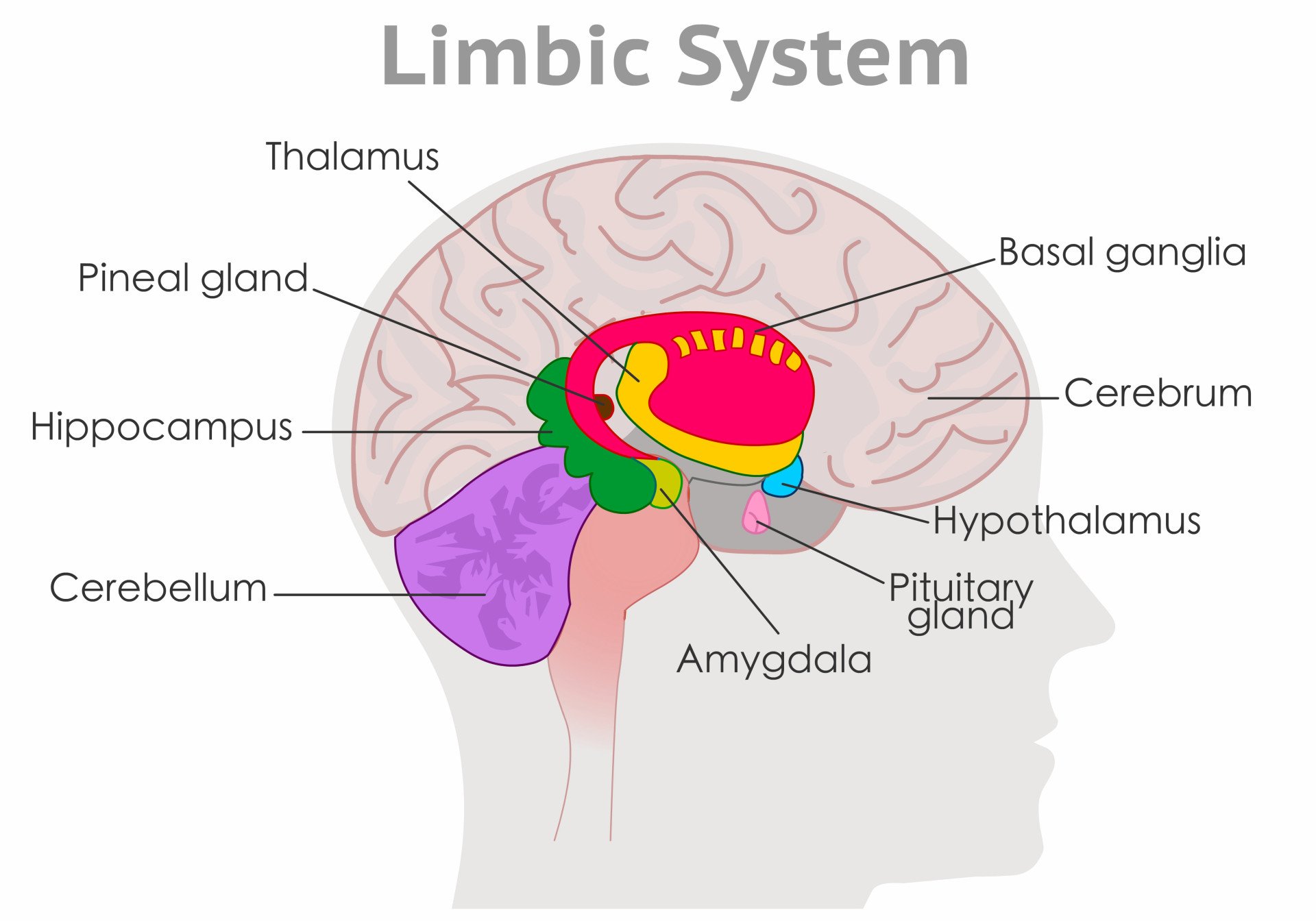
Under the cortex are a number of other structures, including the thalamus, hypothalamus, pituitary gland, basal ganglia, hippocampus, and amygdala, some of which form the limbic system (involved in emotional behavior, motivation, and learning).
Limbic System
The forebrain also features important structures in the limbic system, which controls basic emotions and psychological drives.
The limbic system is made up of a number of different structures, but three of the most important are the hippocampus, the amygdala, and the hypothalamus.
A critical component of the limbic system is the amygdala, an almond-shaped set of neurons responsible for processing fear.
The connection between fear and the amygdala can be traced back to research by Heinrich Kluver and Paul Bucy in the 1930s, who removed the amygdalae in rhesus monkeys and found them to display little fear (Hayman et al., 1998).
Another important part of the limbic system is the hippocampus, which is responsible for long-term memory formation. Henry Gustave Molaison, known as H.M., had two-thirds of his hippocampi removed to treat his epilepsy in 1953.
As a result, he suffered from severe anterograde amnesia: an inability to form new memories. H.M. also had difficulty remembering events just before the lesion, a condition known as graded retrograde amnesia (Halber, 2018).
There are two other major structures of the limbic system worth mentioning: the thalamus and the hypothalamus. The thalamus is considered to be the neural railway station of the brain.
Sensory input from the body travels to the thalamus, where it is then relayed to the rest of the brain as a specific sensation. The thalamus is also involved with consciousness, alertness, and sleep (Mandal, 2019).
Located between the two halves of the thalamus is the pineal gland: a pea-shaped gland that regulates sleep. Its other functions are not yet fully understood.
The hypothalamus is located at the base of the brain near the pituitary gland, and it is involved with pleasure, food, body temperature, and sex (Seladi-Schulman, 2018). If the body temperature gets too high, the hypothalamus instructs the body to sweat.
If the body is cold, the hypothalamus will cause shivers. Irregular hypothalamic behavior can, in turn, lead to sweating and shivering when these reactions are not needed.
The hypothalamus also regulates the pituitary gland and regulates the other hormone-releasing glands in the body. For this reason, it is often referred to as the “master gland” of the endocrine system.
Midbrain (Mesencephalon)
The second area of the brain is the midbrain, which lies on top of the brainstem.
The midbrain is involved in auditory and visual processing (Peters, 2017).
The midbrain, also known as the mesencephalon, is a vital structure located in the middle of the brain, acting as an extension of the brainstem that connects the forebrain to the hindbrain and spinal cord.
During embryonic development, it originates from the middle of the three primary brain vesicles.
While it is a large and prominent structure in fish, amphibians, reptiles, and birds, in adult mammals it is relatively small and dwarfed by the surrounding, highly developed forebrain.
Despite its small size, it plays an incredibly diverse and vital role in motor control, sensory processing, and the regulation of consciousness.
Anatomical Structure
The midbrain is divided into two main regions by the cerebral aqueduct, a narrow, fluid-filled canal running through its core that carries cerebrospinal fluid (CSF) between the third and fourth ventricles.
1. The Tectum (Roof) The dorsal (top) surface of the midbrain is called the tectum. It features two pairs of swellings known as the colliculi:
Superior Colliculus: Also known as the optic tectum, it receives direct visual input from the eyes. It is responsible for controlling visual reflexes, eye movements, and the top-down control of attentional shifting.
Inferior Colliculus: This structure serves as a crucial relay station for auditory (hearing) information as it travels from the inner ear to the thalamus.
2. The Tegmentum (Floor) Lying ventral to (underneath) the tectum is the tegmentum, which forms the intermediate level of the midbrain. It contains several specialized and highly colorful structures:
Substantia Nigra: Meaning “black substance,” this region contains dopamine-producing neurons and is heavily involved in the control of voluntary movement, mood, reward, and addiction. The degeneration of neurons in the substantia nigra is the primary cause of Parkinson’s disease.
Red Nucleus: A structure with a distinctive pinkish hue that also contributes to motor control via the rubrospinal tract.
Periaqueductal Gray Matter: This area surrounds the cerebral aqueduct and is an important center for modulating and inhibiting somatic pain sensations.
Cranial Nerve Nuclei: The tegmentum houses the nuclei for the third (oculomotor) and fourth (trochlear) cranial nerves, which supply the muscles that control eye movement.
Note: The midbrain also features the crus cerebri (cerebral peduncles), which carry large bundles of descending nerve fibers.
Key Functions
Information Conduit The midbrain acts as a major physical passageway for nerve tracts traveling up and down the central nervous system. For example, the corticospinal tract descends from the cerebral cortex through the midbrain on its way to the spinal cord to execute voluntary motor commands.
Arousal, Attention, and Sleep The midbrain houses important parts of the reticular formation (or reticular activating system), a widespread network of neurons that filters background stimuli and produces general arousal in the body. It regulates the sleep-wake cycle and alerts the cerebral cortex to novel or challenging tasks. Severe damage to the midbrain’s reticular formation can result in a prolonged sleep-like state or coma.
Reflex Integration The midbrain acts as a correlation center for sensory and motor reflexes. It manages the orienting reflex, which is an automatic physical response to a novel visual or auditory stimulus (such as turning your head suddenly to a loud noise).
Neurochemical Regulation Four highly concentrated groups of neurons in and around the midbrain use specific neurotransmitters to control the activation levels of the rest of the brain: the ventral tegmental area and substantia nigra (dopamine), the raphe nuclei (serotonin), and the locus coeruleus (noradrenaline). For instance, stimulation of the midbrain’s ventral tegmental area can elicit predatory aggressive behaviors or activate the brain’s reward and reinforcement systems.
Hindbrain (Rhombencephalon)
The hindbrain is located at the back of the head and looks like an extension of the spinal cord. It contains the medulla oblongata, pons, and cerebellum (collectively known as the brainstem).
The hindbrain mostly coordinates autonomic functions that are essential to survival.
Major Structures and Functions
The hindbrain consists of three primary structures, which collectively govern vital bodily functions and movement:
1. Medulla Oblongata
Often simply called the medulla, this fibrous structure is roughly 2 cm long and acts as an enlarged, elaborated extension of the spinal cord.
The medulla is responsible for controlling vital, automatic reflexes such as breathing, heart rate, blood pressure, swallowing, vomiting, coughing, and sneezing.
Because it regulates these critical life-sustaining functions, damage to the medulla is frequently fatal, and large doses of certain drugs (like opiates) are life-threatening precisely because they suppress medullary activity.
The medulla also houses the nuclei for several cranial nerves, which control sensations and muscle movements in the head.
2. Pons
Located anterior and ventral to the medulla, the pons derives its name from the Latin word for “bridge”.
True to its name, it serves as a massive switchboard and connection point within the brain.
It connects the two halves of the cerebellum and allows nerve fibers to cross from one side of the brain to the other, integrating movements between the left and right sides of the body.
It also relays motor commands from the cerebral cortex down to the cerebellum. Additionally, the pons plays a role in regulating brain activity during sleep and arousal.
3. Cerebellum
The cerebellum, or “little brain,” is a highly convoluted structure located at the back of the hindbrain.
Though it accounts for only about 11% of the brain’s total weight, it contains more neurons than the rest of the brain combined. Its primary functions include:
Motor Control and Balance: The cerebellum coordinates voluntary (skeletal) muscle activity, posture, and fine movements. It receives input from the spinal cord about the body’s position and compares it with intended movement goals from the cerebral cortex to calculate the precise muscle contractions needed.
Procedural Memory: It stores motor programs and procedural memories, acting as an “automatic pilot” that allows us to perform complex, well-rehearsed tasks (like walking or picking up a glass) without conscious thought.
Cognitive and Sensory Timing: Beyond movement, the cerebellum is involved in shifting attention between auditory and visual stimuli, as well as executing behaviors and perceptions that depend on the precise timing of short intervals, such as judging rhythms or the speed of moving objects
FAQs
What is the forebrain?
The forebrain is the largest part of the brain, including the cerebrum, with the cerebral cortex, thalamus, and hypothalamus.
It is responsible for various functions, including receiving and processing sensory information, thinking, perceiving, producing and understanding language, and controlling motor functions.
It also regulates body temperature, reproductive functions, eating, sleeping, and the display of emotions.
What does the forebrain do?
The forebrain, comprising the cerebrum (with the cerebral cortex), thalamus, and hypothalamus, plays a critical role in many functions.
It involves sensory perception, cognition, generation and comprehension of language, motor control, and complex behaviors.
Additionally, it regulates body temperature, manages reproductive functions, controls eating and sleeping patterns, and orchestrates the display of emotions.
References
Adair, J. C., & Meador, K. J. (2003). Parietal lobe. In Encyclopedia of the neurological sciences.
Bailey, R. (2019, November 15). Divisions of the Brain: Forebrain, Midbrain, Hindbrain. ThoughtCo. https://www.thoughtco.com/divisions-of-the-brain-4032899
Bailey, R. (2109, February 1). Occipital lobes and visual perception. ThoughtCo. https://www.thoughtco.com/occipital-lobes-anatomy-373224
Halber, D. (2018, August 28). The curious case of patient H.M. BrainFacts. https://www.brainfacts.org/in-the-lab/tools-and-techniques/2018/the-curious-case-of-patient-hm-082818
Hayman, L. A., Rexer, J. L., Pavol, M. A., Strite, D., & Meyers, C. A. (1998). Klüver-Bucy syndrome after bilateral selective damage of amygdala and its cortical connections. The Journal of Neuropsychiatry and Clinical Neurosciences, 10 (3), 354-358.
Irshad, M. (2015, April 4). The Cerebrum. TeachMeAnatomy – Making Anatomy Simple. https://teachmeanatomy.info/neuroanatomy/structures/cerebrum/
Lienhard, D. A. (2017, December 27). Roger Sperry’s split brain experiments (1959–1968). The Embryo Project Encyclopedia. https://embryo.asu.edu/pages/roger-sperrys-split-brain-experiments-1959-1968
Mandal, A. (2019, February 27). What is the thalamus? News-Medical. https://www.news-medical.net/health/What-is-the-Thalamus.aspx
Patel, H., & Sugano, Y. (2018, January 22). The pons. TeachMeAnatomy – Making Anatomy Simple. https://teachmeanatomy.info/neuroanatomy/brainstem/pons/
Peters, L. (2016, March 3). The medulla oblongata. TeachMeAnatomy – Making Anatomy Simple. https://teachmeanatomy.info/neuroanatomy/brainstem/medulla-oblongata/
Peters, L. (2017, August 30). The Midbrain. TeachMeAnatomy – Making Anatomy Simple. https://teachmeanatomy.info/neuroanatomy/brainstem/midbrain/
Salazar, A. (2017, June 13). Frontal lobe | Areas, functions and disorders | Cognifit. Health, Brain and Neuroscience. https://blog.cognifit.com/frontal-lobe/
Seladi-Schulman, J. (2018, March 1). Hypothalamus overview. Healthline. https://www.healthline.com/human-body-maps/hypothalamus
Sidelkivska, V. (2016, April 21). The Curious Case of Phineas Gage: Traumatic Brain Injury. Health, Brain and Neuroscience. https://blog.cognifit.com/phineas-gage/
Venturini, S. (2015, March 7). The cerebellum. TeachMeAnatomy – Making Anatomy Simple. https://teachmeanatomy.info/neuroanatomy/structures/cerebellum/
BSc (Hons) Psychology, MRes, PhD, University of Manchester
Chartered Psychologist (CPsychol)
Saul McLeod, PhD, is a qualified psychology teacher with over 18 years of experience in further and higher education. He has been published in peer-reviewed journals, including the Journal of Clinical Psychology.
BSc (Hons) Psychology, MSc Psychology of Education
Associate Editor for Simply Psychology
Olivia Guy-Evans is a writer and associate editor for Simply Psychology, where she contributes accessible content on psychological topics. She is also an autistic PhD student at the University of Birmingham, researching autistic camouflaging in higher education.
Dody Eid holds a BA in Economics from Harvard University. During his college years, he served as a research assistant to Jeffrey Miron, the Director of Undergraduate Studies, exploring the interplay between behavioral and neoclassical economic models and government policy. Additionally, he worked as a Course Assistant for Math 21b: Linear Algebra and Differential Equations, aiding students in grasping complex mathematical concepts.